Is Nvidia Stock a Buy? Why Semiconductor Strength May Signal a Market Top
Knox Ridley·MAY 1, 2026·13 min read
On this page
In last week’s report, we announced that we are significantly trimming our Nvidia position, a stock we have often held as a top-three holding since 2021. The rationale for this pivot rests on a shifting landscape within the AI trend toward inference, and how that shift will pressure Nvidia’s pristine positioning.
The numbers back it up. Per TrendForce, GPU-based AI servers will account for 69.7% of shipments in 2026 with ASIC-based servers rising to 27.8%. This is happening while a reported one-quarter delay on Rubin, Nvidia’s next-gen GPU platform, lands at exactly the wrong moment. The hardware moat that powered the first phase of Nvidia’s ascent is becoming less absolute, and with it, the case for premium pricing and 70% gross margins.
This thesis is reinforced by technical analysis, which suggests that Nvidia, as well as the broader market, is approaching a meaningful top. While that top is likely to be a correction within a much larger uptrend, it exposes investors to a level of risk we have not experienced in recent years.
In this report, we take a deeper look at the technical scenarios, which suggests that Nvidia’s latest high is shaping up to be a potential bull trap. That view is corroborated by the broader semiconductor complex. Specifically, the failure of other key sub-sectors to confirm the move higher.
Spotting Bull Traps: Why Market Divergences Matter at All-Time Highs
There are several techniques investors can use to lower the odds of being caught in a bull trap. One of the most important is checking whether major markets, sectors, and bellwether stocks are confirming the move higher.
When every major stock, sector, and index breaks out to new highs together, it is the hallmark of a powerful trend that historically extends much further and lasts for quite a while. However, not every breakout plays out that way. False breakouts, or bull traps, do exist. They occur when buyers get trapped on the final gasp of an uptrend, left holding the bag as the market rolls over and corrects.
Today, the S&P 500, led by semiconductors, is breaking out to new highs. However, the number of divergences across major stocks, sectors and supporting markets poses a warning to larger uptrend.
Nvidia Stock Divergence
Since the current bull cycle began in October 2022, the defining theme has been AI, specifically the hardware buildout concentrated in the semiconductor sector. The returns tell the story as the Broad-Based Semiconductor ETF (SMH) is up over 470% from the 2022 low, while the Mag 7-heavy NASDAQ-100 has gained roughly 150% over the same period.
Within the Semiconductor sector, the undoubted leader is Nvidia, which is up more than 1700% in the same time frame. Because of Nvidia’s outsized influence, its performance relative to the broader market has become a remarkably reliable technical tell for coming weakness.
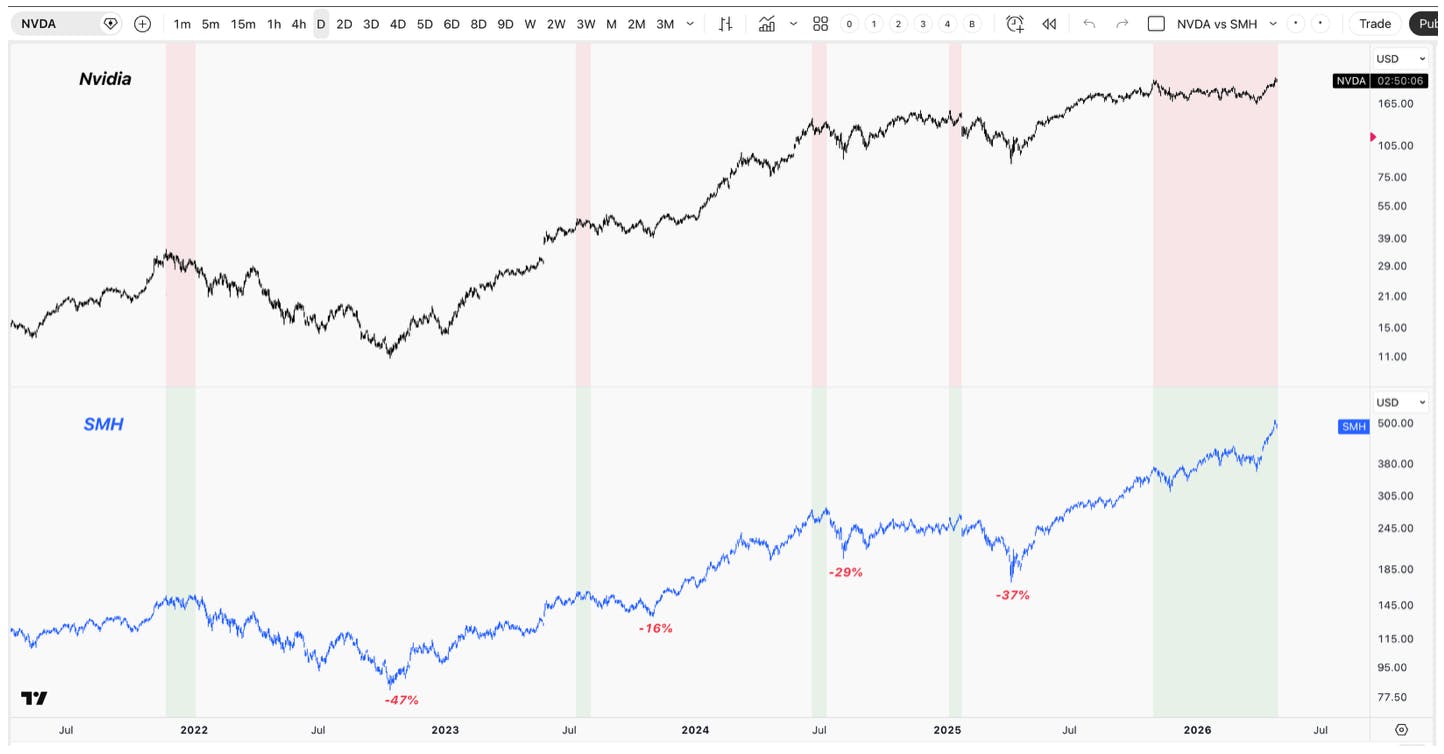
Case in point, since Nvidia’s watershed earnings report in May 2023 — the event that effectively ignited the AI trade — every time the Broad Semiconductor Sector (SMH) has made a new high without Nvidia confirming, it has signaled the prevailing trend is running on fumes and setting up for a reversal.
Chart comparing Nvidia stock with the Semiconductor ETF (SMH), highlighting repeated divergences where SMH pushes to new highs while Nvidia fails to confirm. Historically, these divergence periods have preceded notable semiconductor sector corrections, signaling elevated risk beneath the rally.
As of today, SMH sits more than 30% above its late-October 2025 top, while Nvidia is still 1% below that same level – an uncomfortable warning sign beneath the recent strength of the broader semiconductor sector.
This divergence analysis can be applied more broadly to gauge the risk embedded in the current push higher. While the NASDAQ-100, S&P 500, and the broader Semiconductor Index sector (SMH) are all making new highs, that move is not being confirmed by other major sectors and markets.
The Magnificent 7 Stocks
If Nvidia is the single most important stock in the market, the Magnificent 7 are the most important group. They led the recovery out of the 2022 bear, they’ve driven the bulk of S&P 500 returns in every year since, and historically they’ve turned before the broad market does. That’s why their failure to confirm new highs is one of the cleanest leading indicators we track.
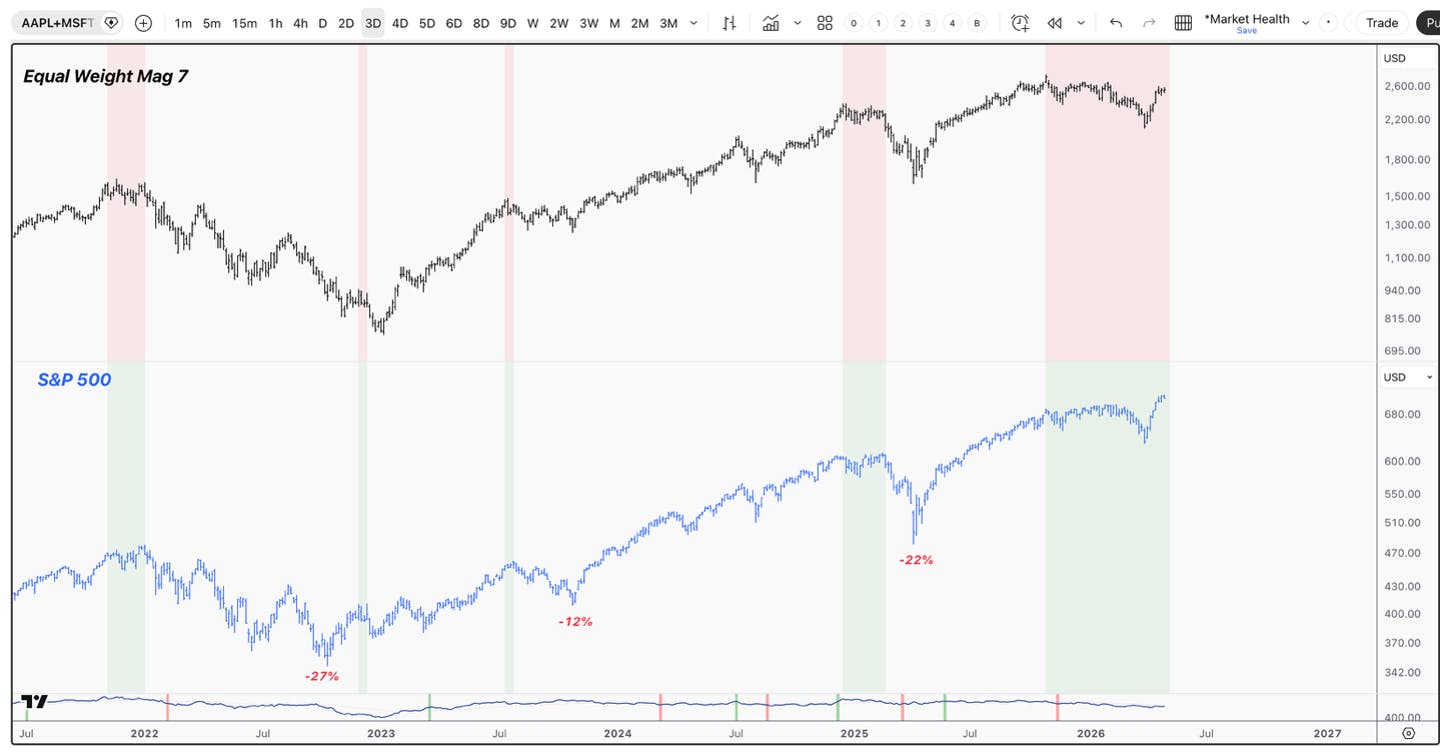
Since November 2021, when the equal-weight Mag 7 Index does not confirm a new high in the S&P 500, it has been a reliable signal of a weakening market environment. A similar divergence is occurring today and, until it resolves to the upside, it remains a warning for the durability of the broader uptrend.
Chart comparing the equal‑weight Magnificent 7 index with the S&P 500, highlighting recurring divergences where the S&P 500 advances while equal‑weight leadership lags. Historically, these non‑confirmation periods have preceded meaningful market pullbacks and signal weakening market breadth beneath index‑level strength.
Financial Stocks (XLF)
While the technology sector has undoubtedly been the most important sector in the current secular bull market, the financial sector has been a close second. Given the financialization of the US economy, which has expanded to global markets, the health of our big banks is paramount to an ongoing growth narrative.
The financial sector has also been a leading sector off the April 2025 low, until recently. In fact, the chart suggests a top formed in January, providing early warning signs.
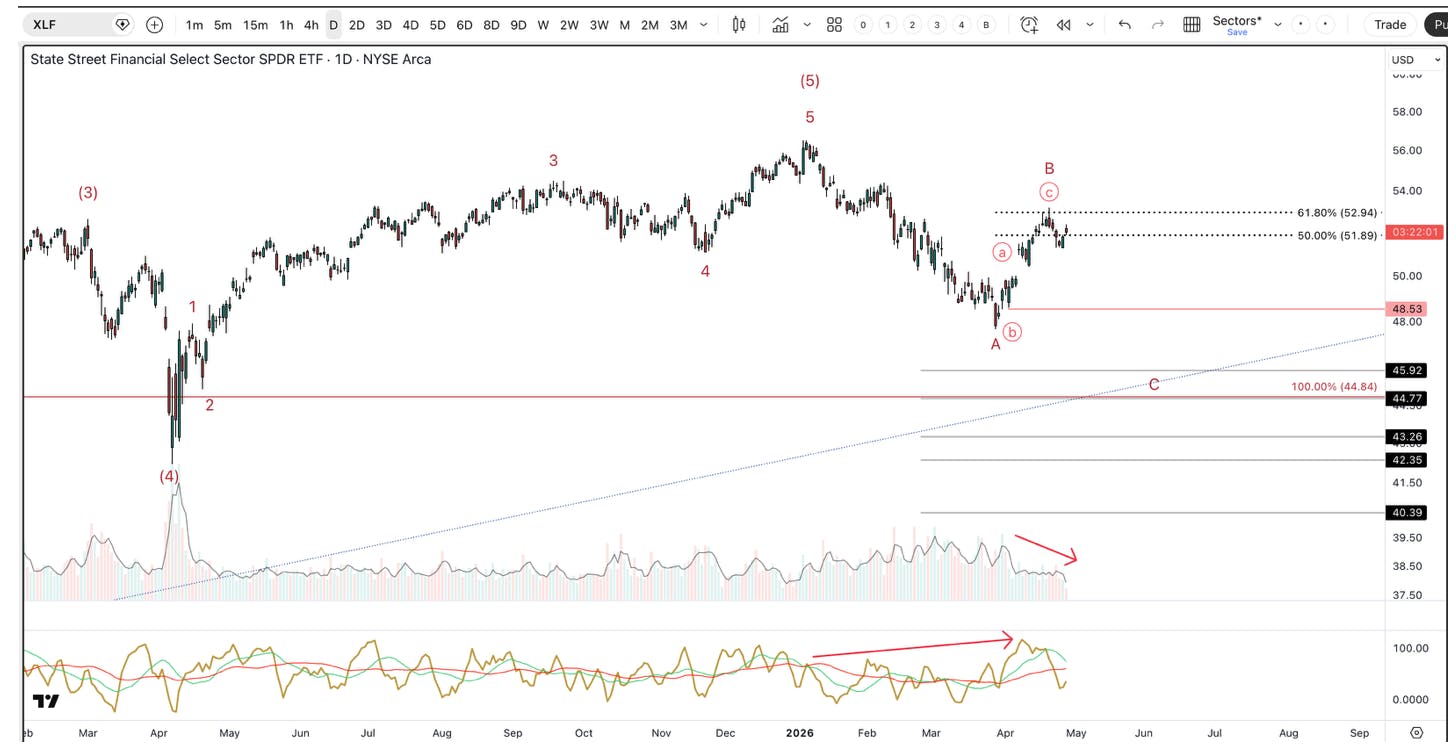
Chart showing XLF completing a five‑wave uptrend before rolling over into a corrective structure. The current rebound is unfolding as a three‑wave bounce on declining volume, while momentum diverges from price—a setup that typically signals a corrective rally within a broader downtrend and increased downside risk for the financial sector.
What stands out in the chart above is that XLF traced a clean five-wave uptrend off the April 2025 low, topping in early January 2026. Since then, it has carved out its first series of lower lows, retracing more than half of the gains made off the 2025 low.
Note, too, that the current bounce is a three-wave move on decelerating volume, a clear sign of low conviction. At the same time, momentum is making a new high while price is putting in a lower low, the kind of behavior we typically see inside larger downtrends. Taken together, these signals strongly suggest XLF is in a corrective bounce within a broader downtrend that targets $44 (~14% lower from the current price).
Most notably, while SMH is 14% above its February top, XLF is 8% below its January top. That is not a healthy signal, and it suggests that SMH is likely in the process of completing a bull trap.
Industrial Stocks (XLI)
We can see a similar pattern playing out in the industrials sector. XLI is one of the cleanest reads on real-economy capex, PMIs, and global trade. When ISM manufacturing turns, industrials lead. When the Fed pivots, industrials typically lead the rotation out of defensives. That economic sensitivity is precisely what makes the sector worth monitoring closely.
Today, the chart of XLI looks much like XLF above.
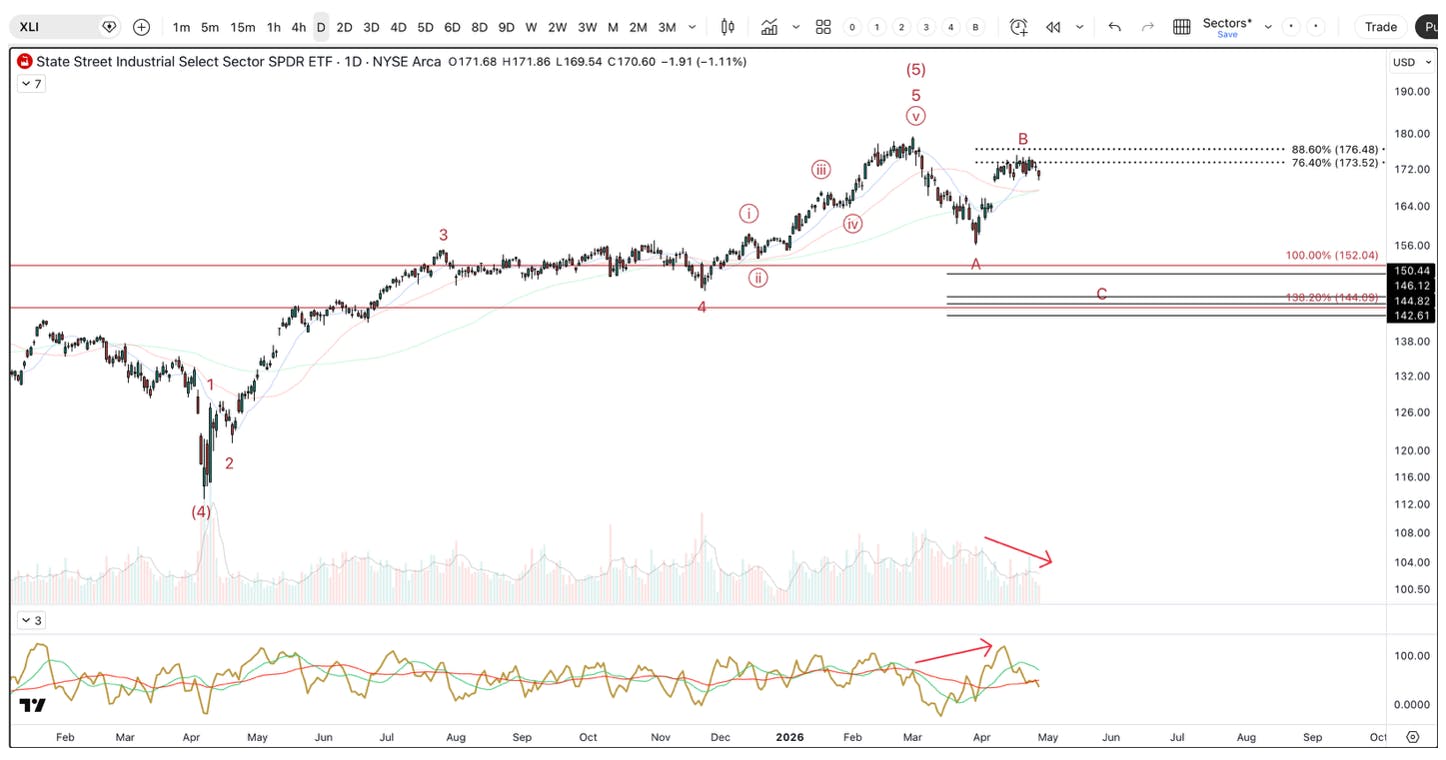
Chart showing XLI completing a five‑wave uptrend before entering a corrective phase. The recent rebound appears to be a lower‑volume, three‑wave bounce, while momentum diverges from price—characteristics typical of corrective rallies within a broader downtrend and signals of elevated downside risk for the industrials sector.
After a clear 5 wave uptrend off the 2025 low, XLI has provided the first lower low in the recent drop. The bounce is clearly 3-waves and on tepid volume. This is backed by momentum making a new high while price makes a lower high. The target for this sector, based on the evidence discussed, is around $150.
These markets have not been cherry-picked. They are major bellwethers, and they are not confirming the strength we are seeing in the broad market and semiconductors. They are also joined by other key groups—the Dow Jones Industrial Average, transportation, consumer discretionary, high-beta, as well as several global markets.
Get Our Free Weekly Stock Newsletter
Get weekly stock insights, market analysis, and technology updates straight to your inbox.
Weekly stock insights
Market analysis
Technology updates
As long as these divergences persist, the risk to the bulls remains elevated.
How Elliott Wave Theory Identifies the End of a Trend
Another technique that can help identify bull traps is Elliott Wave theory. The general idea behind this framework is that markets move in repeating patterns—five waves in the direction of the larger trend, followed by a three-wave correction against it. This is ultimately driven by the collective psychology of buyers and sellers, which is quantifiable in repetitive patterns.
Within a five-wave structure, the third wave is typically the most powerful phase of the trend. It is the moment the market collectively “gets it” all at once, shorts rush to cover while sidelined participants panic-buy into longs. The result is often a sharp, near-vertical advance that coincides with peak expansion in both volume and momentum.
The fifth wave, by contrast, is driven by late arrivals – those who missed the earlier move and assume the trend is only just beginning. It is often the riskiest segment of the advance and, in our view, should only be approached with a defined exit plan. In this phase, price may still push to a higher high, but it frequently does so on declining volume and weakening momentum.
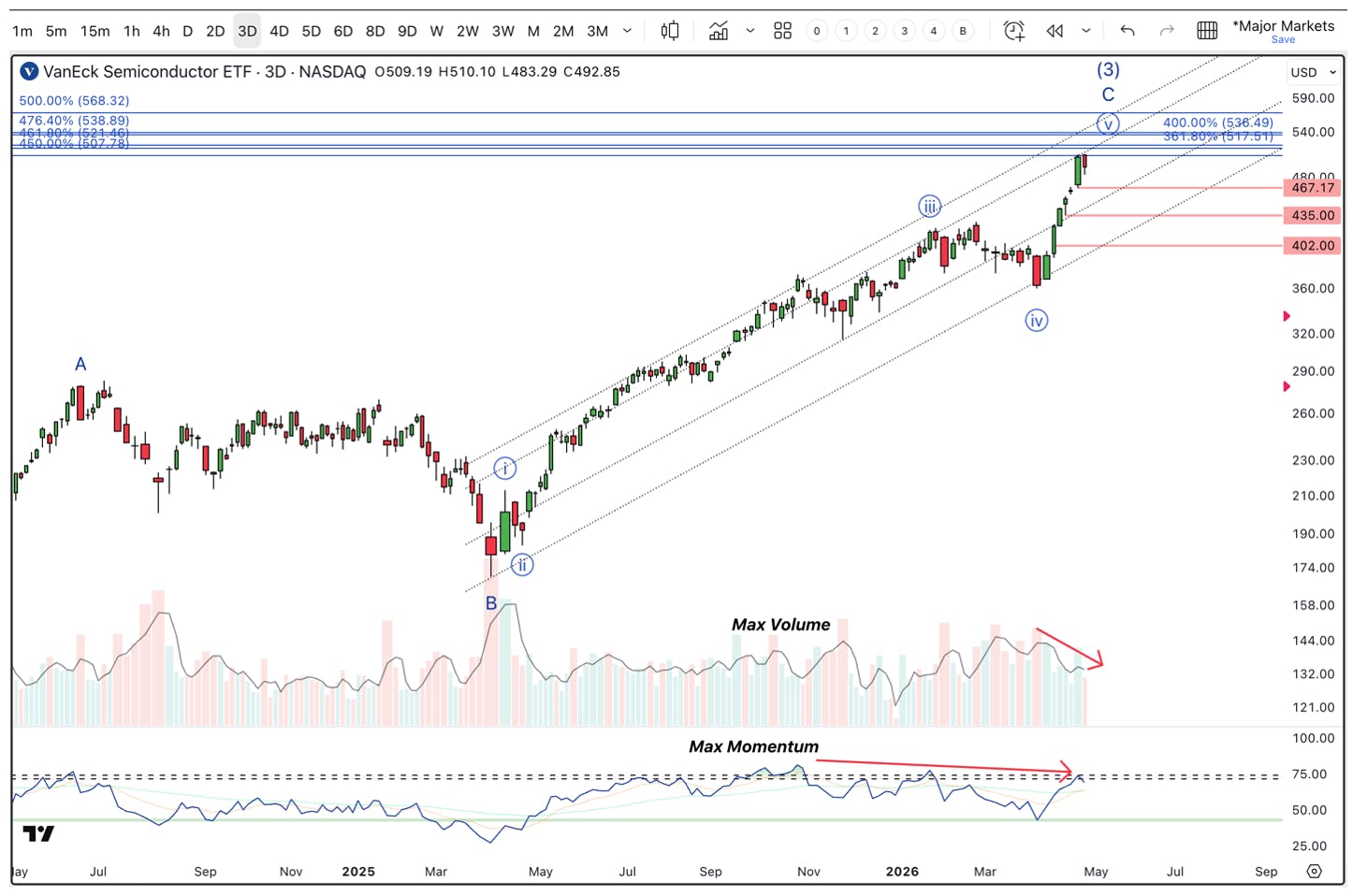
As shown below, this is precisely the behavior we are seeing in the broad semiconductor sector (SMH).
SMH chart showing a powerful semiconductor sector advance unfolding within a rising channel, labeled as a fifth‑wave move. While price has surged toward projected resistance levels, both volume and momentum are fading, a pattern consistent with late‑cycle rallies and increased risk of a pullback or bull trap near market highs.
While the rally in SMH has been nearly vertical off the recent low, it is unfolding on weakening volume and fading momentum. That is classic fifth-wave behavior, and it suggests the current push higher is the final swing within the uptrend off the April 2025 low. The implication is that the Mag 7, financials, industrials, are leading the broader trend lower, while semis are simply playing catch-up to the upside.
We can see the same fifth-wave playbook in the top three holdings of SMH, which together account for roughly 38% of the entire index weighting.
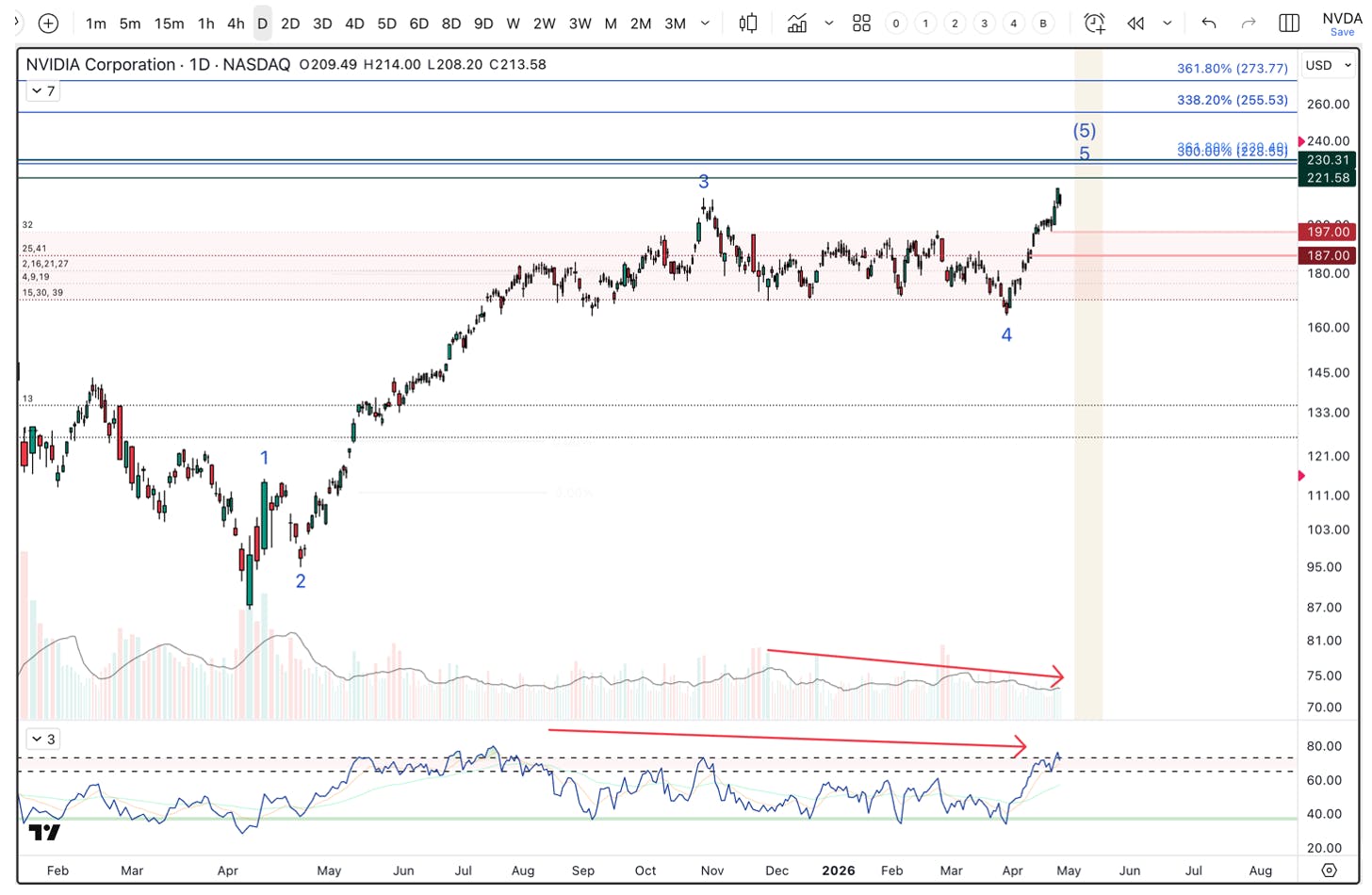
Nvidia’s Technical Setup (NVDA)
Chart showing Nvidia stock progressing into a fifth‑wave rally following a completed corrective phase. While price has pushed toward key resistance levels, underlying volume and momentum are fading, a combination that often characterizes late‑cycle advances and raises the risk that the current breakout develops into a bull trap rather than a sustainable uptrend.
Nvidia barely broke above its late October 2025 high, before pushing back below it. The vertical nature of this bounce suggests that Nvidia is also in a 5th wave, like SMH. Note the decelerating volume and momentum as price attempts at a new high.
As long as Nvidia stays over $197-$187 the odds favor one more push higher. The targets for this 5th wave are $221 – $230, if this breakout remains a lows volume and low momentum move, it will likely remain the final 5th wave swing higher and continue to be a warning.
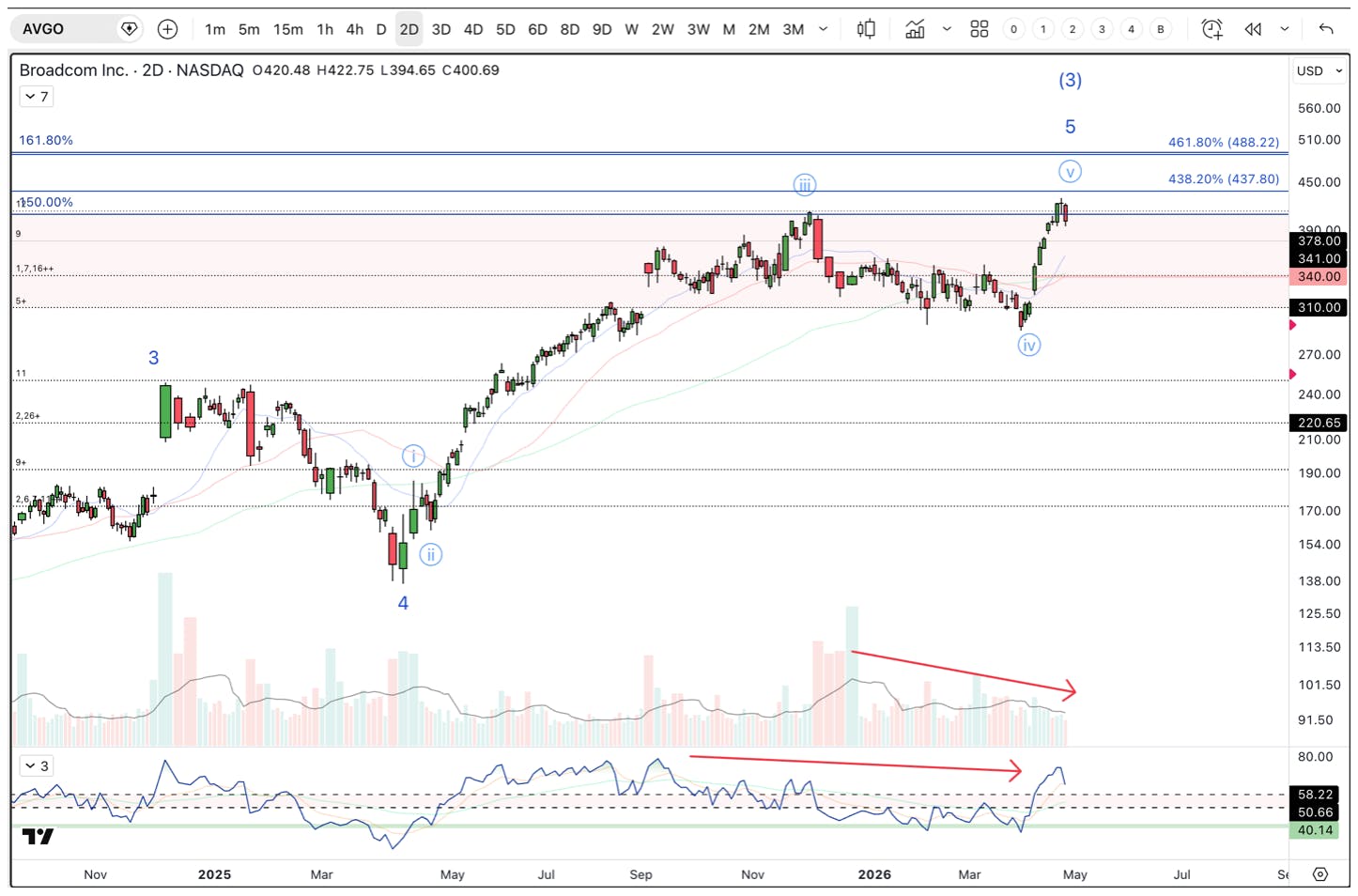
Broadcom’s Technical Setup (AVGO)
AVGO also appears to be in a fifth-wave swing, with the recent breakout occurring at lower volume and weakening momentum. If this read is correct, it should set up a multi-month drawdown that retraces most of the five-wave uptrend now appearing to complete.
Chart showing Broadcom stock advancing into a fifth‑wave rally following a corrective phase. While price has pushed higher toward projected resistance, volume and momentum are failing to confirm the move—characteristics commonly associated with late‑cycle advances and increased risk of a corrective reversal rather than a sustained breakout.
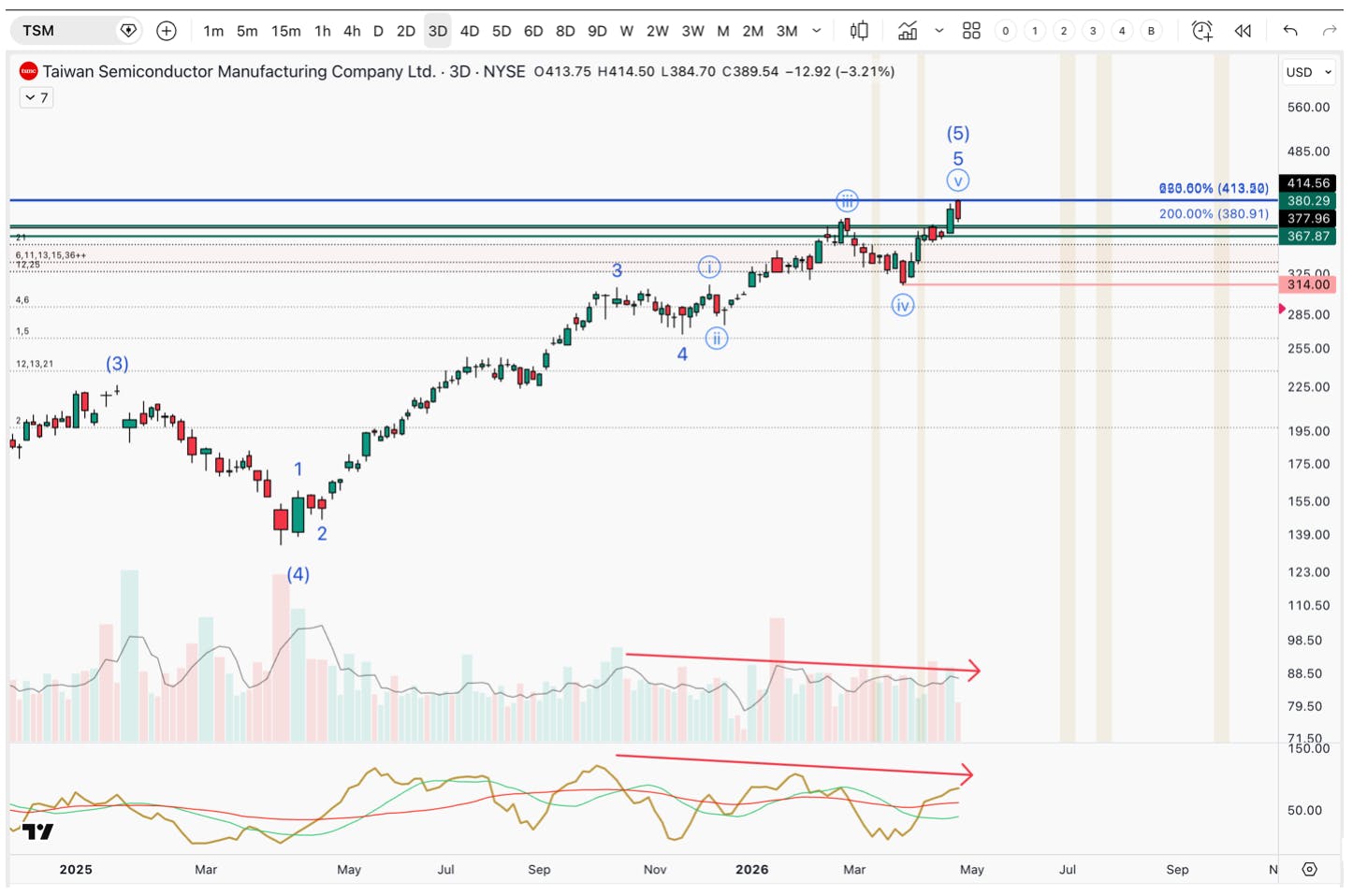
Taiwan Semiconductor (TSM)
The same 5th wave characteristics can be seen in TSM’s chart below, which bolsters the evidence that SMH is likely in a final 5th wave swing higher.
Chart showing Taiwan Semiconductor progressing into a fifth‑wave advance following a multi‑month uptrend. While price has reached key resistance levels, underlying volume and momentum are failing to confirm the move, a pattern that often marks late‑cycle rallies and raises the risk of a corrective pullback rather than a sustained breakout.
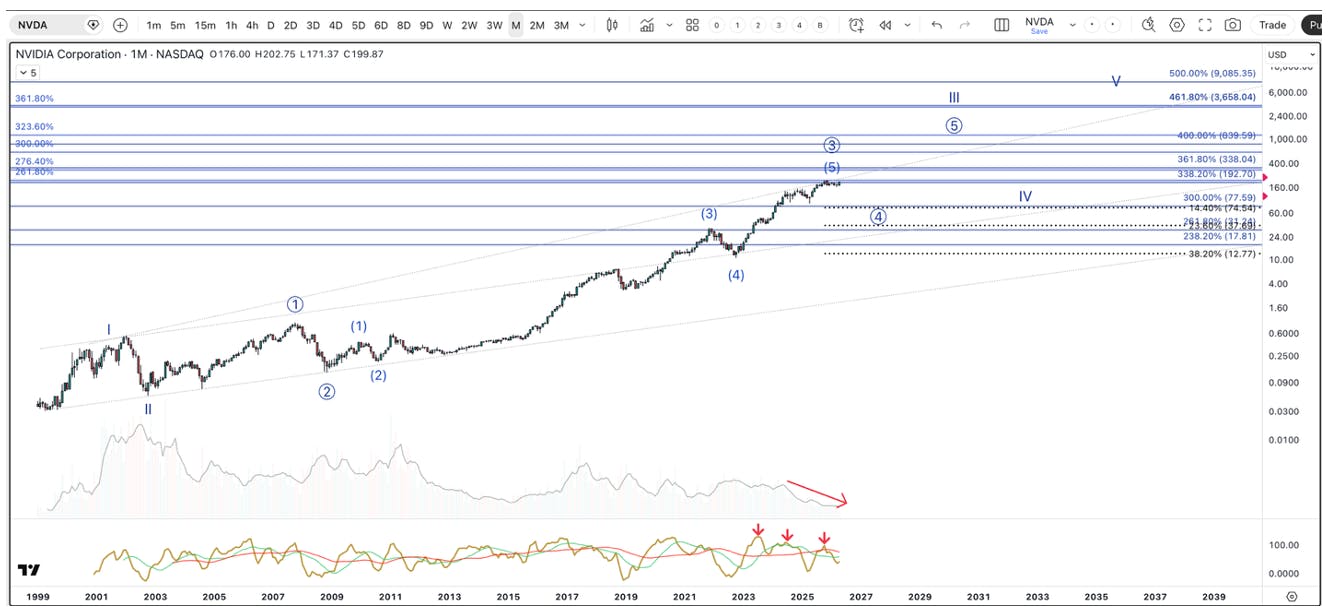
While Nvidia is likely setting up for a larger period of volatility than most believe, the technical framework also supports a very large uptrend that should continue for years, with large bouts of volatility along the way. This perfectly aligns with our thesis that 2026 may not be Nvidia’s best year, yet the stock will likely still lead over the decade.
While divergences are growing amongst key markets and stocks, the current strength in the market appears to be a 5th wave, defined as the final swing of an uptrend, met with low volume and low momentum.
Long‑term chart of Nvidia stock illustrating a multi‑decade Elliott Wave structure within a rising secular channel. While the broader trend remains upward, momentum has begun to flatten near projected upper resistance levels, a pattern that historically accompanies late‑cycle phases and signals elevated risk of significant corrective periods within a longer‑term uptrend.
In the near-term, can the broad market handle a selloff, with Nvidia leading the way? The Nasdaq-100 is only up 9% YTD and most influencer-led tech ETFs are lagging the broad market. The I/O Fund is up 35% YTD – outperforming not just on the long side, but also through active risk management during bouts of volatility.
The I/O Fund has built a strong track record in lesser-known AI winners, including Bloom Energy, up 1100% since our initial entry last year, an optical networking stock up more than 620% since November, and one of our largest positions at a 10% allocation already up 130% year to date. We publish more than 100paywalledarticles each year on AI stocks, supported by an actively managed portfolio and real-time trade alerts. Don’t miss out on the AI trade. Learn more here
Please note: The I/O Fund conducts research and draws conclusions for the company’s portfolio. We then share that information with our readers and offer real-time trade notifications. This is not a guarantee of a stock’s performance and it is not financial advice. Please consult your personal financial advisor before buying any stock in the companies mentioned in this analysis. Beth Kindig and the I/O Fund own shares in NVDA at the time of writing and may own stocks pictured in the charts.