The AI Networking Stock That Beat Nvidia by 7X YTD for Returns of 135% YTD
May 22, 2026
Beth Kindig
Lead Tech Analyst
April 2026 was a historically strong period for the stock market. The S&P 500 rose by 10.43%—its best monthly return since April 2020, when the market rebounded from COVID-era lows. The Nasdaq-100 achieved the same feat, rising over 15%.
Against this backdrop, I/O Fund performed exceptionally well, as we owned 4 of the market’s 10 best-performing large caps in April. This includes the market’s top large cap gainer, Bloom Energy, which soared 112.81%. In February, my firm called out Bloom as our Top AI Stock Pick for 2026.
Adding to AI energy's strong performance was networking stocks, a subsector that most investors shy away from due to the complexity of the products, in addition to the supply chain moving lightning fast with immense volatility in both directions. The reason networking sees immense volatility is straightforward: much of the market is tied to a single customer, Nvidia; and Nvidia is rolling out new architectural iterations at an unusually fast pace these days.
AI networking stock Lumentum is among the key I/O Fund winners in 2026. We allocated heavily to LITE in January—a month before Nvidia backed the company. While most investors couldn’t stomach taking a stake in this stock that soared 339% in 2025, I/O Fund built a 9% position that has since paid off in spades. Overall, in just five brief months, our Lumentum position delivered a return of 135.4%, or 6.8X higher than Nvidia’s 19.9% return since the end of January.
For investors new to this name, Lumentum recently received significant validation from the world’s most valuable company—Nvidia—with the dominant force in AI infrastructure investing $2 billion in LITE. However, the importance of this goes far beyond the investment itself. The real story is Lumentum’s central position in Nvidia’s multi-year networking roadmap, and the broader AI market, which is affording Lumentum the opportunity to grow its business several times over.
Below, we break down the key dynamics currently benefiting Lumentum, the structural factors supporting continued margin and EPS growth, and our perspective on the key question: “Is it too late?”
Nvidia–Lumentum Partnership: CPO Growth and Optical Transceiver Market Expansion
Nvidia’s partnership with Lumentum includes multi-billion-dollar agreements on two fronts: the investment and a purchase commitment for the company’s ultra-high-powered lasers (UHPs).
Currently, Lumentum is the sole supplier of UHPs for Nvidia’s co-packaged optic (CPO) networking switches—which are expected to undergo a step function in demand over the coming years. Nvidia has already taken up nearly all of Lumentum’s UHP capacity, leaving little for other customers.
The $2 billion investment is key to expanding Lumentum’s existing UHP capacity in San Jose, its Caswell fab in the United Kingdom, and bringing online its recently acquired fab in Greensboro, North Carolina.
This is all due to the dramatic ramp-up of CPO demand that Nvidia is preparing for. Lumentum expects to generate its first $100 million in CPO-related revenue in the final quarter of calendar 2026, but the longer-term opportunity is much larger. More on this later.
Overall, Nvidia sees Lumentum as a vital partner in this ramp-up and is making significant commitments to ensure capacity once CPO takes off. This ties Lumentum directly to the world’s preeminent AI infrastructure company over a multi-year period. And, even as CPO has yet to penetrate significantly into data centers, Lumentum is posting extremely strong financial results. This is driven by insatiable demand for high-speed optical transceivers.
Get $275 off Advanced Market Signals for our 6-year anniversary sale. Access real-time trade alerts, weekly webinars, and 100+ research articles on the AI trade per year. Claim Offer
Optical Transceiver Market Growth Forecast (2025–2026)
TrendForce notes that "the global market for AI-focused optical transceivers has entered a phase of rapid growth” and projects the market will expand from $16.5 billion in 2025 to $26 billion in 2026—growing 57.6% YoY.
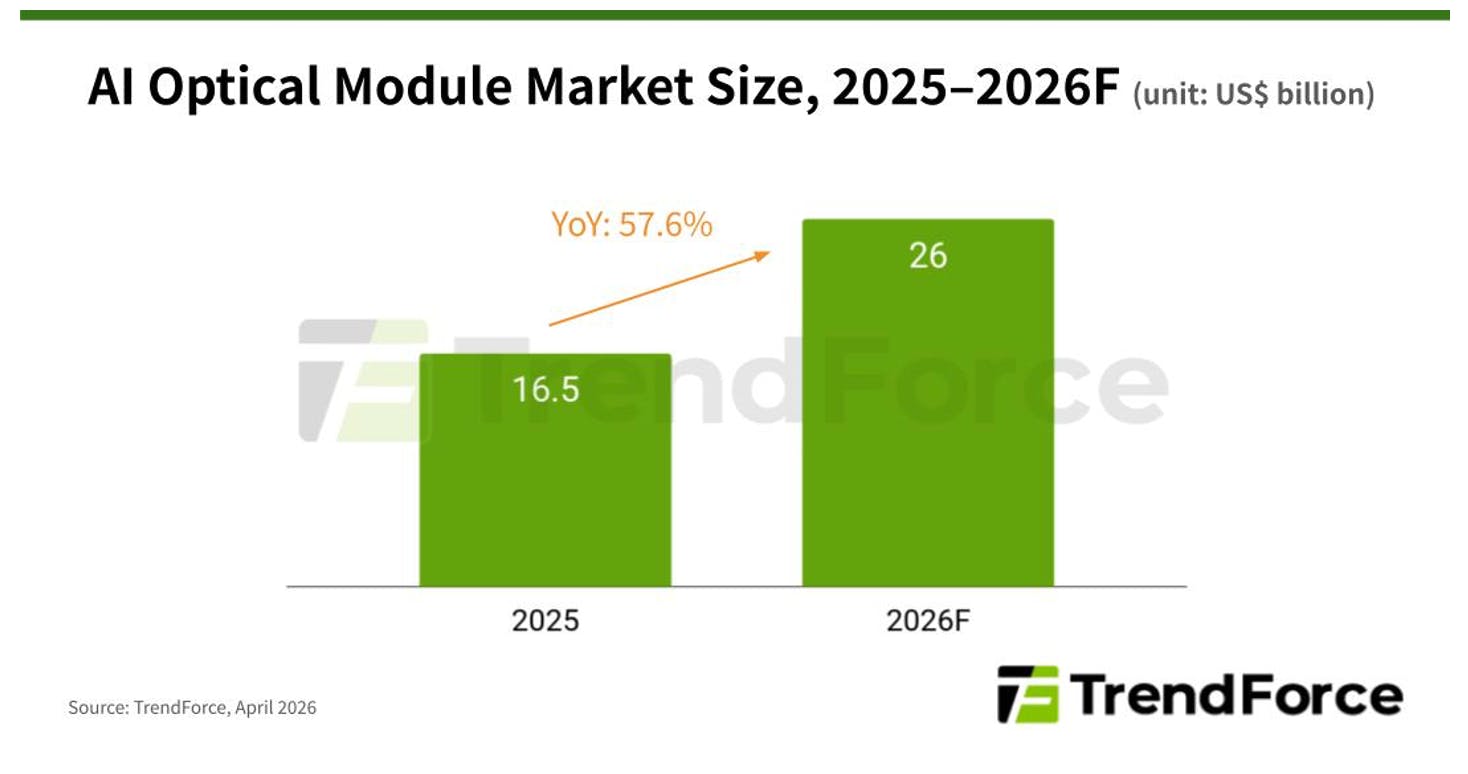
Chart illustrating the rapid expansion of the AI optical module market, with revenue projected to increase by 57.6% year-over-year from $16.5 billion in 2025 to $26 billion in 2026, driven by rising demand for high-speed optical transceivers such as 800G and 1.6T. Source: TrendForce (April 2026).
800G modules are the primary growth driver, with shipments of 1.6T units ramping in mid-to-late 2026. TrendForce also predicts that “optical transceivers shipments of 800G and higher will hit 24 million units in 2025, then jump by 2.6 times to nearly 63 million units in 2026.” Within this, Yole Group forecasts over 10 million 1.6T module shipments in 2026.
Lumentum is a critical player here, generating growth on two sides of the transceiver coin. Lumentum sells its own 800G and 1.6T transceivers, and is a supplier of key components to other transceiver makers.
Lumentum Financials: Record Revenue Growth and Precipitous Margin Expansion
Lumentum’s latest results showed that the company is indisputably firing on all cylinders. It’s Q3 FY2026 ended in March, with Lumentum posting revenue of $808.4 million. The figure missed analysts' estimates very slightly (0.2%), but sales still grew by 90.1% YoY. This marked the fastest YoY growth rate in Lumentum’s history and was a large acceleration over 65.5% YoY in Q2.
The company expects growth to accelerate further next quarter. It projects sales of $980.5 million at the midpoint, implying growth of 104.9% YoY. Additionally, after QoQ growth decelerated from 24.7% in Q2 to 21.5% in Q3, its midpoint guidance projects solid consistency with 21.8% in Q4.
Lumentum’s Margin Expansion Across Gross, Operating, and Net Income
The margin story was equally impressive, driven by improved manufacturing utilization, favorable product mix, and operating leverage.
- FQ3 adjusted gross margin improved by 12.7 percentage points YoY to 47.9%, supported by utilization gains.
- FQ3 Adjusted operating margin rose by 21.4 percentage points YoY to 32.2%, benefiting from gross margin improvements and operating leverage.
- FQ3 adjusted net income margin rose by 18.3 percentage points to 27.9%.
Adjusted net income expansion was moderately less than operating margin expansion, largely due to higher income tax provisions. However, higher taxes are simply the cost of doing business when adjusted net income soars 184.8% YoY to $225.7 million. In Q4, management projects further adjusted operating margin improvement, with the figure moving up to 35.5%, or a 3 point QoQ gain.
Key Growth Drivers Powering Lumentum’s AI Networking Business
Lumentum is achieving this growth without large sales from the Nvidia UHP partnership, as UHP shipments have yet to ramp significantly. Instead, electro-absorption modulated (EML) lasers, narrow linewidth and pump lasers, and optical transceivers are driving growth.
EMLs are lasers used within optical transceivers for scale-out networking applications, with the company selling them as components, and using them in its own transceivers. Notably, Lumentum saw record EML shipments in FQ3. 100G shipments drove this, but 200G revenue also more than doubled QoQ.
Narrow linewidth and pump lasers are used in scale across applications—connecting geographically separated data centers. Pump laser sales grew rapidly by 80% YoY, and narrow linewidth lasers saw their ninth consecutive quarter of growth, with sales rising 120% YoY. EML's, narrow linewidth lasers, and pump lasers helped the company’s Components revenue rise by 77.3% YoY to $533.3 million, accounting for 66% of total revenue.
This strong growth comes even though Lumentum is capacity constrained across all three components. The firm is working to expand EML capacity at its Japan fab, expecting to increase EML units by over 50% by December 2026 versus a December 2025 baseline.
When it comes to pump and narrow linewidth lasers, Lumentum says it is “effectively sold out for the foreseeable future." Notably, pump lasers are even more constrained than EMLs.
Cloud Transceivers and Systems Revenue Expansion
Cloud transceivers grew 40% QoQ with record shipments, likely driven mostly by 800G units. Cloud transceivers represent most of Lumentum’s System sales, which rose 121% YoY to $275.1 million, or 34% of total revenue. As EMLs are used in transceivers, the company is also facing significant capacity constraints here.
The takeaway is that Lumentum is shipping these various products at a rapid and, in many cases, record pace, and still under-shipping the market. Demand is pent up, putting pricing leverage on Lumentum’s side, and creating future growth opportunities. All the while, demand specific to the Nvidia relationship has yet to meaningfully kick in.
Indium Phosphide (InP): The Chokepoint Material in Optical Interconnects
Across its business, Lumentum’s indium phosphide (InP) processing capacity is the unifying constraint holding back laser output. InP is the specialized semiconductor material that all of the discussed products are built on, with ideal properties for optical communication.
Thus, ameliorating the constraints in InP wafer processing is key to meeting customer demand. Notably, InP capacity constraints come even as Lumentum leads the market, saying “We probably have more [indium phosphide] capacity than any company on the planet."
Lumentum’s InP Capacity Expansion Plans
Lumentum is making strides to increase its InP processing capacity. From the last quarter of calendar 2025 to the last quarter of calendar 2026, the company plans to increase its InP capacity by 50% while already having the industry’s largest base. This is a meaningful increase over the company’s past statements of expanding capacity by 40%.
Despite all of this, the company is still under-shipping drastically, by more than 30% as of FQ3. Furthermore, as its UHP business scales, Lumentum expects the gap between supply and demand to widen.
While this is a negative for unit growth, supply and demand imbalances can provide significant benefits to margins and EPS. The memory chip market shows how companies that control undersupplied AI infrastructure products are in a very favorable position.
Supply Constraints Driving Pricing Power
With InP imbalances expected to grow, Lumentum’s margins and EPS can be prime beneficiaries of this dynamic.
Lumentum CEO Michael Hurlston substantiated the company’s pricing power recently, stating negotiations are on “very favorable terms” with non-Nvidia buyers. This comes as Nvidia will soak up much of its InP capacity, creating a “little bit of a feeding frenzy” among other players.
It is important to note that InP constraints extend beyond the wafer processing layer. InP substrates are the most upstream input for InP-based products, and a set of concentrated suppliers controls this layer. Japanese firms Sumitomo Electric and JX Nippon Mining, as well as AXT (U.S.-headquartered, Chinese manufacturing), are the top names. China and the United States have created geopolitical risks at this level.
Geopolitical Risks in InP Supply Chain
Per AXT’s 10-K filing, China placed InP substrates on its export control list in February 2025, requiring an export permit for every order. Meanwhile, in March 2025, the United States placed 70% tariffs on Chinese products, including substrates. Supreme Court rulings have invalidated certain tariffs, but others remain in place.
These factors have had a significant impact on AXT. The company saw full-year revenues fall 11% YoY in 2025, and North America fell from 10% of total sales to 1% in its latest quarter. This adds pressure to companies like Lumentum looking to ramp up InP wafer processing, with Hurlston noting, “the thing that keeps me up at night most is substrates.”
However, Lumentum has worked to mitigate this risk through long-term supply agreements, signing a 7-year substrate supply deal with a non-Chinese firm that extends through the mid-2030s. Hurlston says Lumentum worked with this partner to “corner the supply of their indium phosphide substrates," presumably securing a very significant share of their capacity.
With this agreement, Lumentum says it is in “pretty good shape on substrates." However, it needs to continue securing supply as laser output is going to have to take a “massive” step up in 2027, given CPO demand.
Future Catalysts for Lumentum: 1.6T, OCS and CPO Growth
Beyond products driving current results, Lumentum has two near-term catalysts layering on: the 1.6T transceiver ramp alongside the insourcing of continuous wave (CW) lasers. Lumentum is set to ramp its higher bandwidth 1.6T transceivers in FQ4. Combining its strong pricing power on 800G modules and ramping already higher-margin 1.6T modules should allow for further margin expansion.
At the same time, Lumentum will insource more of the CW lasers used in its transceivers, expecting insourced CW lasers to be in ~20% of transceiver modules in FQ4. Reducing its reliance on third-party CW laser suppliers should benefit transceiver gross margin and alleviate some external supply constraints.
Optical Circuit Switching (OCS) Growth Opportunity
Optical circuit switching (OCS) is another key demand driver. Lumentum has recently signed a multi-year, multibillion-dollar order with an OCS customer. Currently, Lumentum holds a $400 million OCS backlog, which is “very much on track to be shipping” in the second half of calendar 2026. In calendar 2027, Lumentum expects OCS revenue to ramp above $1 billion.
Importantly, Lumentum addressed concerns that this was simply a “bubble order" or a large one-time deal that will not be repeated. The firm definitively said that was not the case, and instead stated, “We would expect to see significantly more business across calendar '27 on the OCS.” This strongly suggests that the firm expects additional OCS orders from current or new customers in 2027.
CPO Runway and Revenue Potential
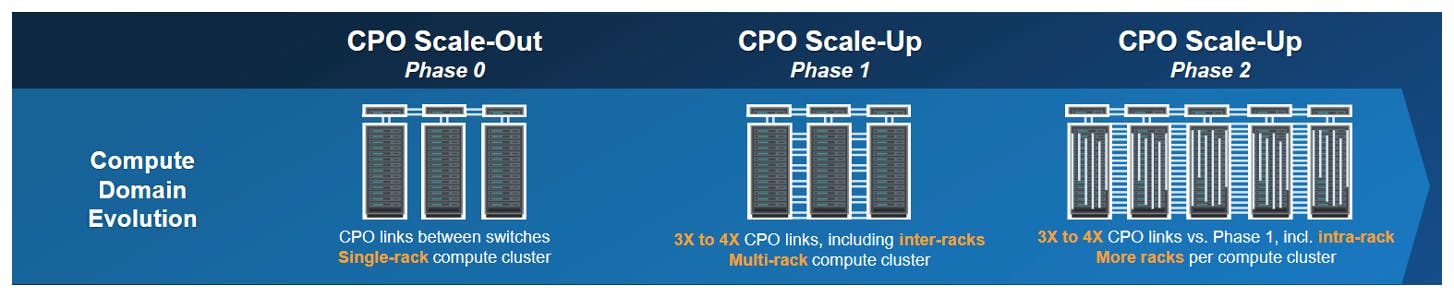
However, CPO demand, anchored through Lumentum’s Nvidia partnership and expected to broaden across hyperscalers over time, is the potential game changer. The company describes the CPO opportunity as being in three phases. Phase 0 is scale-out CPO, where Lumentum expects to generate $100 million in revenue in the final quarter of calendar 2026. The company will then deliver on a multi-hundred-million-dollar scale-out commitment in H1 2027.
Lumentum’s market in scale-up CPO is drastically larger. Phase 1 CPO involves connections between racks in scale-up pods and is 3X-4X larger than its Phase 0 scale-out CPO opportunity. The opportunity in Phase 2 scale-up CPO, which involves links within each rack as copper gets displaced over even shorter distances, is 10X larger than Phase 0.
Graphic illustrating the evolution of co-packaged optics (CPO) deployment across AI data centers. Phase 0 begins with scale-out architectures using single-rack clusters. Phase 1 expands to multi-rack clusters with inter-rack optical links, increasing CPO connections by 3X to 4X. Phase 2 advances to intra-rack optical connectivity, significantly increasing link density and enabling larger-scale compute clusters. Source: Lumentum.
Phase 1 scale-up shipments are expected to begin in H2 2027 and ramp significantly in 2028 and beyond. The Phase 2 opportunity is expected to inflect in late 2029 and 2030. Increasing InP capacity is critical to meeting scale-up demand, which is exactly what Lumentum’s newly acquired facility in Greensboro is designed to accomplish.
After retrofitting the site for InP-based devices, Lumentum expects to ramp UHP production in mid-2028. Greensboro is the ‘moonshot’ opportunity for Lumentum, with the company targeting $5 billion of incremental annual revenue capacity through the facility. Compared to Lumentum’s last 12 months' revenue of $2.488 billion, the full ramp-up of Greensboro alone has the potential to triple the size of its business.
Greensboro will also come with semiconductor-like margins—which are structurally higher than transceiver margins. This provides Lumentum with another opportunity to significantly improve its profitability profile.
Lumentum’s AI Networking TAM Expansion
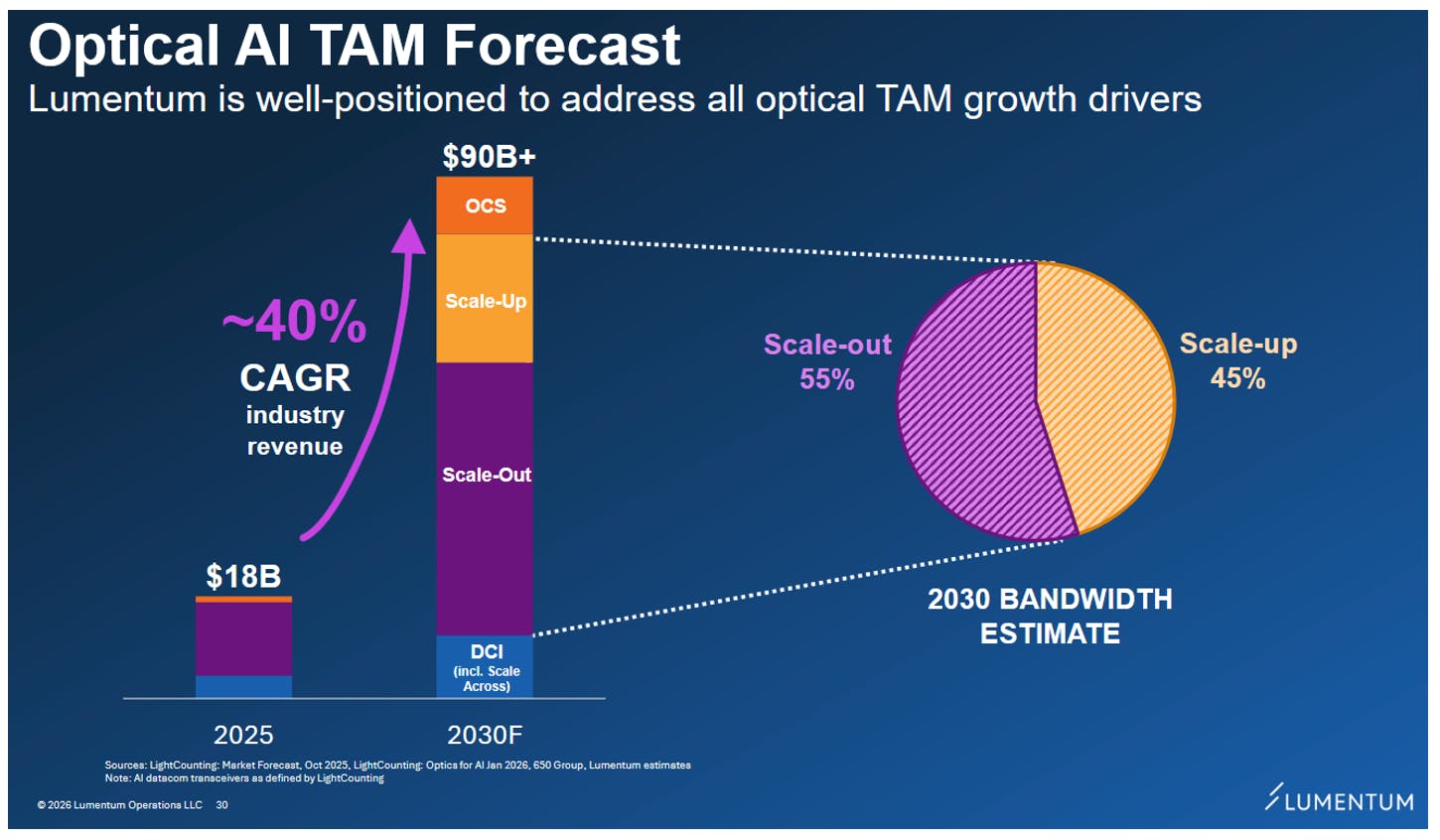
Through the combination of four networking markets: scale across (narrow linewidth and pump lasers), scale-out (CPO, transceivers, and transceiver components), scale-up (CPO), and OCS, Lumentum sees its optical AI total addressable market (TAM) expanding massively. From 2025 to 2030, Lumentum forecasts a 5X TAM increase, surging from $18 billion to $90 billion.
Chart illustrating Lumentum’s projected expansion in the optical AI total addressable market (TAM), growing from approximately $18 billion in 2025 to over $90 billion by 2030, representing ~40% CAGR. Growth is driven by scale-out networking, scale-up architectures, and optical circuit switching (OCS), with 2030 bandwidth demand split roughly between 55% scale-out and 45% scale-up. Source: Lumentum.
The Ultimate Question: “Is it Too Late?”
Clearly, Lumentum has a huge opportunity ahead of it to not only grow revenues but also expand margins. Fundamentally, this opportunity rests on the supply and demand dynamics in the optical networking market. Lumentum is already under-shipping the market by over 30%, despite having market-leading InP capacity today.
Even as Lumentum increases capacity by 50% from December 2025 to December 2026, it expects the gap to widen. This setup puts more power in Lumentum’s hands over time, benefiting pricing, margins, and EPS. The dramatic rise in both Lumentum’s sales and margins today shows this dynamic is already playing out, and the factors driving it are getting stronger, not weaker.
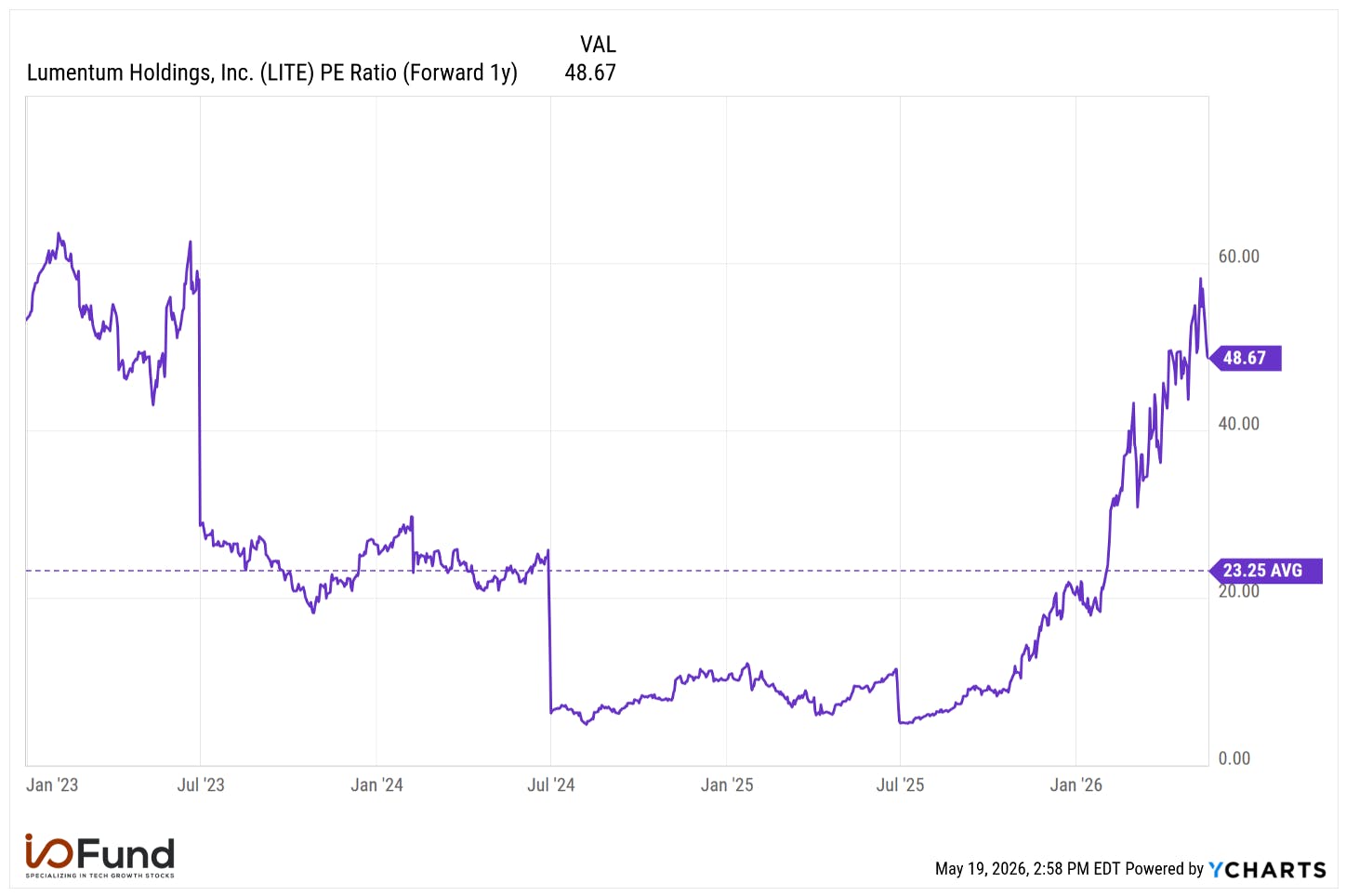
Still, investors have taken notice of this, as well as Lumentum’s very strong financial performance. Based on FY 2027 earnings estimates, Lumentum trades at a forward P/E ratio of 48.67X, approximately 109% above its average forward P/E of 23.25X since the start of 2023.
Chart illustrating Lumentum’s forward price-to-earnings (P/E) ratio over time, showing a recent rise to 63.2x, significantly above its three-year median of 33.8x. The valuation expansion reflects strong investor expectations for continued growth in AI networking, optical transceivers, and co-packaged optics (CPO) demand. Source: YCharts
However, analysts forecast a dramatic rise in the denominator, reflecting continued transceiver growth and the ramp-up of scale-out CPO, OCS, and the early stages of scale-up CPO, boosting revenues and margins.
EPS Growth and Forward Valuation
Estimates place Lumentum’s NTM adjusted EPS at roughly $15.84. In Lumentum’s FY 2028 (the 12 months ending calendar Q2 2028) that estimate rises to $28.12. Using this figure puts Lumentum’s forward P/E at 31.65X, drastically closer to its average since the start of 2023. And, critically, this comes before Phase 2—Lumentum's largest CPO opportunity—gets underway.
All the while, Lumentum benefits from having the largest base of InP capacity and expanding that capacity significantly, leaving the firm in a prime position to service scale-up demand. When considering these factors, Lumentum’s valuation starts to look much more reasonable.
Final Thoughts: Looking Beyond Nvidia
Networking stocks are notoriously difficult to navigate. The products are complex and supply chains shift quickly, particularly for those supplying Nvidia. This can create the kind of volatility that pushes most investors to the sidelines. Lumentum’s 339% run in 2025 is a perfect example: most funds allocated heavily to Nvidia instead of recognizing that run would likely continue into 2026. Five months later, and Lumentum surged another 135.4%.
The broader AI trade problem illustrates this well, as many funds treat Nvidia as their entire AI allocation. Meanwhile, the AI infrastructure buildout is expanding across power, networking, memory and more, and the best-performing names are increasingly not Nvidia.
The I/O Fund owned 4-of-10 top large cap performers in April, which illustrates the importance of looking more broadly at the AI trade. Our large Lumentum position is up 135.4% YTD – or 6.8X what Nvidia returned in the same window. Lumentum is one example; along with Bloom Energy and another networking stock up 750% since November, leading to YTD returns of 48% - nearly 3X the Nasdaq and 5X popular ETFs.
To celebrate six years of the I/O Fund, we're offering our deepest discount of the year: $275 off Advanced Market Signals through May 27. 🥂
Members get our Q2 Top 15 AI Stocks report that runs over 70 pages and identifies the 15 stocks I expect to lead the AI market this quarter. The report is built on the same investment discipline that drove our YTD outperformance and surfaced Lumentum, Bloom Energy, and other major AI winners.
Since May 2020, our audited portfolio has returned 326% cumulatively — a track record that would place I/O Fund #1 versus hedge funds and #3 versus tech ETFs or mutual funds, before including this year's 48% YTD return.
Leo Miller, AI and Semiconductor Investment Writer at I/O Fund, contributed to this analysis. Leo Miller owns shares of NVDA.
Please note: The I/O Fund conducts research and draws conclusions for the company’s portfolio. We then share that information with our readers and offer real-time trade notifications. This is not a guarantee of a stock’s performance and it is not financial advice. Please consult your personal financial advisor before buying any stock in the companies mentioned in this analysis. Beth Kindig and the I/O Fund own shares in LITE at the time of writing and may own stocks pictured in the charts.
Recommended Reading:
More To Explore
Newsletter
The AI Networking Stock That Beat Nvidia by 7X YTD for Returns of 135% YTD
AI networking stock Lumentum is among the key I/O Fund winners in 2026. We allocated heavily to LITE in January—a month before Nvidia backed the company. While most investors couldn’t stomach taking a
Bloom Energy — Our 2026 Top Pick Was the Best Performing Stock in April
April was the best month in six years for the Nasdaq-100. The single best-performing large-cap stock wasn't Nvidia, Microsoft, or Meta. It was Bloom Energy, up roughly 109% in one month. As you'll rec
Inside Nvidia’s $4B Optical Strategy—and Why CPO Changes Everything
Within the AI investment theme, there is nowhere that the supply chain shifts faster than in networking, leading companies to gain content on new platforms or lose incremental share. The reason is str
Is Nvidia Stock a Buy? Why Semiconductor Strength May Signal a Market Top
In this report, we take a deeper look at the technical scenarios, which suggests that Nvidia’s latest high is shaping up to be a potential bull trap. That view is corroborated by the broader semicondu
Nvidia’s $20 Trillion Thesis Is Intact. My 2026 Allocation Isn't
The thesis on Nvidia's hardware moat has played out exceptionally well, but that also highlights one of the biggest risks investors face, which is becoming emotionally attached to a winning stock. Whi
Bitcoin 2026 Price Prediction: Why the Dollar, Global Liquidity and Volume Signal More Downside Ahead
In our last Bitcoin analysis, "Bitcoin After the Cycle Peak: What Comes Next and How We're Positioning", we argued that Bitcoin was closer to a cycle low than most believed, even if one final drop rem
2026 Stock Market Outlook: Cycle Convergence & What's Next
In our last broad market update, the S&P 500 was trading near 6,850, grinding through its fifth consecutive month of going nowhere. I drew a clear line in the sand at the 6,780 level. This was where t
Arm Stock Could Win as Agentic AI Shifts the Bottleneck to CPUs
Arm unveiled an AGI CPU to address one of AI’s biggest bottlenecks, which is orchestration. During the chatbot craze of 2023-2025, GPUs did most of the heavy lifting while CPUs had become an afterthou
Nvidia Stock Prediction: The Path to a $20 Trillion Market Cap is Strengthening
The $20 trillion market cap will not come from GPU unit growth alone, though unit growth remains very important. Rather, the value proposition will increasingly focus on economic output. This marks a
Nvidia Stock to See New Growth Catalyst; 35X Faster AI with Groq 3 LPX
At GTC this week, Jensen Huang stated the revenue opportunity for Nvidia’s artificial intelligence chips may reach at least $1 trillion through 2027, up from a previous target of $500 billion. While t