Bloom Energy — Our 2026 Top Pick Was the Best Performing Stock in April
May 17, 2026
Beth Kindig
Lead Tech Analyst
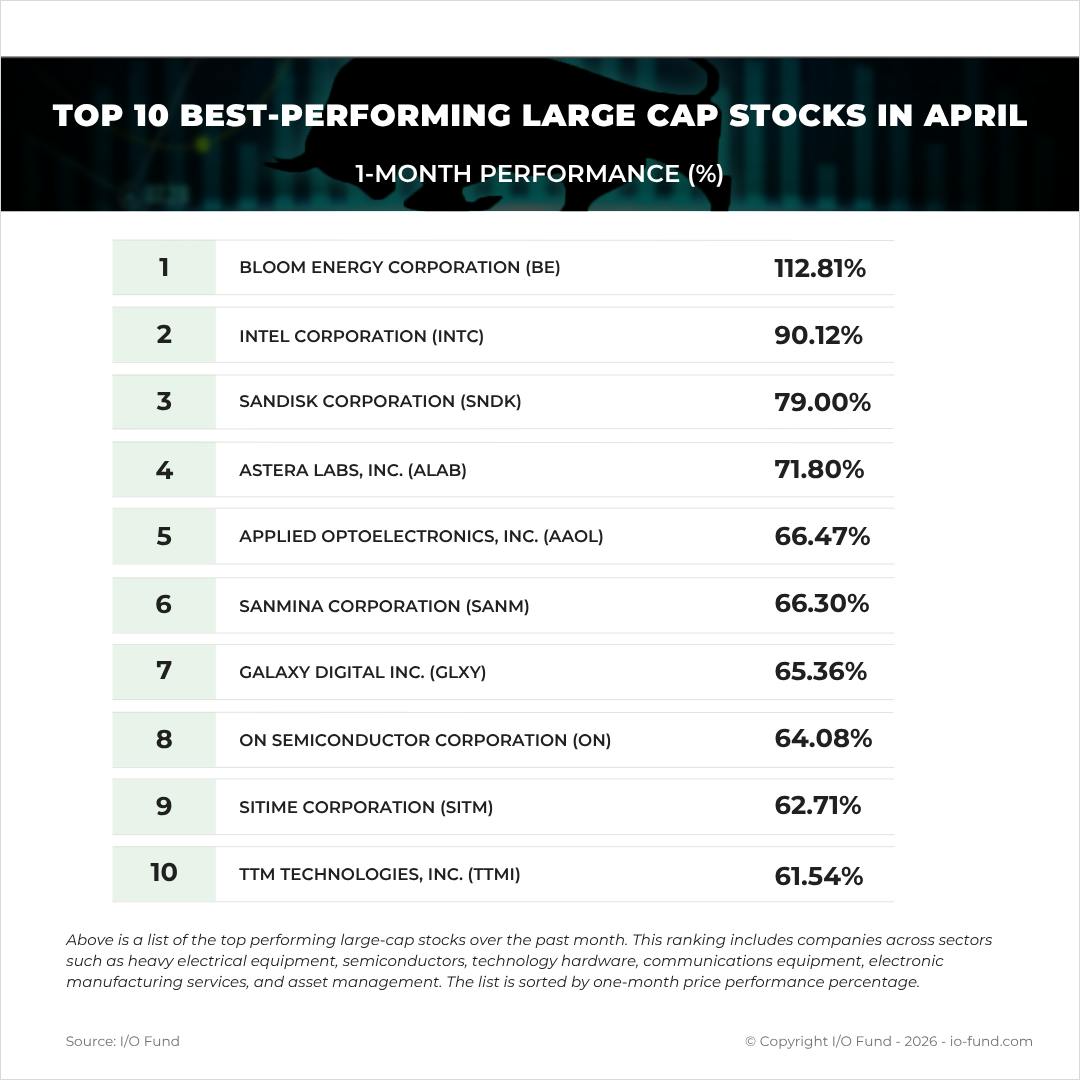
Last month was the S&P 500’s best month in six years, marking the biggest rally since the Covid lows in April of 2020. The S&P 500 rose 10.43%, while the Nasdaq gained more than 15%. Yet the single best-performing large-cap stock in that historic month was not Nvidia, Microsoft, Meta, or another obvious AI leader. Rather, it was Bloom Energy, which rose roughly 109%.
Bloom was our 2026 Top Stock pick, published on February 27th when shares were at $160.90. However, my firm’s history on the stock began one year ago when we first identified AI energy as the next bottleneck, with initial buys during the April lows at $16.64 and $17.04. For most of the last 12 months, we’ve held Bloom at a high allocation of 10% or higher, with real-time trade alerts sent to our Research Members. Today our returns from those entries are roughly 1300%. Many of Wall Street's most renowned firms eventually followed the I/O Fund much later and entered at significantly higher prices.
Earlier this year, I designated Bloom as our Top 2026 Stock Pick on February 27 when shares were at $160.90 (about 10X on our cost basis).
The decision to place Bloom as our Top Stock pick required strong conviction — not only in Bloom Energy's positioning, but in the sheer pressure from AI's primary bottleneck to believe the stock could see a repeat year of strong performance. Repeat years are especially rare after a big run-up as early investors typically book gains and move on.
Below, I’ll walk you through why Bloom outperformed in the strongest rally tech has seen in six years, why the recent Q1 2026 results confirm the fundamentals beneath the rally, and why I believe the setup still holds – even after the stock rose 109% in April, just two months after we named it our 2026 Top Stock pick.
Why an Energy Stock — Not Software or Semiconductors — Led Tech’s Biggest Rally in 6 Years
Investors should take note that tech’s biggest month in six years was not led by a Mag 7 stock, a semiconductor, or a software platform like it was in 2020. Although many of these sectors were deservedly ranked in the top 10, the month’s biggest outperformer was centered around power availability.
The reason for this is straightforward as companies like Microsoft, Google and Meta are spending hundreds of billions annually on AI, with tens of billions allocated to Nvidia’s GPUs and custom silicon like Google’s TPUs. These systems risk being delayed if Big Tech cannot energize and deploy them quickly. Meanwhile, the market has already penalized these companies for outsized spending on AI infrastructure. The effects of low immediate ROI only compound with a timing risk as GPUs sit idle, while competitors who do have power amplify the consequences of a delay.
Despite power being the primary bottleneck, the market is hyper-focused on whether Big Tech can monetize AI. My contention in my original article on Bloom Energy is that the market is missing the point. Monetization has never been Big Tech’s weakness as explosive revenue growth and high margins have defined their businesses for decades. While execution risk always exists, these companies remain the world’s most reliable operators at scale.
Instead, the real risk to the AI economy lies in the physical constraints of scaling these AI ambitions — not in compute availability from companies like Nvidia or Broadcom, and certainly not in Big Tech’s software capabilities, but in power availability, thermal management, and infrastructure that were never designed for this magnitude of demand.
Bloom Energy Solves AI’s Most Critical Bottleneck: Time to Power
Over the next two years, Nvidia’s GPU systems are expected to require a 5x increase in power per rack from what was needed in the first half of 2025 as we move across GPU generations from Blackwell to Rubin Ultra. As stated, if hyperscalers cannot energize these systems quickly, billions of dollars of AI capex can sit idle, especially critical now that the AI market is shifting toward generating inference revenue.
Therefore, due to the rapidly increasing power requirements for AI systems, it is not enough to say the AI economy needs more power, but rather it needs power urgently. These are two entirely different matters; for example, the first could be supported by the expansion of nuclear power and the electrical grid, but the latter cannot. In fact, combining these two is something very few companies can do.
Get $275 off Advanced Market Signals for our 6-year anniversary sale. Access real-time trade alerts, weekly webinars, and 100+ research articles on the AI trade per year. Claim Offer
Behind‑the‑Meter Fuel Cells vs Grid‑Dependent Power
Bloom Energy offers onsite power generation through solid oxide fuel cells that are behind the meter to reduce dependency on the grid. By providing behind-the-meter generation, Bloom reduces reliance on utility infrastructure and accelerates time-to-power for customers. An added benefit is the United States is the largest producer of natural gas, therefore, Bloom does not struggle to secure supply given the United States has large, well-developed gas supplies and pipeline infrastructure.
Our primary message has been “time to power” for Bloom, and the company continues to stand out for this very reason as it is finding strong product market fit in AI data center power needs. This is a key advantage as on-site power is becoming more of a necessity as grid constraints and connection timelines rise.
Regarding grid constraints, PJM has already fallen short of reliability requirements in its last two capacity auctions, including a roughly 6.6 GW shortfall for the 2027/28 planning year, while ERCOT’s interconnection queue has surged to about 226 GW, including roughly 165 GW from data center projects targeting approval by 2030. Against that demand, ERCOT added only 23 GW of new capacity in 2024–25, underscoring why time-to-power is becoming a central bottleneck for AI data centers.
This further validates Bloom’s positioning by enabling new data center projects to come online sooner with on-site, behind the meter power without sitting in interconnection queues for years at a time. Bloom has already proven that it can quickly establish data center power solutions in a rapid manner, completing shipments to Oracle Cloud Infrastructure in just 55 days of its 90-day delivery request.
Its fuel cells are also fuel-flexible and can run on natural gas, biogas, or hydrogen, and provide continuous power with 99.9-99.999% reliability metrics. They are also modular in nature and can scale from 20 MW to 500 MW+, allowing flexibility in deployments and ease of scaling. Bloom is also continuously improving on price-performance, stating that its fuel cells have seen double digit YoY cost reductions each year for the past ten years, and a 10X increase in power production in the same footprint versus ten years ago.
Oracle’s Project Jupiter Sends Bloom’s Stock Soaring in April
We’ve covered previously that Bloom delivered a fuel cell system to Oracle in 55 days, standing out among the longer to deploy solutions in the market. In April, Bloom Energy announced an expansion with Oracle for a total of 2.8GW of fuel cell capacity with 1.2GWs shipping now.
Following the capacity announcement, Oracle announced Project Jupiter yesterday stating the company will utilize up to 2.45GWs “to fully power the AI data center campus” located in New Mexico. This is an important development as it means the AI data center will not use gas turbines and the diesel generators as originally planned. According to the press release, nitrous oxide emissions will be cut by 92% compared to the previous gas turbine plan.
The following was stated about the new deal: “It will be 100% Bloom. When completed, it will be one of the largest islanded microgrid power facilities in the world. Oracle pivoted to Bloom only solution for 2 main reasons: first, be a responsible corporate citizen and partner by being responsive to resident concerns about air quality, water use, noise and increasing electricity rates.
Second, to stand up their grid independent and clean AI factory with even greater reliability and speed. Bloom is the cleanest commercially available on-site power generation option for such data centers and the most water efficient. Even Blooms community-friendly attributes, Oracle should be able to energize the campus materially faster than any other available alternative solution in the market.”
The new deal with Oracle has sent Bloom’s stock soaring on a 1-month basis (on top of the already strong 1-year returns). We’ve discussed in-depth the product market fit for the stock as being “time to power,” yet the company’s value proposition has actually improved since last quarter as the Jupiter deal serves as an important proof of concept for the company.
My understanding, as an analyst how has tracked this stock longer than any research site on record, is the Jupiter deal will mark the first time an AI data center will be powered entirely by Boom Energy’s solutions – an important moment in Bloom’s history.
At minute 5:43, Beth Kindig discusses why Bloom Energy is her top stock pick for 2026.
Why AI Inference Will Drive the Next Wave of Power Demand
The inference market will require more gigawatts than training, yet an additional constraint is location (or geography). Inference sits at the edge, close to users for latency, which means demand will be coming from dense metros instead of less populated areas, such as where training data centers are located (rural areas).
The underlying trend is significant. Boston Consulting Group projects inference power demand to grow at a 122% CAGR through 2028, compared to 30% for training. McKinsey forecasts inference rising from ~21 GW today to ~91 GW by 2030 at a 35% CAGR, accounting for the majority of AI's incremental power draw through the end of the decade. As frontier models stabilize and the AI economy shifts toward serving users at scale, inference will overtake training as the dominant compute workload, which translates to inference also consuming more power.
Bloom’s Advantage in Dense Metro Deployments
Bloom could see more demand from the inference market compared to training as it offers a combination of low emissions, minimal water use and a small footprint – which is ideal for dense areas. Its solid oxide fuel cells (SOFCs) are electrochemical rather than combustion-based, producing minimal emissions. They are also modular, scaling from 20 MW to 500+ MW, and operate quietly enough to be placed in urban environments. Lastly, they run on natural gas pipelines that already exist in metros, bypassing grid interconnection queues entirely. For an inference-driven AI buildout, these details matter.
Notably, the newly appointed CFO is a signal that Bloom is positioning for this shift toward inference, as Simon Edwards, was the former CEO of Groq, a leading developer of inference infrastructure and LPUs (recently acquired by Nvidia). Edwards is likely a deliberate, strategic hire ahead of the inference scale-up.
Q1 2026 Revenue Surged 130% YoY — Strongest Growth in Bloom Energy’s History
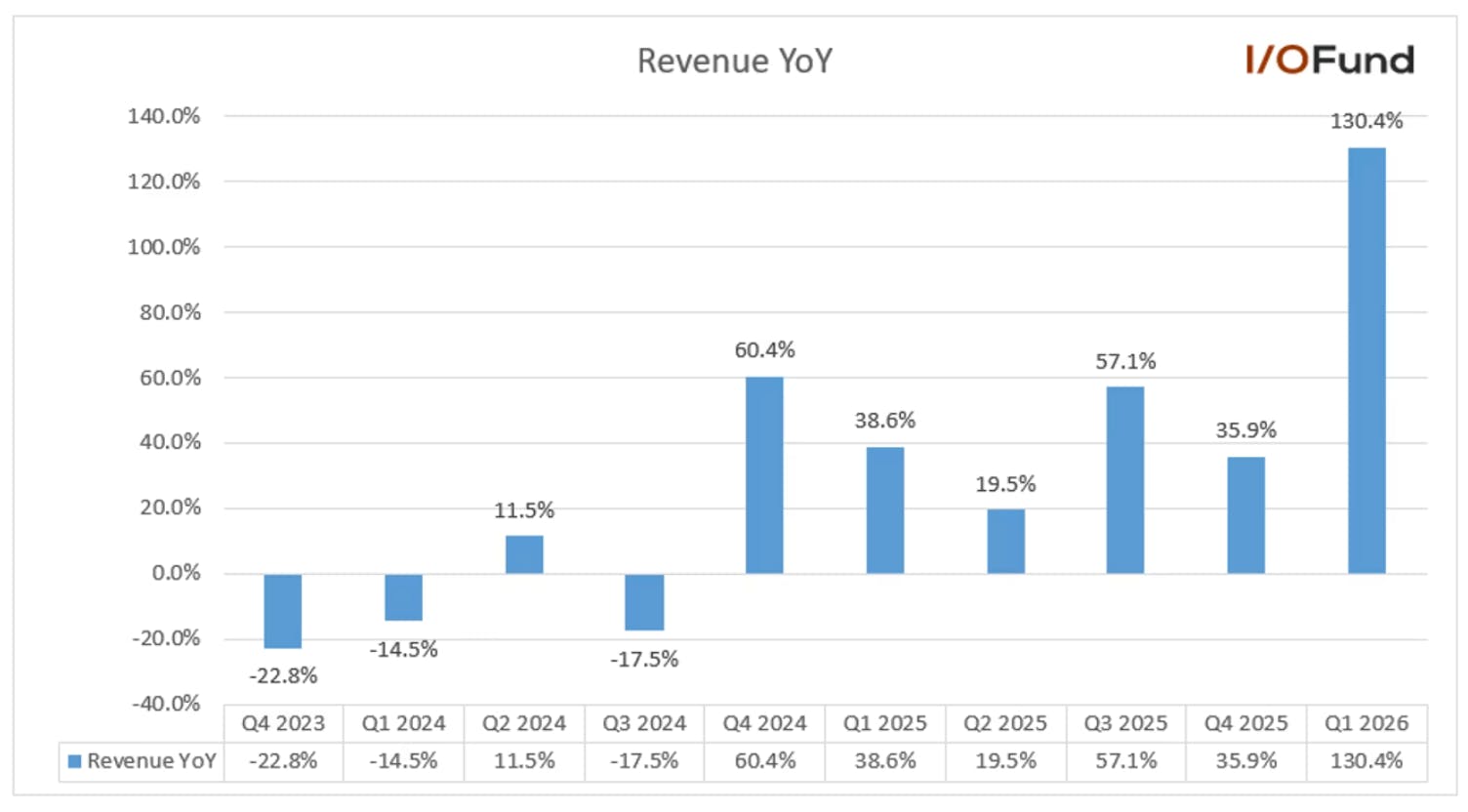
Bloom Energy reported Q1 2026 revenue of $751.1 million, up 130.4% YoY and beating estimates by 39.1% — the strongest growth in the company's public history. Product revenue reached $653.4 million, up 208.4% YoY, and now represents ~87% of total revenue.
Management raised full-year 2026 guidance to $3.4 billion–$3.8 billion, implying 77.9% YoY growth at the midpoint, up from $3.1–$3.3 billion.
Gross and Operating Margins Expanded Sharply YoY
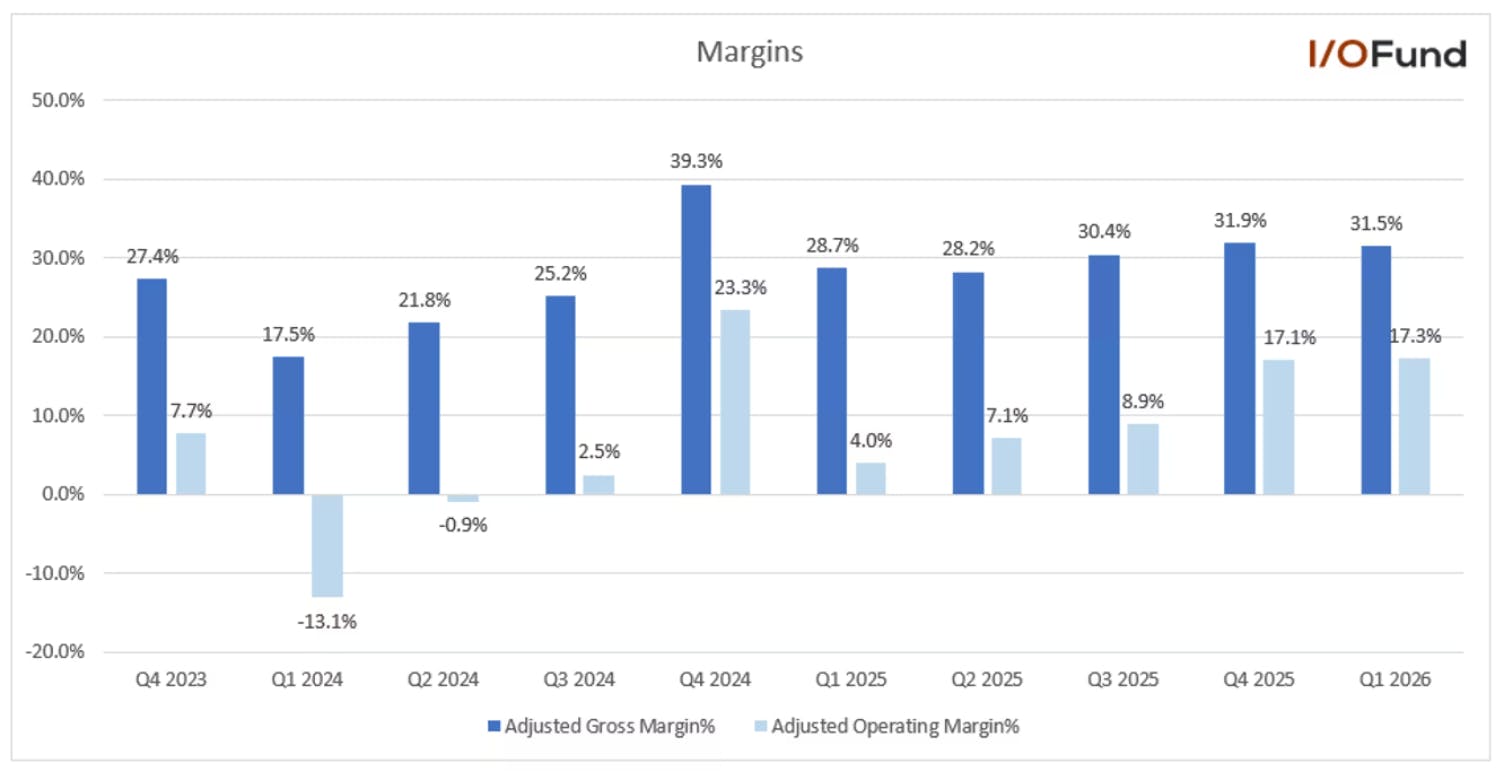
GAAP gross margin was 30%, up 280 basis points YoY. Adjusted gross margin was 31.5%, up from 28.7% in Q1 2025. Management raised full-year 2026 adjusted gross margin guidance to 34%, up from 32%.
GAAP operating margin was 9.6%, up from (5.8%) in Q1 2025. Adjusted operating margin was 17.3%, up from 4%. Management raised FY2026 adjusted operating income guidance to $675 million at the midpoint, up from $450 million.
Bloom Energy EPS Crushed Estimates by 242%
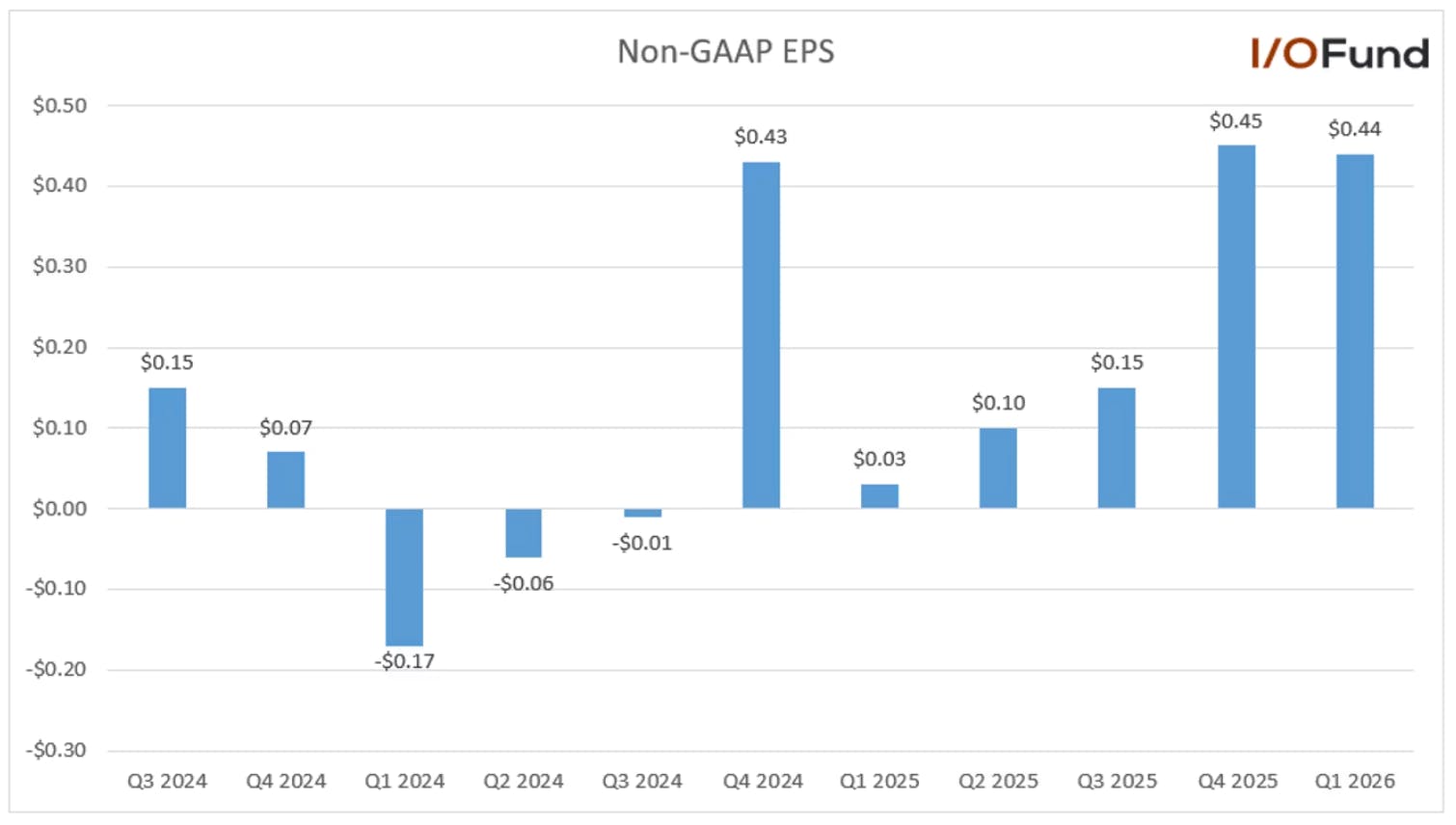
Adjusted EPS was $0.44, crushing estimates of $0.13 by 242.4%. GAAP EPS was $0.23 versus estimates of ($0.02). Management raised full-year 2026 adjusted EPS guidance to $2.05 at the midpoint, implying 169.7% YoY growth, up from $1.405.
Positive Cash Flow Inflection
Bloom reported the first positive Q1 operating cash flow in company history at $73.6 million (9.8% of revenue), versus an outflow of ($110.8 million) a year ago. Free cash flow was $47.4 million. Cash of $2.49 billion and debt of $2.60 billion at quarter-end.
Conclusion:
Bloom Energy’s April rally validated what we have been writing since June 2024, which is that power is the leading constraint on the AI buildout. Of this, time-to-power is the variable that matters most, and Bloom is one company that can deliver mission critical power solutions for the incoming inference market.
The harder question, and one that matters more than entering Bloom at $17 in April 2025, is what comes next. The investors who outperform from here will not be the ones who pile into the trade that already worked. They will be the ones positioned for the next bottleneck long before the market sees it.
Get $275 Off on our Advanced Plan. April was the Nasdaq-100’s best month in six years, and few portfolios participated like I/O Fund. Bloom Energy was the top-performing large-cap stock during the April rally, yet I/O Fund also held four of the top 10 large-cap stocks at allocations of 7% or higher.
Since May 2020, our audited portfolio has returned 326% cumulatively. Based on our published comparisons, that would place I/O Fund #1 versus hedge funds and #3 versus tech ETFs or mutual funds — before including our 48% YTD return in 2026.
Join during our 6-year anniversary sale and save $275 on our Advanced Plan 🥂
Members receive real-time trade alerts, I/O Fund’s portfolio, 100+ research articles on the AI trade per year, and weekly one-hour webinars.
Offer ends soon. Claim Offer
Please note: The I/O Fund conducts research and draws conclusions for the company’s portfolio. We then share that information with our readers and offer real-time trade notifications. This is not a guarantee of a stock’s performance and it is not financial advice. Please consult your personal financial advisor before buying any stock in the companies mentioned in this analysis. Beth Kindig and the I/O Fund own shares in BE at the time of writing and may own stocks pictured in the charts.
Recommended Reading:
- Inside Nvidia’s $4B Optical Strategy—and Why CPO Changes Everything
- Is Nvidia Stock a Buy? Why Semiconductor Strength May Signal a Market Top
- Nvidia’s $20 Trillion Thesis Is Intact. My 2026 Allocation Isn't
- Bitcoin 2026 Price Prediction: Why the Dollar, Global Liquidity and Volume Signal More Downside Ahead
More To Explore
Newsletter
Bloom Energy — Our 2026 Top Pick Was the Best Performing Stock in April
April was the best month in six years for the Nasdaq-100. The single best-performing large-cap stock wasn't Nvidia, Microsoft, or Meta. It was Bloom Energy, up roughly 109% in one month. As you'll rec
Inside Nvidia’s $4B Optical Strategy—and Why CPO Changes Everything
Within the AI investment theme, there is nowhere that the supply chain shifts faster than in networking, leading companies to gain content on new platforms or lose incremental share. The reason is str
Is Nvidia Stock a Buy? Why Semiconductor Strength May Signal a Market Top
In this report, we take a deeper look at the technical scenarios, which suggests that Nvidia’s latest high is shaping up to be a potential bull trap. That view is corroborated by the broader semicondu
Nvidia’s $20 Trillion Thesis Is Intact. My 2026 Allocation Isn't
The thesis on Nvidia's hardware moat has played out exceptionally well, but that also highlights one of the biggest risks investors face, which is becoming emotionally attached to a winning stock. Whi
Bitcoin 2026 Price Prediction: Why the Dollar, Global Liquidity and Volume Signal More Downside Ahead
In our last Bitcoin analysis, "Bitcoin After the Cycle Peak: What Comes Next and How We're Positioning", we argued that Bitcoin was closer to a cycle low than most believed, even if one final drop rem
2026 Stock Market Outlook: Cycle Convergence & What's Next
In our last broad market update, the S&P 500 was trading near 6,850, grinding through its fifth consecutive month of going nowhere. I drew a clear line in the sand at the 6,780 level. This was where t
Arm Stock Could Win as Agentic AI Shifts the Bottleneck to CPUs
Arm unveiled an AGI CPU to address one of AI’s biggest bottlenecks, which is orchestration. During the chatbot craze of 2023-2025, GPUs did most of the heavy lifting while CPUs had become an afterthou
Nvidia Stock Prediction: The Path to a $20 Trillion Market Cap is Strengthening
The $20 trillion market cap will not come from GPU unit growth alone, though unit growth remains very important. Rather, the value proposition will increasingly focus on economic output. This marks a
Nvidia Stock to See New Growth Catalyst; 35X Faster AI with Groq 3 LPX
At GTC this week, Jensen Huang stated the revenue opportunity for Nvidia’s artificial intelligence chips may reach at least $1 trillion through 2027, up from a previous target of $500 billion. While t
Palantir Stock is Out of Favor, but is the Growth Engine Still Intact?
Palantir stock sold off 38% from November to February and is down about 10% year-to-date. Even so, it has held up better than many software peers given the software sector has taken it on the chin lat