Nvidia Stock Prediction: The Path to a $20 Trillion Market Cap is Strengthening
Beth Kindig·MAR 27, 2026·17 min read
On this page
Last week at GTC, Jensen Huang stated that Nvidia has a path to $1 trillion in cumulative sales across the Blackwell and Rubin generations from 2025 through 2027. If you follow Nvidia’s stock closely, this isn’t new information; rather it’s roughly aligned with what analyst forecasts already had baked in.
The distinction is crucial for investors as separating what’s already priced in from what can make a meaningful difference in stock returns. The latter typically offers alpha, while the other potentially sets up an investor for losses (hence the saying: “buy the rumor, sell the news” “buy the rumor, sell the news”).
The math for Nvidia to see $1 Trillion in Revenue was already there.
We must go back to October to more fully understand why the statement that Nvidia has visibility to $1 trillion in revenue through 2027 is anti-climactic.
Last October, Huang stated that the combined revenue from Blackwell and Rubin was an estimated $500 billion through the end of 2026. Our firm modeled something similar nearly two years earlier, when my original Nvidia $10 trillion market cap thesis was published, stating we would see a $320 billion data center segment in 2026 (FY2027).
Beth Kindig of the I/O Fund first laid out the case for Nvidia reaching a $10 trillion market cap in June 2024 — a view Jensen Huang later expressed publicly in March 2026 nearly two years later.
Blackwell revenue was $184 billion in 2025 when you combine compute and networking, along with the $320 billion expected in 2026, comes out to the $500 billion quoted at GTC in October. This means our model proved correct roughly 16 months before the CEO confirmed it. When I first made the $320 billion data center prediction in June 2024, it resulted in 56% upside, versus a 15% decline by the time the CEO effectively confirmed the thesis in October 2025.
Being early can pay off at many points along a stock’s trajectory. Of course, this is modest compared to the I/O Fund getting ahead of the Street on Nvidia in 2018–2019, which led to returns of more than 4,000%. But each milestone still matters when you’re talking about one of the world’s most valuable companies, as generating outsized returns becomes far more difficult at this stage.
Now consider the trajectory to $1 trillion laid out by Huang. Bridging from $500 billion (approximately $184 billion in 2025 and $320 billion in 2026) to $1 trillion implies about $500 billion in CY2027, or about 54% year-over-year growth for about $125B a quarter.
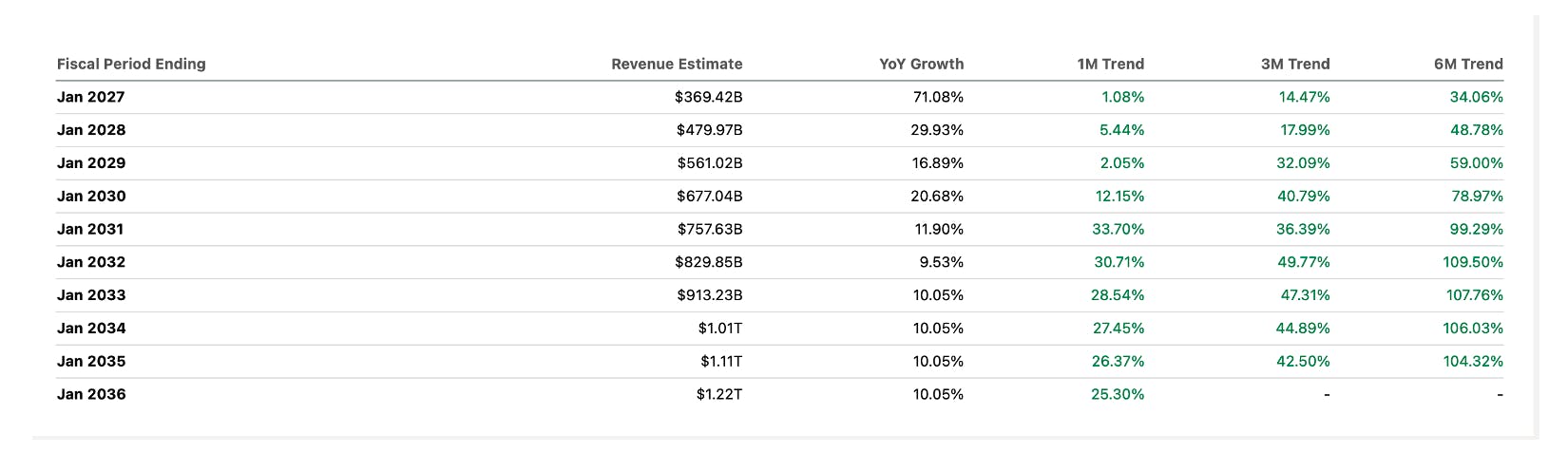
The Street had largely modeled this in, with FY28 (CY27) quarters at $114B, $119B, $125.5B, and $132B for a total of $490.5B for the fiscal year ending in January.
In other words, there was not much alpha in the comment, which helps explain why the stock didn’t move much from the “blockbuster” $1 trillion comment.
Chart showing Nvidia’s long‑term revenue forecast for FY2027–FY2031, including annual estimates, year‑over‑year growth, and multi‑period trend revisions that highlight consistently rising analyst expectations.
On the heels of the $1 trillion cumulative revenue comment, Huang publicly stated this week on a podcast that he sees a path to a $10 trillion market cap for Nvidia.
“Nvidia has a market cap of $3 trillion today. We believe Nvidia will reach a $10 trillion market cap by 2030 or sooner through a rapid product road map, it’s impenetrable moat from the CUDA software platform, and due to being an AI systems company that provides components well beyond GPUs, including networking and software platforms.”
Admittedly, 16 months later, that is no longer a contrarian call. Once the CEO goes on record with a number like that, it’s a sign the $10 trillion market cap narrative is transitioning from offering alpha to becoming increasingly priced in.
Which is exactly why I pushed the thesis further out, publishing a new article last November that Nvidia has a path to end the decade with a $20 trillion market cap.
How Nvidia Gets to $20 Trillion.
The $20 trillion market cap will not come from GPU unit growth alone, though unit growth remains very important. Rather, the value proposition will increasingly focus on economic output. This marks a tremendous shift for how Nvidia is evaluated.
As the AI market shifts toward inference, Nvidia’s product cycles will be optimized around token economics such as throughput, latency, power efficiency and cost per token. The goal is no longer to simply sell faster and more powerful chips, but to deliver superior economic value at the system level relative to custom silicon (in other words, let the battle begin).
Leading up to this, Nvidia was competing on performance metrics, and MLPerf benchmarks still matter of course. But going forward, workload economics and system-level efficiency will play a much larger role in how their systems are evaluated.
Historical Mispricing — How Analysts Missed Nvidia by 4X
Nvidia’s stock price is highly dependent on upward revisions – more so than any company that I can recall. To put it plainly, Wall Street’s estimates have consistently underestimated this company, and this gap is critical for where investors can continue to find an edge.
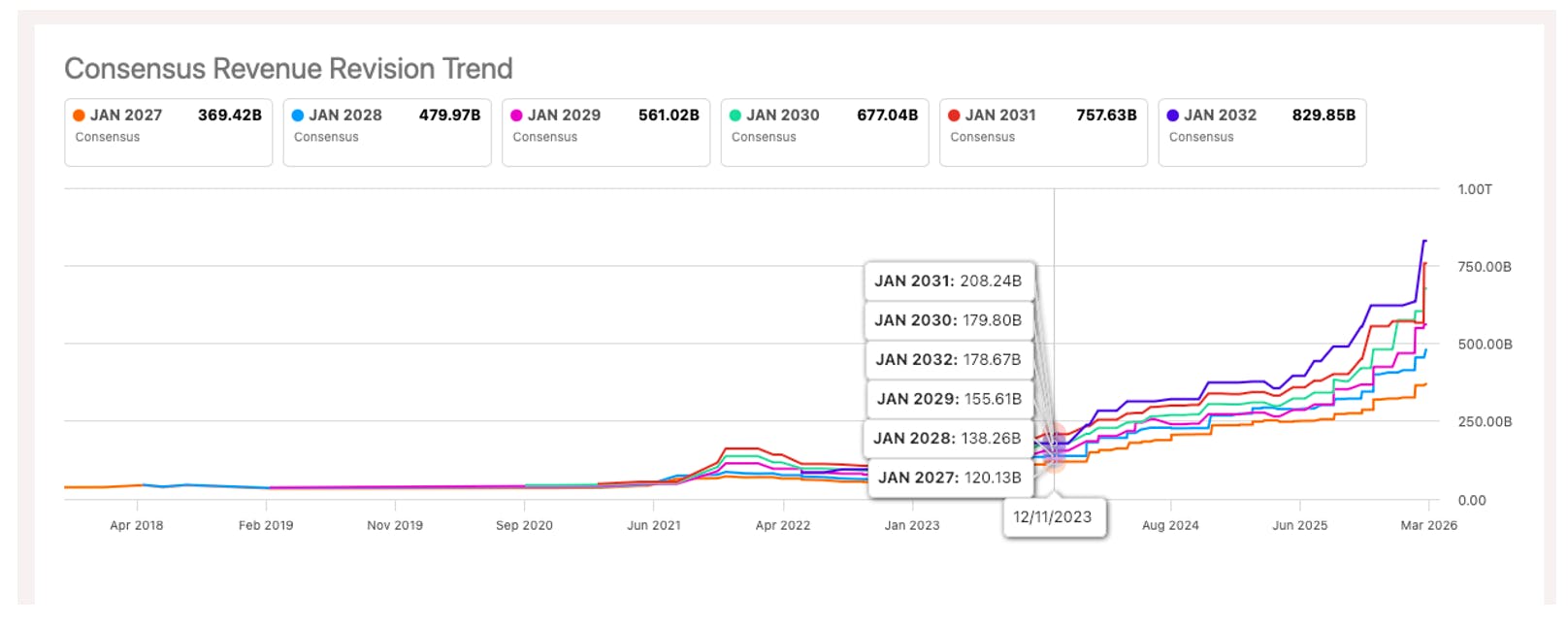
Three quarters after Nvidia’s breakout earnings report in May of 2023, analysts had eight months to price in the AI trade. Consensus for the fiscal year ending in 2028 was set at $138.3 billion. Today, that same estimate stands at $480 billion.
Further out, the error widens with Jan 2031 estimates of $208 billion versus where they are today at $757.6 billion or nearly 4X higher.
Chart showing Nvidia’s consensus revenue revision trend from 2018 to 2026, highlighting steady upward revisions for FY2027–2032. Key estimates—such as $369.42B for FY2027, $479.97B for FY2028, and $757.63B for FY2031—have climbed sharply, reflecting rising expectations for Nvidia’s AI, data center, and accelerator demand. The sustained increase in long‑term forecasts reinforces bullish sentiment around Nvidia stock and its multi‑trillion‑dollar market cap outlook.and its multi‑trillion‑dollar market cap outlook.
Only One Year Ago, Nvidia Revenue Estimates Were Far Too Low
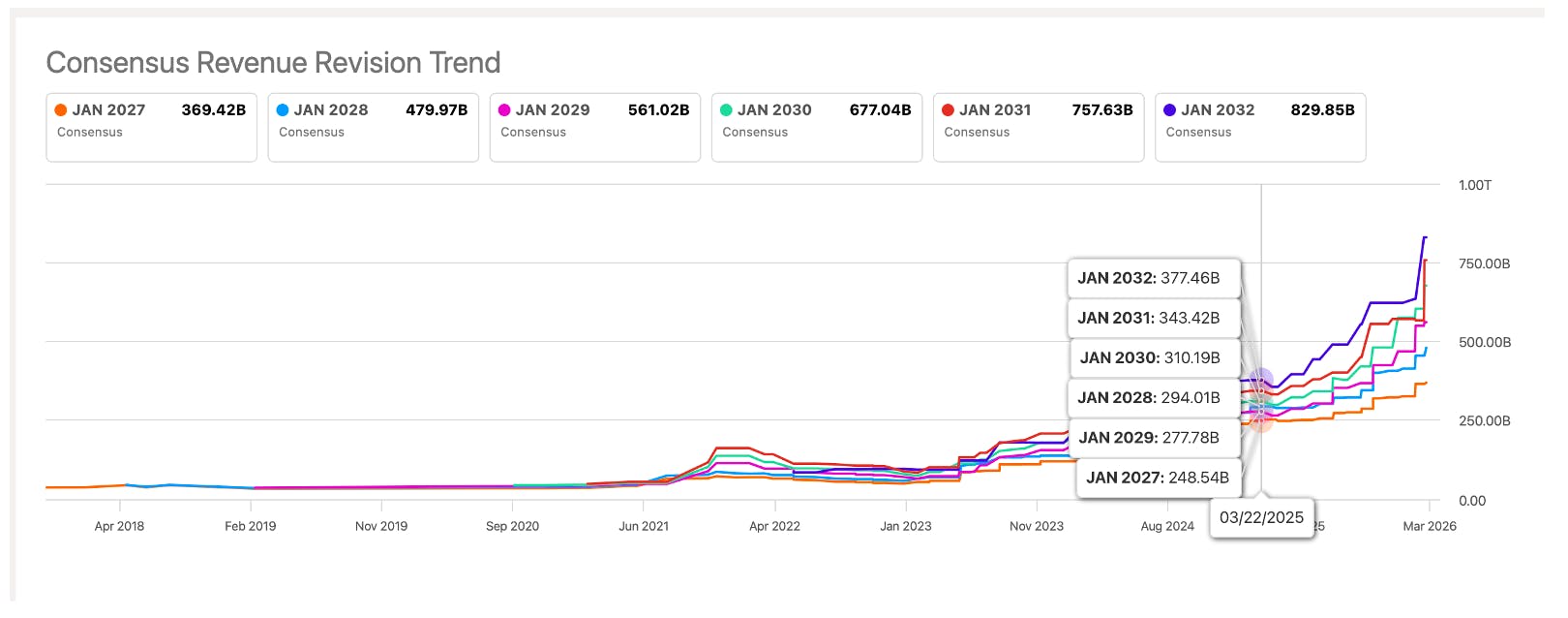
If we repeat this exercise and look back exactly a year ago, we will see that analysts continue to miss the target. Just one year ago, the fiscal year ending January 2028 was expected to see revenue of $294 billion. Today, consensus is at $480 billion. All else equal; those revisions could potentially represent alpha of 63%.
If you look at FY2031, estimates were $343.5 billion compared to $757.6 billion – meaning analyst estimates were off by 2X from where they are today.
Chart showing Nvidia stock revenue revision trends from 2018–2026, highlighting steadily rising analyst estimates for FY2027 through FY2032 as expectations for Nvidia’s AI and data center growth continue to increase.
How This Ties into Nvidia Reaching a $20 Trillion Market Cap by 2030
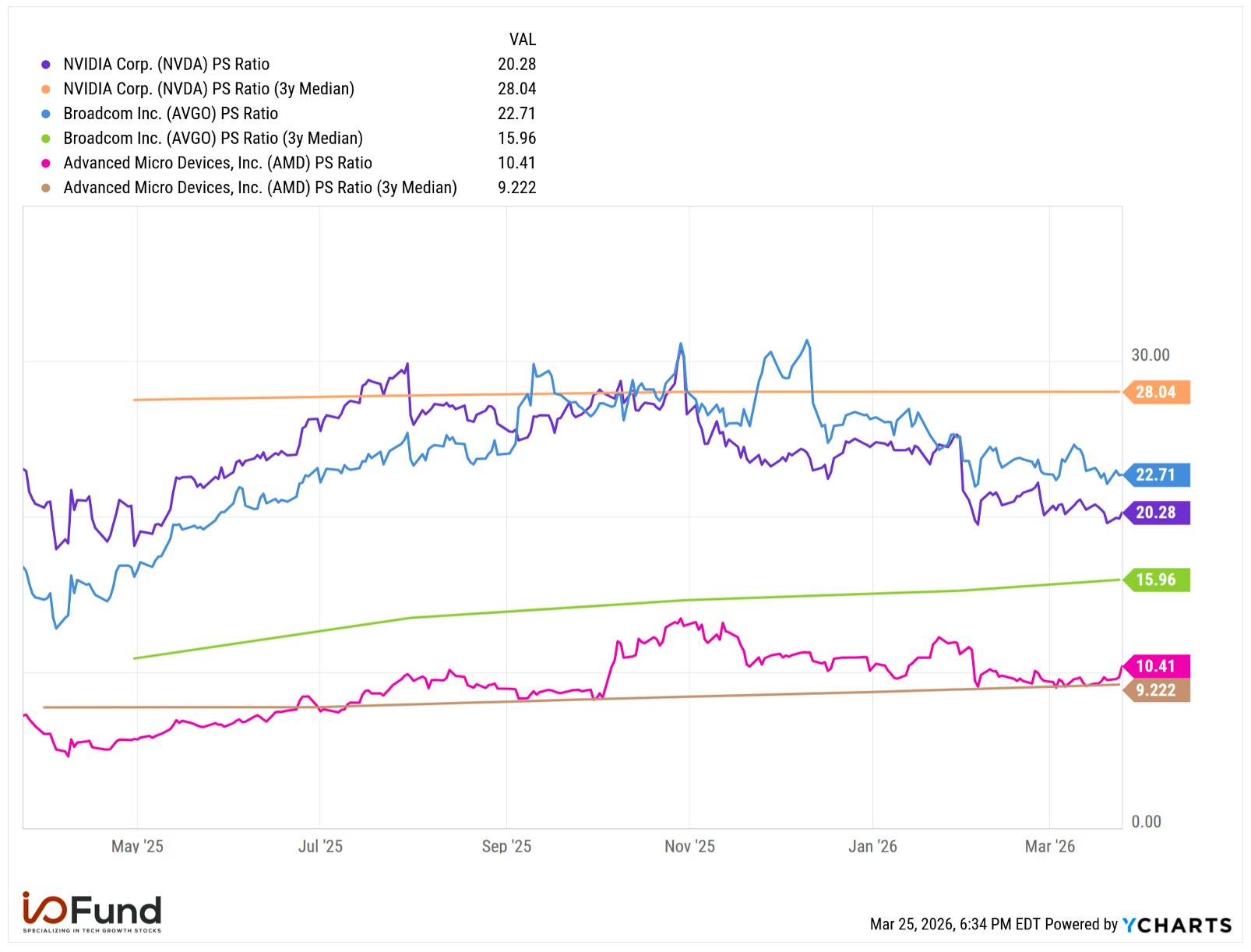
My $20 trillion market cap thesis for Nvidia is grounded in certain assumptions, primarily that Nvidia reaches $930 billion in data center revenue in a single year prior to the close of the decade combined with a price-to-sales ratio of 22X – a few points below the stock’s 3-year median P/S of 28X.
Right now, analyst estimates sit at $757 billion for the fiscal year ending January 2031. However, given the estimates have doubled in the past year alone, the 23% difference in estimates compared to my firm’s base case of $1 trillion seems achievable.
As I recently emphasized in an interview with Bloomberg Asia, analysts revising estimates intra-quarter is one of the most important catalysts for this stock.
What’s Pressuring Nvidia’s Valuation in 2026
Despite odds favoring Nvidia ending the decade at $930 billion or more in annual revenue, the more pressing issue is valuation. The stock has been trading at a significant discount to its historical valuation, yet buyers are not stepping in. Meanwhile, Broadcom is trading right well above its 3-year median and AMD is two points above its 3-year median.
Chart comparing Nvidia, AMD, and Broadcom P/S ratios and 3‑year median P/S ratios from 2023–2026, showing Nvidia trading below its historical valuation while Broadcom and AMD remain closer to their 3‑year medians.
I’ve heard some outlandish theories about this disconnect, but I believe the reason Nvidia is seeing a weaker valuation is fairly straightforward: the inference market offers immense opportunity for Nvidia yet is expected to lower Nvidia’s overall percentage of the AI accelerator market. Yes, this means Nvidia’s near-monopoly is set to end.
According to TrendForce, custom silicon represents 20.9% of the market in 2025 yet is expected to expand to 27.8% of the market in 2026. Adding to the competitive pressure, AMD is expected to release Helios MI400s in the second half of 2026, which could further eat into Nvidia’s GPU market share, adding to the pressure of custom chips gaining 7 points with architectures like Google’s TPUs.
Chart showing global AI server shipment share by accelerator type from 2023 to 2026, based on TrendForce data. GPUs remain dominant, while custom silicon grows from 20.9% of the market in 2025 to a projected 27.8% in 2026, highlighting accelerating adoption of ASIC‑based AI infrastructure.
Nvidia Versus Custom Silicon is Overly Simplistic
Get Our Free Weekly Stock Newsletter
Get weekly stock insights, market analysis, and technology updates straight to your inbox.
Weekly stock insights
Market analysis
Technology updates
The assumption that losing AI accelerator market share should result in a lower valuation is overly simplistic for four reasons.
Capex Growth Expands the Entire AI Accelerator Market: The first reason is that capex is the primary multiplier. Because capex continues to grow the overall pie, the market will expand faster than any single architecture can absorb. Compute demand is compounding; a shrinking slice of a rapidly growing pie can still mean explosive revenue growth.
GPUs Remain the Most Flexible Architecture for New Workloads: The second reason is that GPUs remain the default when workloads change. The versatility of GPUs is a competitive advantage as Big Tech does not always know what next quarter or next year will bring. Consider too that custom silicon is not only inflexible yet takes years to design. When a new model architecture emerges or workloads shift, GPUs step up in ways that custom silicon can’t. For example, during the reasoning model era, architectural breakthroughs such as OpenAI releasing o1 and DeepSeek releasing R1 required significantly more compute at inference. Custom silicon is a better choice when workloads are stable versus rapidly evolving like we saw with reasoning models and inference-time scaling.
Nvidia Monetizes at the System‑Level: Nvidia is monetizing the system rather than just the chips, evidenced by the explosive networking growth of 263% this past quarter. On that note, speaking of Broadcom, Nvidia’s management team stated that Nvidia is now the world’s largest Ethernet company, overtaking former Ethernet giant Broadcom, and this was accomplished in just a few years’ time.
Fourth – and most importantly, the value of what Nvidia offers is rapidly shifting from raw compute to token economics. If Nvidia continues to lead in performance per watt and performance per rack, its premium valuation can persist. Big Tech will prioritize unit economics, which means if Nvidia’s systems cost 2-3X more, the goal will be to produce more tokens per watt than the alternative to offset the premium.
This point is critical for how Nvidia plans to defend its positioning over the next few years. When token volume scales 10X, 100X or even 1000X, Nvidia’s ability to sell more units increases, along with the platform of more networking, more software and more tooling.
In that framework, it will be less about which systems cost $40,000 versus $15,000 and more about which platform delivers better economics at scale.
The Market Is Not Pricing in Nvidia’s Inference Opportunity
Last week, in the article “Nvidia Stock to See New Growth Catalyst; 35X Faster AI with Groq 3 LPX, I argued that the $1 trillion revenue comment through 2027 wasn’t the headline. The real development was the new Groq 3 LPX racks delivering up to 35X higher throughput per megawatt.
Why the Groq 3 LPX Integration Is a Major Catalyst
The 256-chip LPX rack introduces Groq’s unique SRAM‑based architecture that allows Nvidia to offload decode‑phase workloads and massively increase token throughput. This primarily targets trillion‑parameter LLMs, million-token context, and multi‑agent systems, which are bottlenecked less by compute and more by how efficiently a system can move data and generate tokens. Paired with the new Vera Rubin GPUs, Nvidia claims this architecture can deliver up to 35X higher throughput per megawatt, with seamless integration into Vera Rubin deployments.
The Groq acquisition is aimed to solve the limiter of inference throughput per watt, where memory bandwidth can become the gating factor to token output and cost. Nvidia is preparing to position its GPUs to be among the best inference options available, utilizing Groq’s unique SRAM-based architecture to significantly turbocharge token throughput and accelerate inference performance.
Nvidia expects Groq will help drive up to a 15X increase in tokens per second, directly translating into higher tokens per megawatt, which is already scaling by a factor of 10X between Blackwell and Rubin. If these claims hold true, then cheaper inference will unlock more usage, and more usage should lead to higher revenue and higher profits as the AI monetization wave plays out.
Nvidia is positioning its new Groq 3 LPX racks as a ‘token accelerator’ functioning in tandem with Vera Rubin GPUs to significantly boost token throughput and address the upcoming multi-agent future. The Groq LPUs are not meant to replace GPUs in inference workloads, but rather compliment them by optimizing for memory-intensive decode.
Off the bat, Nvidia expects that combining Rubin GPUs and Groq racks will drive a substantial increase in token throughput, with Nvidia VP Ian Buck claiming the combination “moves us from a world where 100 tokens per second is a reasonable throughput to one of 1500 TPS or more for AI agent intercommunication.”
To visualize this, anything over 100 TPS feels near-instantaneous, such as for chatbot users; in other terms, this would represent 1,500 words per second, or ~275X the average human reading speed. This distinction and shift from 100 TPS to 1,500+ TPS is more important than it might appear, as 100 TPS is optimized for human consumption, such as chatbot outputs, while 1,500 TPS is optimal for machine consumption, such as multi-agent communication, autonomous long-form reasoning and real-time AI systems that all require continuous, low-latency token generation.
Rubin + Groq Racks and the $300B Annual Revenue Opportunity
The introduction of the Groq LPUs as the seventh chip in Rubin’s co-design also represents a natural shift in Nvidia’s rack scale strategy that may help deepen its moat, where it disaggregates compute and bandwidth via different specialized architectures to optimize inference at the rack and system rather than chip level. Nvidia is moving quickly with the new combined infrastructure, with Groq chips in volume production at Samsung and CEO Jensen Huang saying they would be shipping around the Q3 timeframe.
While some analysts had cautioned that reaching the upper end of this would depend on buyer appetite and ‘ultra-premium’ tiers such as up to $150 per million tokens (nearly ~10X of GPT 5.4’s cost), the scale of the opportunity reflects Nvidia’s belief that inference-optimized rack-level systems will become a key part of future AI infrastructure buildouts.
Read more about the importance of the Groq 3 LPX racks and why the acquisition represents an important catalyst for the Nvidia’s stock. an important catalyst for the Nvidia’s stock.
Nvidia Stock Broke Minor Support at $176
Quick note on pricing:
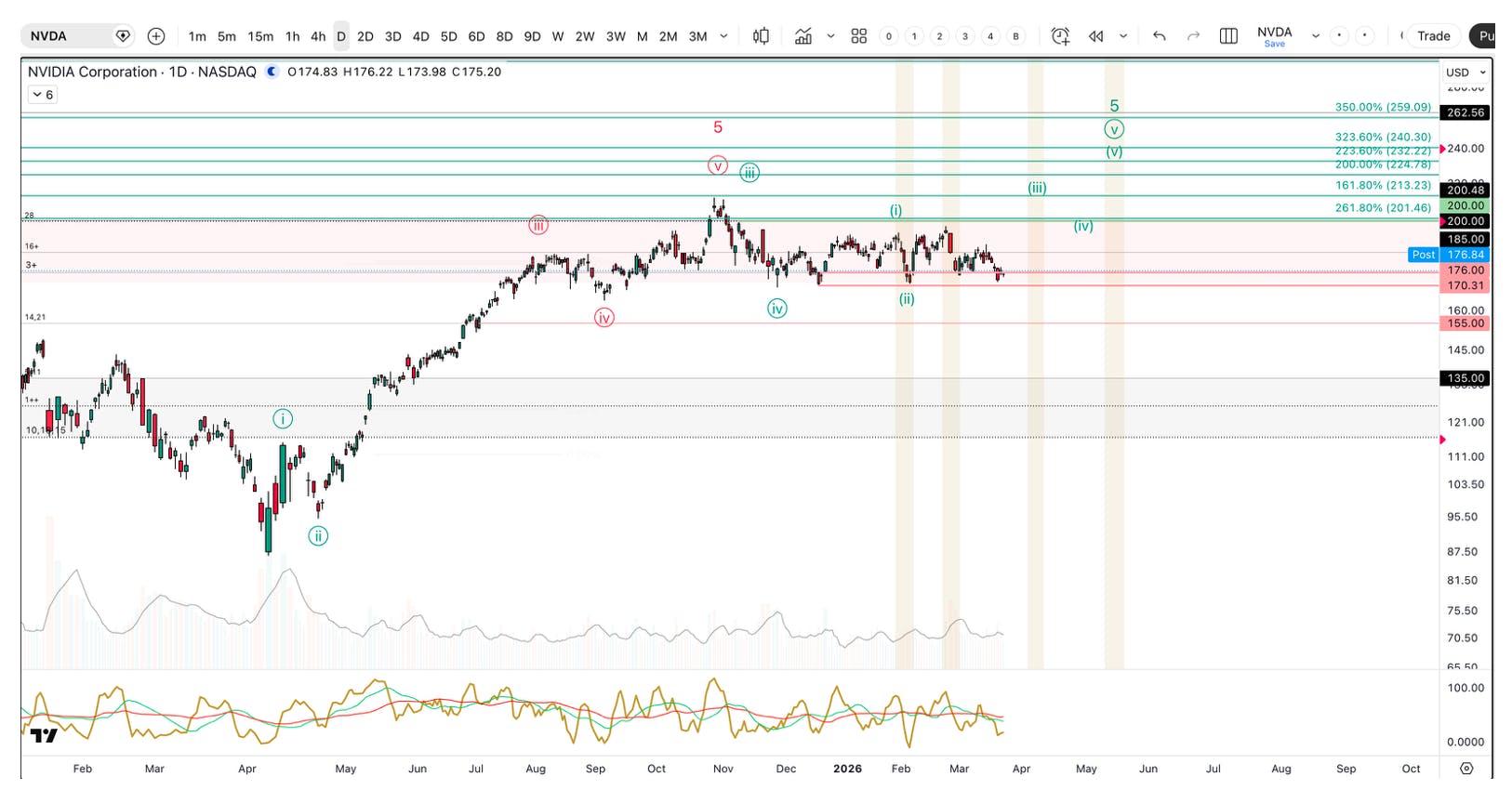
Nvidia topped in late October 2025, which was one of several occurrences that signaled growing weakness in the broader market. Since then, we have seen numerous large block trades hit Nvidia’s price while in this consolidation zone. This implies larger institutions are either accumulating a big move higher or distributing before another bout of volatility hits.
Chart showing Nvidia’s daily price action with key support near $170, Fibonacci extension targets, and Elliott Wave counts highlighting potential breakout and downside levels.
Nvidia is barely holding the lower end of this consolidation zone, and even broke minor support at $176. This is not ideal; however, final support is $170. Below this zone, and we would likely see Nvidia move toward the $155 – $135 region. If Nvidia can instead break over $200, then it would strongly suggest that it is setting up for the next leg higher.
Conclusion:
As discussed, analysts had difficulty pricing in the training market while it was in motion despite a clear product roadmap of the incoming GPU generations. Based on the history of analyst estimates being up to 4X too low 5-years out and 2X too low 1-year out for the training market opportunity, the chances that Nvidia’s inference opportunity is correctly priced in is fairly low in my opinion. This is especially true at this moment in time because inference has not made a dent yet on the return on capital for Big Tech companies. Furthermore, Groq is a recent acquisition and its impact on Nvidia’s revenue trajectory is not fully modeled yet.
That is not to say that current estimates are 4X too low, but rather that the 23% gap between current estimates of $757 billion and the $930 billion gets closed is a reasonable assumption. It’s also reasonable that if Nvidia can prove strong execution in the inference market, the company will make a case for its premium valuation again.
The I/O Fund’s portfolio is on fire this year with a lesser-known AI semiconductor stock up 170%+ YTD and another lesser-known AI semiconductor stock up 90%+ YTD. We are the team that predicted Nvidia would become the world’s most valuable company in 2019 – years before Street consensus, and we have dominated the AI trade in recent years.
In fact, our high-performing tech portfolio with cumulative returns of 326%, which would place us as #1 if we were a hedge fund and #3 if we were a tech ETF or mutual fund. To get a 60-page analysis on our Top 15 AI Stocks, sign up now.326%, which would place us as #1 if we were a hedge fund and #3 if we were a tech ETF or mutual fund. To get a 60-page analysis on our Top 15 AI Stocks, sign up now.
Please note: The I/O Fund conducts research and draws conclusions for the company’s portfolio. We then share that information with our readers and offer real-time trade notifications. This is not a guarantee of a stock’s performance and it is not financial advice. Please consult your personal financial advisor before buying any stock in the companies mentioned in this analysis. Beth Kindig and the I/O Fund own shares in NVDA at the time of writing and may own stocks pictured in the charts.