
Best Bet for Tech Stocks in 2019? Secular IaaS.
February 08, 2019

Beth Kindig
Lead Tech Analyst

If ever there was a growth story in the next 2-3 years, especially during potential economic uncertainty, then infrastructure-as-a-service (IaaS) is it. This past week, Amazon’s IaaS offering, AWS, reported sales growth of 45% from $5.11 billion to $7.43 billion, with operating income increasing 61% to $2.18 billion up from $1.35 billion. Microsoft’s IaaS offering, Azure, was up 76 percent (same as last quarter) reaching $4 billion in revenue. Microsoft’s overall commercial cloud computing revenue which includes software grew 48 percent to $9 billion. If both companies continue on this trajectory in 2019, then Microsoft will narrow its gap from 3:1 to 2:1 with Amazon.
2018 CLOUD IAAS REVENUES
$26 billion AWS
$10 billion MS
UPDATED PROJECTED 2019 if growth continues at current rate
$16 billion MS
$30 billion AWS

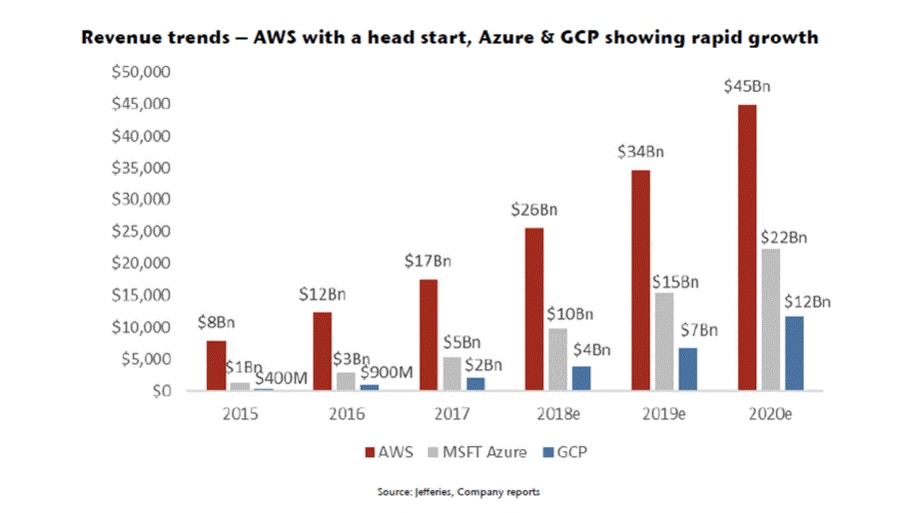
Amazon, Microsoft and Google Revenue Trend Chart
Note: I’ve written quite a bit of analysis over the last few months about the duopoly between Microsoft and Amazon. To quickly summarize, my first analysis discussed the strategic acquisition of Github. My second analysis discussed the great efforts Microsoft has put into become a serious bidder for the Pentagon contract.
Truly, there is plenty of green field for both players. The investment window for the IaaS market is far from over as it took twelve years for the IaaS market to reach $40 billion and it will take only three years to double to $80 million – and this figure is on the low end of estimates.
My newsletter subscribers get this information first. Sign up here.
Here are a few of the projections for this space from various analysts:
- Amazon’s Cloud Business could reach $71 billion by 2022 with a valuation of $350 Billion (source Jefferies – which tends to be more bullish on AWS than MS).
- Microsoft’s Cloud Business Could Be Bigger Than Windows by 2021 with $26.4 billion in revenue in 2021 fiscal year vs. $20.3 billion from Windows (source: Keybanc – most estimates on MS are low, which is why there’s still a growth story here)
- Global cloud IT market will triple between 2015 and 2020 with IaaS being the segment with the largest growth of 27% compared to SaaS growth of 18% (source: Bain and also SoftwareStrategistBlog.com)

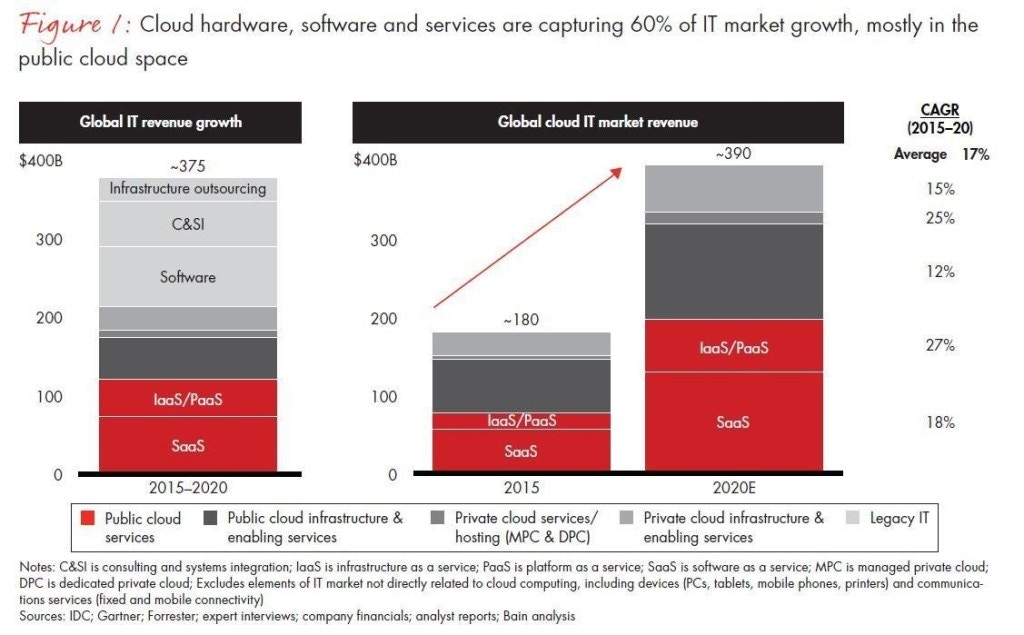
Global IT Revenue Chart Growth source: Bain Analysis
IaaS Cloud is Secular
On a micro-level, the tech industry is in a state of transition. Mobile is hitting saturation, social media faces privacy regulations, chip makers are getting hurt in the trade war, and meanwhile, 5G, artificial intelligence, and autonomous vehicles are too nascent to see returns in the near term. This is one reason I continue to hammer on IaaS as a safe, secular bet. Companies are going through a major transition right now by transferring work loads into the cloud.
As these transitions take place, IaaS will be as essential to companies as food, gas and cigarettes are to consumers. The company that has transferred to the cloud cannot exist without budgeting for this operating expense. Meanwhile, the companies who have not transferred to the cloud risk losing on competitive advantages such as artificial intelligence, machine learning, and scaling quickly through server virtualization.
As it currently stands, IaaS is Amazon’s largest revenue segment and Microsoft’s fastest growing revenue segment – although there is plenty of addressable market left for both players. Amazon’s capex spending (which includes all capex; not AWS specific) was at $14 billion in 2018 while Microsoft reported capex of $12 billion. One major drawback is that these are not pure play IaaS stocks which introduces risk from other revenue segments. You can read my follow up analysis on 6 pure play cloud stocks here.




More To Explore
Newsletter

The Case for Bitcoin to $2 Million After This Bear Market
Our latest analysis lays out how we plan to navigate the rest of this bear cycle, along with the technical roadmap to $2 million — a view further supported by what we're seeing across the U.S. dollar,

Is the AI Dip a Buy? Key S&P 500 Levels and the One Bond Market Line to Watch
In our last broad market report on June 18th, we presented a case for caution, presenting numerous warning signs that we tend to see before a correction, ranging from institutional positioning to nume
Big Tech’s AI Revenue Is Surging, but Suppliers Will Still Be the Bigger Winners
Big Tech’s AI Capex has stomped estimates for multiple years and analysts are now calling for capex to surge to $1 trillion in 2027. However, hyperscalers have long battled investor concerns around wh
AI Capex to Hit $1 Trillion – And Estimates Are Still Too Low
Big Tech capex is the driving force behind the AI infrastructure trade, yet Wall Street has repeatedly underestimated the sheer scale of the buildout. Currently, in 2026, the guidance for $732.5 billi
Token Growth is Surging - Here Are the Beneficiaries
The reality of AI demand growth has shattered early estimates for token processing, yet expectations continue moving up and to the right. In the second installment of our token processing series, we e
AI Token Demand is Shattering Forecasts
Total annual token processing is no longer measured in billions or trillions of tokens, but in the quadrillions and beyond. As annual token processing is now tracked in units with 15 trailing zeros, i

Nvidia and Google Are Crowding TSMC’s N3 Node - Can Intel Fill the Gap?
Nvidia is moving its next-generation Rubin GPUs from 4nm to 3nm, yet Google’s latest TPUs are already on N3 and are expected to remain there. Meanwhile, a growing number of AI CPUs from Nvidia, Amazon

Intel vs TSMC: How CoWoS Packaging Constraints Could Create an Opportunity for Intel Foundry
Taiwan Semiconductor (TSMC) is the single, most important company to the AI industry. However, to compete with the incumbent, Intel does not need to beat TSMC at leading-edge manufacturing. It only ne

Big Tech’s Free Cash Flow is Turning Negative – Who's Next?
Big Tech’s AI revenue is accelerating, but free cash flow is moving sharply in the opposite direction. Across Google, Microsoft, Meta and Amazon, capex is rising much faster than operating cash flow a
Big Tech Earnings Preview: Is AI Monetization Finally Catching Up to Capex?
The most pronounced difference between 2026’s tech rally compared to rallies in the past is which companies have been left out of it. The names most associated with the AI trade have hardly participat