
This article was originally published on Forbes on Sep 22, 2023,05:45am EDT
It is our stance at the I/O Fund that the stock market is not logical, rather it’s sentimental. There is no logical explanation for a stock to go up 100% or more —— only to fall 40% or more in the matter of a couple of months. Fundamentals do not change this quickly, but sentiment does. In the simplest terms, sentiment is driven by how fear and greed interrelate with supply and demand. However, the way to track sentiment to protect capital is much more complex and needs to combine fundamental analysis with technical analysis
This roller coaster ride is most evident in tech stocks, which happens to be our specialty. Therefore, we openly and frequently discuss with our free newsletter readers the importance of layering into a leading position, setting up buy plans ahead of time, and also the importance of taking gains once the technical and fundamentals get stretched.
We’ve had unwavering conviction in Nvidia’s AI story since November of 2018. In fact, it was our leading position going into 2023 and our AI allocation of 45% exceeded Stanley Druckenmiller at 29%, meanwhile, Druckenmiller was celebrated for having a leading AI portfolio. The Street is also taking credit for being early to Nvidia, which was a latecomer recommendation in March of 2023. Ark often discusses AI as a leading trend, yet almost missed this AI leader entirely. We point this out because we provided Nvidia as a stock tip for free, repeatedly, with top tier analysis delivered on Forbes and through our free newsletter, with our own capital backing the research.
The I/O Fund is a strong proponent of offering quality information at the free level. We offer top tier analysis every single week in our free newsletter, and we do not know any other top-performing portfolio that offers this at the free level in a consistent manner.
Unfortunately, free information tends to come from those who are unproven and may not be very good investors at all, while those with a proven track record keep trades close to their chest.
Not only do we actively manage every position we own and send real-time trade alerts, but we discuss openly and frequently our thoughts along the way. Our track record on Nvidia over the past 1-2 years looks like this:
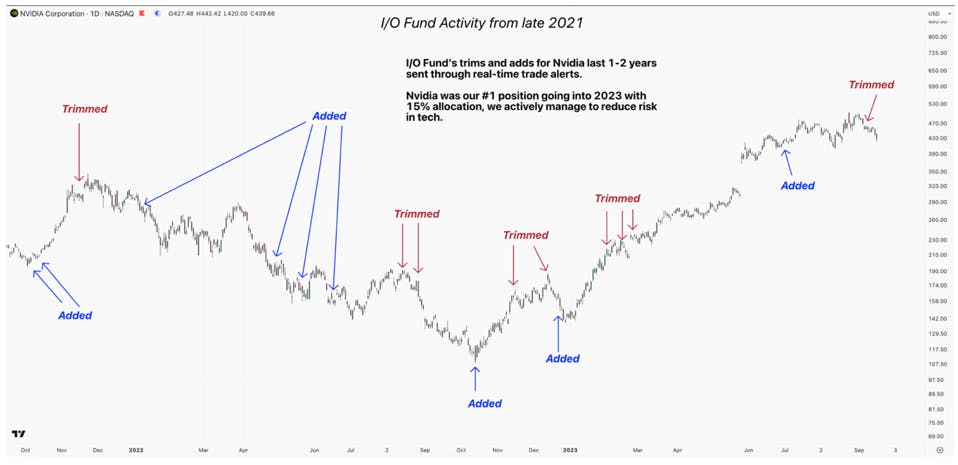
The single biggest issue individual investors face is a lack of quality information that is early, consistent, and comes with ultimate transparency around position sizing, portfolio performance, and how to handle sell-offs.
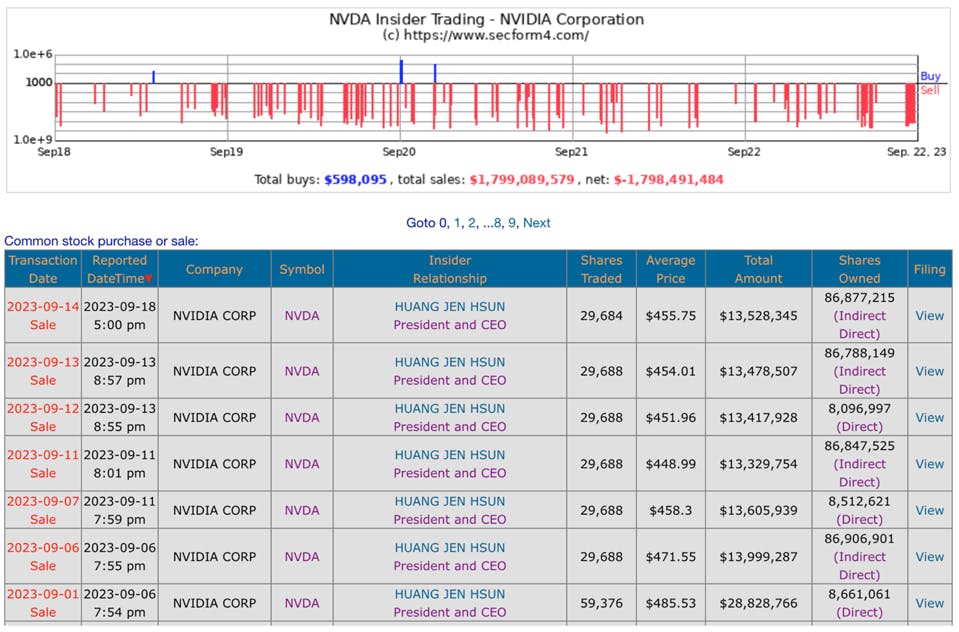
It is this last point that we’d like to discuss with you today “how to handle sell-offs.” We were considered crazy for buying Nvidia in 2022 and we are considered crazy for trimming in 2023. Yet, in what is rare transparency for the financial world, we are sharing with you our plans with this leading portfolio position.
Sign up for I/O Fund’s free newsletter with gains of up to 221% – Click here
Price Analysis
On August 28th, we put out our price analysis on NVDA. We offered two general scenarios that we see playing out, which are still very much in play today. Here is what we said back then…
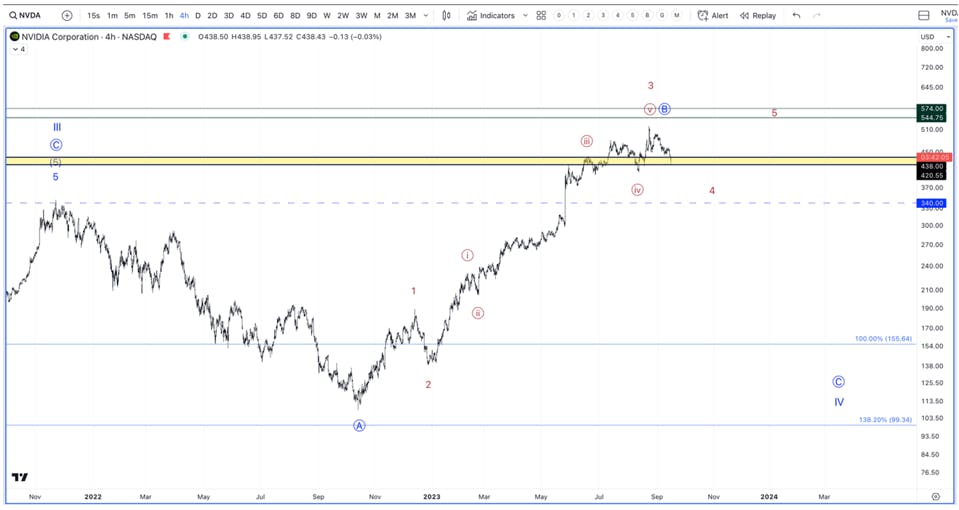
“There are two general Elliott Wave counts I’m using that represent both of these gap possibilities.
- Blue – this count has the 2022 bear market as the first leg in a large degree correction. That would make 2023 the corrective leg, with the final drop on the horizon, which would likely retest the October lows.
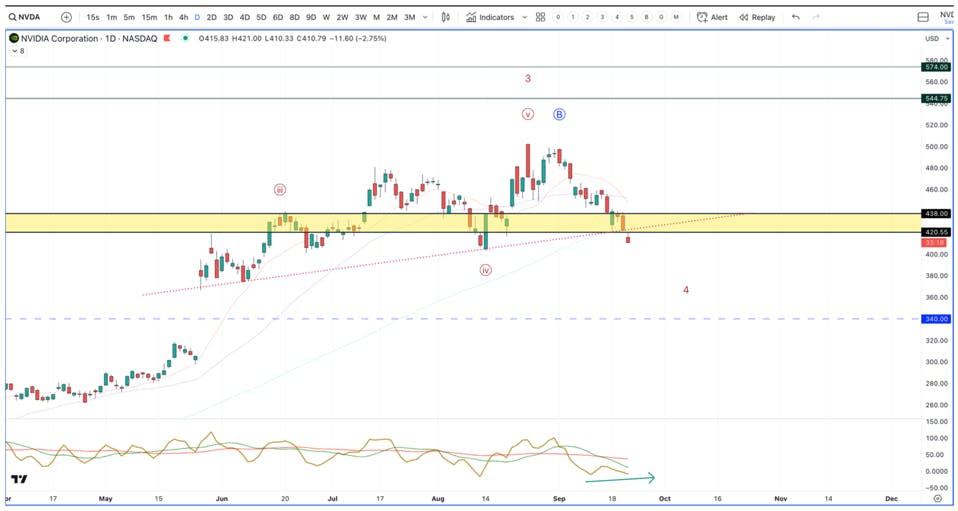
- Red – this count has us in a 4th wave correction within a larger 5 wave uptrend. This would make this current dip a buying opportunity as we push towards the $560-$590 region next.
The lowest I would allow this correction to go and still keep the red count valid would be the $340 region. If we break below $340, then the odds shift that the gap from Nvidia’s last earnings call was in fact an exhaustion gap. Our next move would be to set up downward targets to accumulate Nvidia for the long haul.”
Also, in the last report, we were looking for a breakout above $480 to signal that a low was in and we were heading towards our first overhead target around $545. We did see a breakout, but it failed to hold, which was a warning of more volatility to come. This coupled with some heavy distribution volume above the $440 price level, had us decide to take more gains in Nvidia.