This article was originally published on Forbes on Dec 27, 2023, 07:15 am EST
Ad-tech stocks have generally enjoyed strong returns in 2023, buoyed by a rather fierce tech rally. Ad spending growth showing initial signs of stabilizing in the back half of the year, with ad spend growing YoY in each month from July to October.
Ad spending growth is widely forecast to accelerate in 2024, after a bumpy start to 2023 stemming from macro uncertainty as growth forecasts were pulled lower mid-year. The market looks to be cheering on a return to higher growth in 2024, along with new synergies from generative AI advertising offerings from Big Tech and pockets of stronger growth in digital and retail media ad spend.
Lower budgets in 2022 and early 2023 affected nearly every ad-tech stock, including companies that draw audiences in the billions – on a three-year basis, only three of ad-tech’s primary names have a positive return: The Trade Desk (TTD), Alphabet (GOOG), and Meta (META), and the latter two only recently broke back into positive territory. The rest of the sector is still struggling to cope with a significant slowdown in growth, from 19.6% in 2021 to the low single digits in 2023.
Sign up for I/O Fund’s free newsletter with gains of up to 221% – Click here
Growth Forecast to Gain Steam
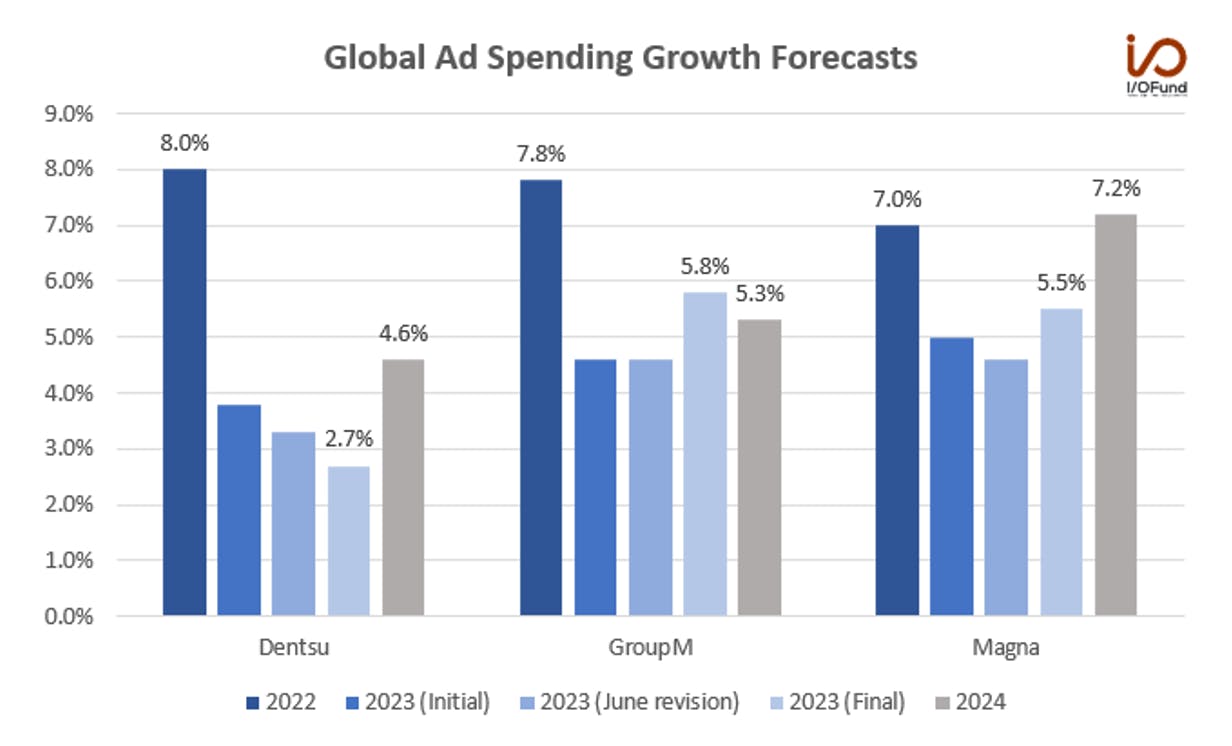
Growth forecasts from Magna, Dentsu and GroupM generally point to an acceleration next year, at around 5.7% on average between the three, compared to 4.7% in 2023.
Source: I/O Fund
Dentsu is projecting 4.6% YoY growth in 2024, almost 2 percentage points higher than its final 2.7% growth forecast for 2023. This outlook is positively impacted by stronger growth in CTV, digital and retail media ad spend. However, Dentsu sees media price inflation contributing 2.1 percentage points of growth in 2024; stripping out that effect, global ad spend is expected to increase just 2.5% YoY, a slight deceleration from 2023.
Magna tends to lean more bullish in its forecasts compared to Dentsu, projecting 5.5% growth in 2023 and a 1.7 percentage point acceleration to 7.2% in 2024. Magna’s outlook is boosted by “economic stabilization and lower inflation,” themes that have been broadly supported by a slew of macroeconomic data over the past two months. Magna and Dentsu both see positive effects from political spend, and major sporting events including the UEFA EURO 2024 and the Summer Olympics.
GroupM is forecasting a 0.5 percentage point deceleration to 5.3% growth in 2024, with this weaker outlook driven primarily by “uncertainty in some markets and interest rates.” Despite the weaker forecast, GroupM is more positive on retail media ad spend, similar to Dentsu, seeing the segment growing 8.3% in 2023.
Below, we will take a look at some of the dominant names across four major digital advertising categories: search, social media, streaming/CTV, and retail media for more color on the ad industry in 2024.
The I/O Fund provides entries and exits through real-time trade alerts for the stocks the portfolio owns. The team is ramping our analysis for our 2024 portfolio now. Learn more here.
Search Ad Spend to Decelerate, But AI Showing Promise
Search ad spending is projected to decelerate in 2024, dropping from an expected 12.5% in 2023 to a projected 9.5% next year as advertisers shift dollars to other mediums, primarily social media and CTV. Even with this deceleration, search ad spend is still projected to outpace global ad spend’s growth.
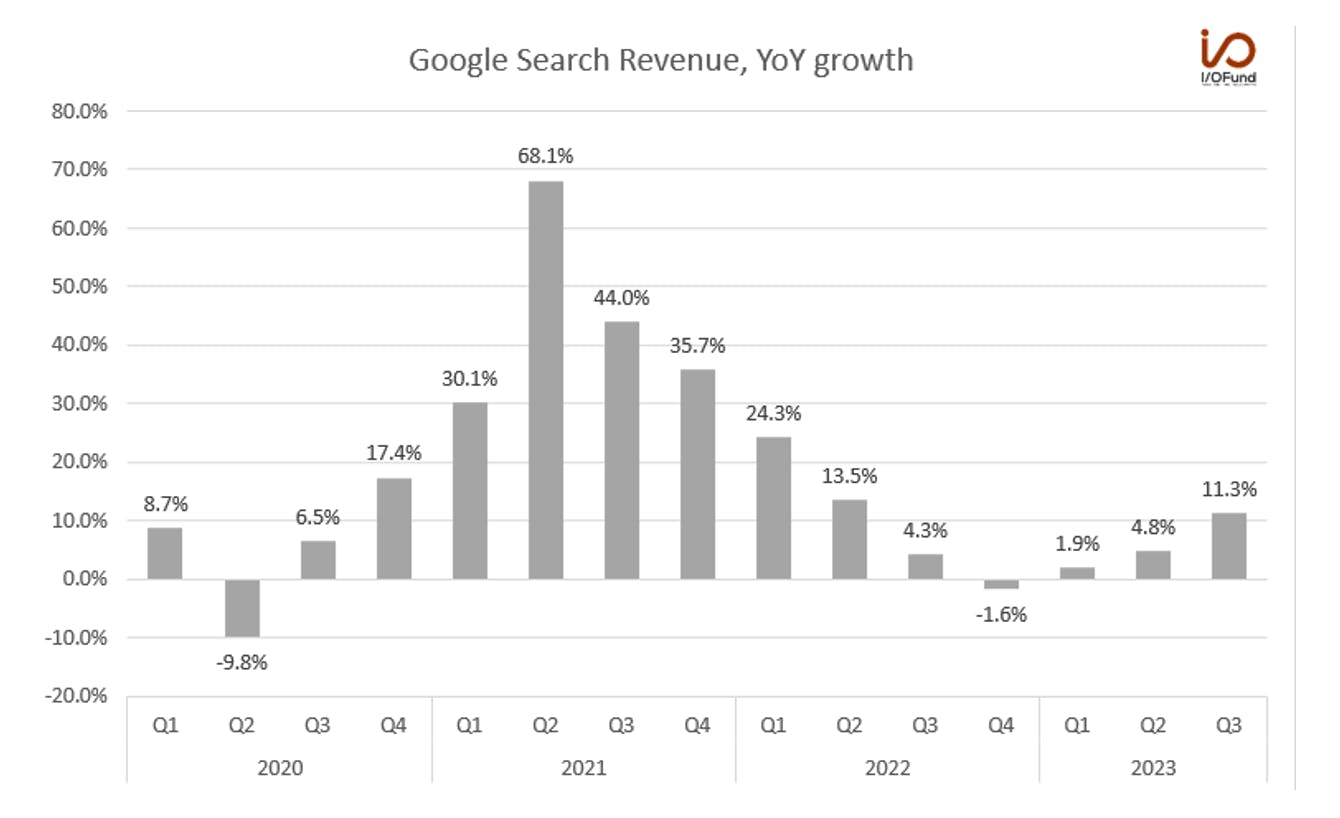
Google has seen Search revenue growth accelerate in each quarter this year, from just below 2% in Q1 to 11.3% in Q3 – the highest growth in five quarters driven by retail vertical growth. What Google is showing in Q3, and likely in a similarly strong Q4, is that AI-powered ad solutions are helping drive resilient Search ad revenue growth.
Google is rolling out AI-driven features and is now reorganizing its digital ad business to place more emphasis on generative AI and AI automated ads. SVP Phillip Schindler explains that these “proven AI-powered solutions like Search and PMax are helping retailers drive reliable, strong ROI and meet customers wherever they are across the funnel.” Increased ROI and improved targeting help keep advertisers engaged and could potentially draw some additional advertising spend to Search.
Source: I/O Fund
We discussed in the past how Google is on the precipice of a multi-decade disruption driven by generative AI: Google is showing early promise with Search Generative Experience (SGE), while Microsoft is actively deploying generative AI to search via Bing Chat.
Deploying generative AI search experiences opens the door for different ad formats and placements, as well as an increase in surfaced links and content. AI can also drive help revenues higher from bid optimization. Google’s AI campaigns, including Performance Max and Smart Bidding, are tapping AI and machine learning tools to analyze millions of data signals to better predict future ad conversions and improve bidding performance.
Today, Google dominates the search advertising market, with estimates placing the giant holding over 60% of the market, however, anti-trust risk is still present for Google as regulators seek to determine if the company has been engaging in anti-competitive behavior across its search engine and demand-side platform (DSP).
For a deeper dive into Alphabet and how the Search giant is entering its Year of Execution, read more here.
Social Media Ad Spend Remains Robust
Social media ad spend is expected to remain robust in 2024, and may potentially overtake search ad spending this year, according to estimates from WARC. This medium will enter 2024 with one of the fastest projected growth rates at +13.8%, with spend estimated to climb to $227.2 billion, or less than 1% below search advertising’s $229.2 billion.
Social media’s share of total daily time spent on the internet remains above 35%, at more than 2 hours and 20 minutes per day on average. Combine that with billions of MAUs across the most popular platforms, and it’s easy to see why social media continues to be a popular place to park ad dollars.
Meta dominates the market with more than 60% share and has shown positive trends heading into the end of 2023 that are likely to carry over into 2024. Advertising revenues rose 23.5% YoY to $33.6 billion in Q3. This was driven by 34.2% growth in Europe to $7.77 billion as ARPU rose 33.8%, and 16.8% growth in US and Canada to $15.19 billion.
Pinterest (PINS) and Snapchat (SNAP) also mirror the trend of strong European growth, with Pinterest reporting European revenues rising 33% to $618 million as ARPU increased 26% in Q3. Pinterest said that its shift to Direct Links generated “88% higher outbound click-through rates and a 39% decrease in cost per outbound click for CPC objectives” for early adopters.
Snapchat’s European revenues rose 19.6% as ARPU rose 15.3%, the slowest of the three but much quicker than its overall revenue growth of 5.3%.
Source: I/O Fund
Get Our Free Weekly Stock Newsletter
Get weekly stock insights, market analysis, and technology updates straight to your inbox.
Weekly stock insights
Market analysis
Technology updates
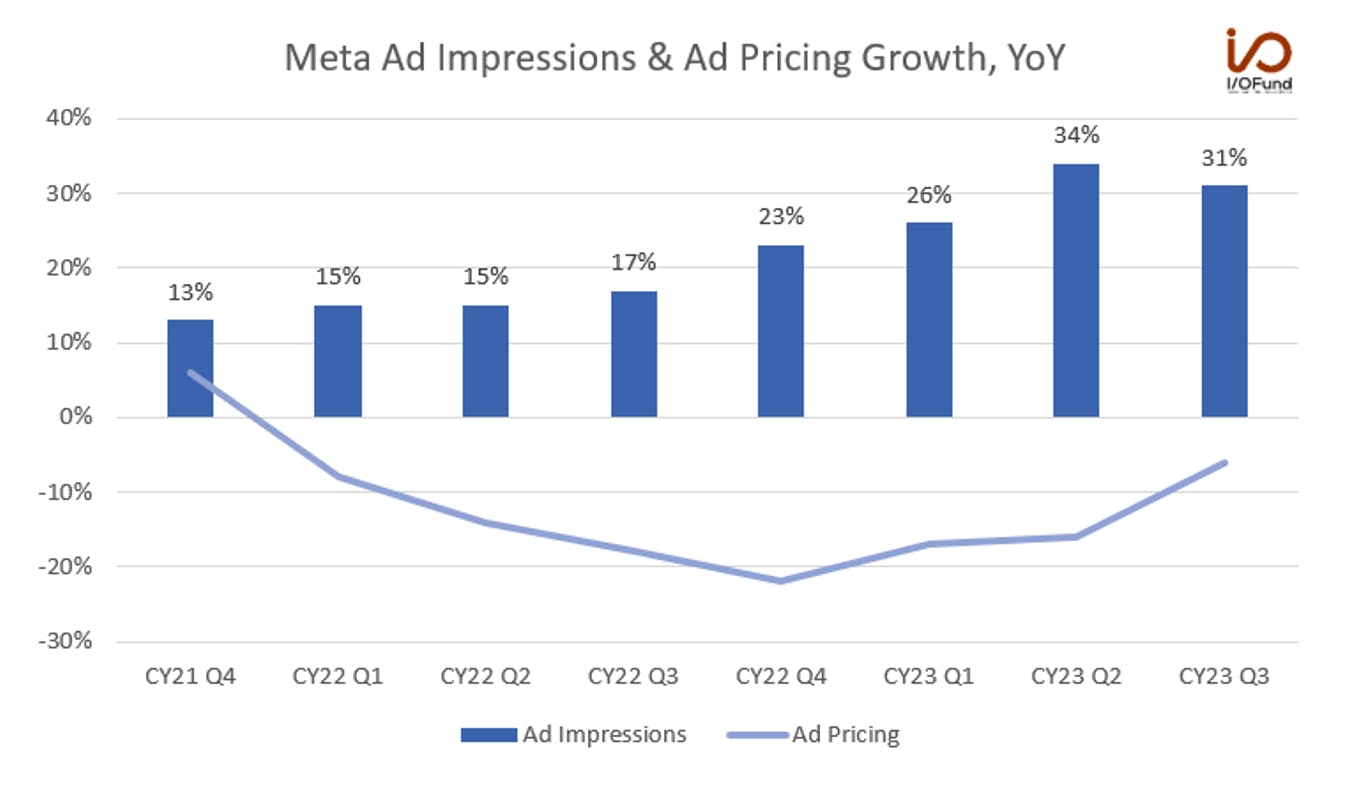
There are two factors currently driving this strong increase in revenues, especially for Meta – a surge in ad impressions to >30% YoY growth, and a recovery in ad pricing, which is nearing an inflection back to growth after declining throughout 2022 and 2023 to-date.
Engagement trends also remain positive, from both a user and advertiser standpoint. Meta noted that “AI-driven feed recommendations continue to grow their impact on incremental engagement,” driving a “7% increase in time spent on Facebook and a 6% increase on Instagram” this year.
Every Thursday at 4:30 pm Eastern, the I/O Fund team holds a webinar for premium members to discuss how to navigate the broad market, as well as various stock entries and exits. We offer trade alerts plus an automated hedging signal. The I/O Fund team is one of the only audited portfolios available to individual investors. Learn more here.
Streaming/CTV to See Double-Digit Growth
With 91.8% of internet users between ages 16 to 64 watching content via streaming services, it’s easy to see why advertisers are favoring CTV and YouTube over linear TV. CTV ad spend has risen 400% since 2019, as use of streaming services surged through 2020 and 2021, while linear TV spend has been declining. CTV ad spend is forecast to be the fastest growing channel next year – Dentsu places growth at 30.8%, while BIA expects growth as high as 39.5%.
Major streaming providers had expanded into ad-supported tiers, which are demonstrating both strong growth and strong ad revenue generation. Netflix’s ad-supported tier accounted for 30% of all sign-ups in September and now accounts for ~6% of all US subscribers, per Antenna.
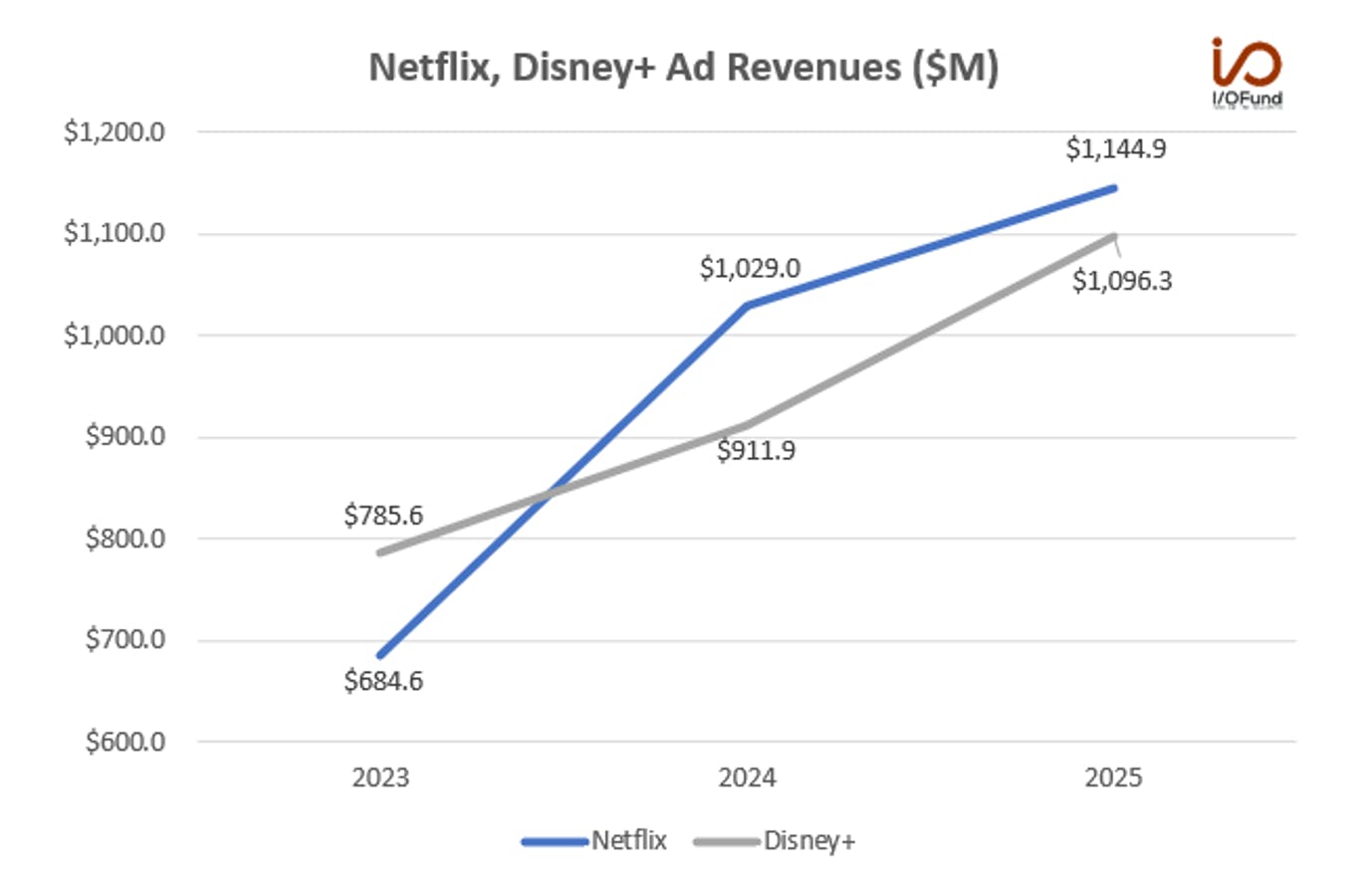
Netflix is projected to reach $1.03 billion in ad revenue in 2024, an estimated 50.3% increase from ~$684.6 million in 2023, according to Insider Intelligence.
Disney+ is expected to see a slower ramp in ad revenue, with a projected 16.1% increase to $911.9 million in 2024 followed by a 20.2% increase in 2025.
Amazon is rolling out its ad-supported Prime Video tier next year, and is projected to generate $3.13 billion in CTV ad revenue, topping Roku to become the third-largest CTV ad platform.
YouTube is also sharing in these gains, with ad revenues rising 12.5% to $7.95 billion in Q3, the fastest growth rate in six quarters.
Source: I/O Fund
Although Roku saw strong contributions from video advertising, it added a bit a caution on the market, saying that the “macro environment continued to pressure the overall U.S. advertising market” in Q3. Roku sees video ads continuing this trajectory in Q4 as it witnesses positive ad momentum driven “in part by diversifying demand sources of advertisers on our platform and expanding partnerships.”
The Trade Desk CEO Jeff Green summed up the CTV opportunity perfectly: “‘Executives at every major streaming giant with both an ad-supported and an ad-free tier, (including Disney, Netflix, Paramount, Warner Bros Discovery and NBC Universal) say that total revenue per user is higher on the ad-supported plan than it is on the ad- free plan.’ Not only do media companies generate more revenue per user within an ad supported option, but the potential for growth is much greater. Ultimately, there’s a limit to how much viewers will spend on subscriptions. Economic pressures on the consumer, right now, are increasing the appeal of a free or low-cost option, that is supported by ads. However, this model is only sustainable if the ad load is significantly lower than traditional linear TV. And the only way we get there is if the ads are relevant to the viewer, so that advertisers are willing to pay more for each of them.”
Retail Media Emerging as One of the Fastest Growing Categories
Retail media ad spend is quickly emerging as one of the fastest growing digital ad categories — US retail media ad spend is forecast to grow nearly 23% next year to more than $55 billion before almost doubling by 2027. Globally, retail media ad spend is expected to increase 10.4% to $141.7 billion, driven by this US growth. Amazon and Alibaba are a dominant duo in this market, with nearly 70% estimated share in 2023, but Walmart, Etsy, eBay and other retailers and e-commerce platforms share in the gains.
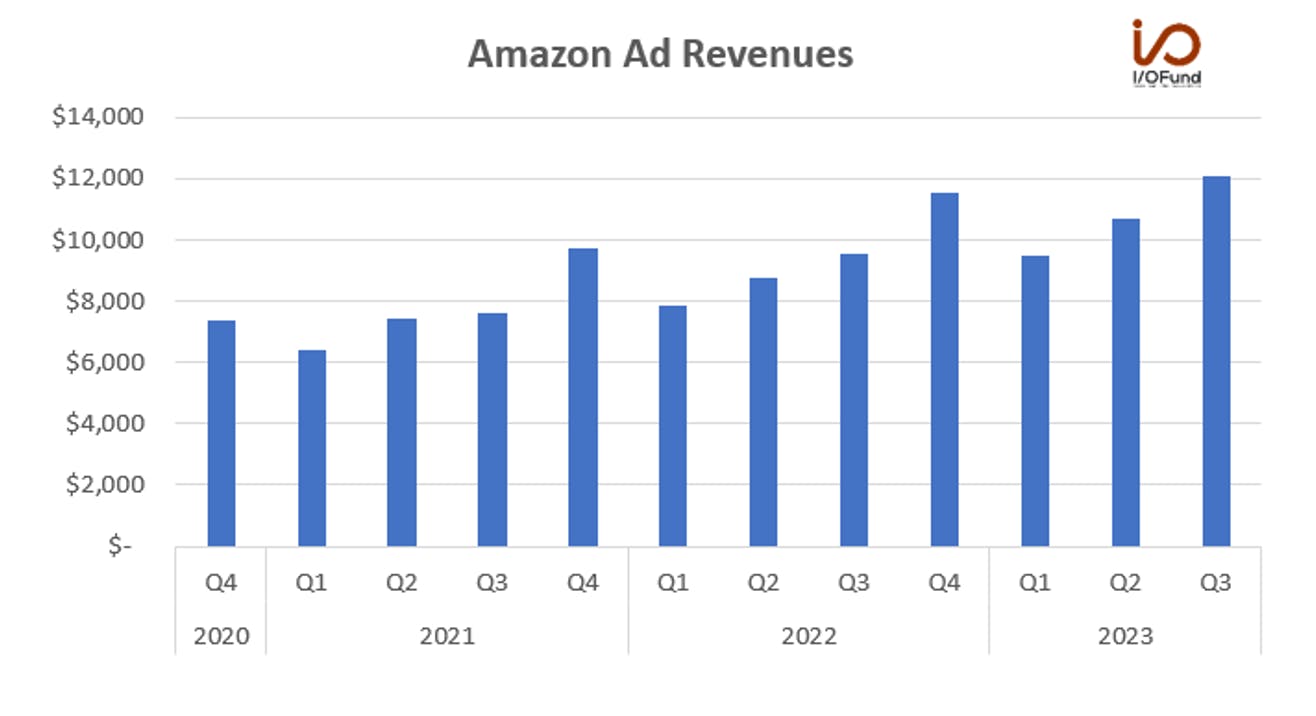
Retailers and advertisers are prepping for a longer and stronger holiday season, with holiday spending on the rise despite weaker consumer sentiment. Amazon is “still seeing a lot of strength in the lower-funnel ad products like sponsored products,” even as companies remain a bit more cautious on upper-funnel ads such as display and video.
Amazon’s ad revenues grew 26% YoY in Q3 to more than $12 billion, setting up for a potential $14 billion quarter in Q4 with supporting seasonal strength. For 2024, Amazon is expected to drive a majority of the market’s growth, as it is forecast to see ad revenues rise 16.7% from $45.4 billion to $52.7 billion. Amazon’s Q4 and Q1 ad revenue growth will give a clue into how retail ad spend growth may unfold.
Source: I/O Fund
Other benchmark companies are showing similarly strong trends: Meta noted that its “online commerce vertical was the largest contributor” to growth in Q3, while its AI tools for Advantage+ shopping campaigns “reaching a $10 billion run rate” with more than half of its advertisers using those tools.
2024 Outlook
2024 is widely expected to see an acceleration in ad spending, with major sporting events and political spend aiding the growth forecast. Retail media is expected to see 23% growth in the United States as it begins to shift to other mediums. CTV’s rapid growth outlook of 30% to 40% is boosted by major streaming media companies introducing ad-supported tiers. CTV ads are currently expected to be the strongest growing segment of the four covered here.
Although search ad spending is forecast to soften, Google’s reorganization of its digital ad business to further integrate and utilize generative AI shows promise in reinvigorating growth. Social media ad spend remains robust, and improving pricing trends combined with strong impression growth and AI opportunities could send growth higher next year.
Macro uncertainties are not completely out of the picture. 2022 and early 2023 saw ad-tech stocks get pummeled as growth slowed dramatically from macroeconomic headwinds, so a resurgence of economic growth concerns and any potential budget optimization trends among major advertisers could dent the strong returns enjoyed by a plethora of ad-tech stocks this year. What’s most important to remember is that ad spending can be paused very quickly or resumed quickly, and so this sector is known for sharp moves. We continue to monitor this sector as we build our 2024 portfolio.
I/O Fund Equity Analyst Damien Robbins contributed to this report.
Please note: The I/O Fund conducts research and draws conclusions for the Fund’s positions. We then share that information with our readers. This is not a guarantee of a stock’s performance. Please consult your personal financial advisor before buying any stock in the companies mentioned in this analysis.
Beth Kindig is the lead tech analyst for the I/O Fund with audited results that beat Ark in 2020 and returns of up to 1700% on her premium site in two years and 1150% in her free newsletter in three years on individual stocks and assets.