Blogs -AMD, Nvidia, Arm, Intel: Inside the $120 Billion CPU Gold Rush

AMD, Nvidia, Arm, Intel: Inside the $120 Billion CPU Gold Rush


June 05, 2026

author

Beth Kindig

Lead Tech Analyst

Three months ago, GPUs were all the rage, and the idea that CPUs could challenge GPUs when it comes to AI budgets was unfathomable. The shift in this perception is evident not only in management commentary, but also in CPU design companies and OEMs raising forecasts that are now 2X+ higher, as many of the largest players have stated they did not foresee the magnitude of the surge in CPU demand from agentic AI. 

In just six months, AMD has issued a massive increase to its server CPU market forecast, nearly doubling its expected CAGR to 35%—estimating that the market will eclipse $120 billion by 2030. Arm made a similar announcement in March, projecting that the total addressable market (TAM) for data center CPUs will grow to over $100 billion by its fiscal year 2031 (roughly calendar year 2030). This would represent a more than 4X increase over its current TAM estimate of $24 billion, equating to a 33% CAGR. 

An important shift is driving these forecasts as the AI market transitions away from chatbots, which saw a CPU-to-GPU ratio that was heavily weighted toward GPUs from 2023-2025. As we move into agentic AI, an Intel and Georgia Tech paper has stated that “tool-dominated agentic AI workloads are significantly bottle-necked" with CPUs consuming up to 88% of the end-to-end latency. The paper further concludes that “with better quality GPUs, the bottleneck can swiftly shift more towards CPUs.” 

What Intel and Georgia Tech are referring to, is that to scale agentic AI efficiently, CPU orchestration capacity will need to catch up to GPU reasoning capacity to minimize latency and prevent GPU underutilization. The answer to this problem is increasing the CPU-to-GPU ratio in AI clusters to keep token costs down.  

Below, I break down why CPUs are positioned to take a larger share of AI cluster bill of materials (BOM) and the explosion in demand we are already seeing. I examine server CPU forecasts that indicate this market will continue to grow rapidly over the coming years. Lastly, I look at the competitive dynamics and key players in this space, and how Nvidia is playing both sides of the CPU-GPU equation, and what front runners Intel and AMD are doing to maintain their lead.  

Ultimately, CPUs have gone from an afterthought to becoming the AI trade’s next great bottleneck – and with AMD, Nvidia, Arm and Intel circling a market that is doubling nearly overnight, the only question left is which company walks away with the lion’s share.

Why Agentic AI Is Driving a Massive Shift to CPUs 

Agentic workloads are structurally different from non-agentic workloads like chatbot queries, which is what has dominated the AI trade up to this point. Chatbots respond to simple requests and provide an output, moving at the pace of the human on the other side. Agents are far more complex, handling hundreds of concurrent tasks autonomously and reasoning through a problem to reach a conclusion, often with limited direction from humans. 

The Intel and the Georgia Tech paper highlights why CPUs are becoming increasingly important as agentic AI proliferates. Researchers noted that while CPU-GPU systems are needed to serve the diverse responsibilities of agents, the “majority of the external tools responsible for agentic capability either run on or are orchestrated by the CPU.” This is not the case in non-agentic workloads, where GPUs are the workhorses that CPUs feed data to. 

Why CPUs Handle Orchestration in AI Workloads 

The key bottleneck this creates on AI infrastructure is orchestration—or the need to call tools, direct API requests, and coordinate tasks between dozens of independent agents. Orchestration is where CPUs thrive. GPUs continue to handle inference reasoning, but CPUs tell GPUs where, when, and how to allocate their resources. 

As AI progresses over the next few years, inference demand is expected to explode—largely driven by agentic AI. Goldman Sachs estimates that by 2030, agentic AI will drive a 24X increase in total token consumption versus today to 120 quadrillion tokens per month. Its forecast shows agentic workloads accounting for over 80% of token consumption in 2030—dramatically higher than their share today.

mid

TrendForce notes that today, the CPU-to-GPU ratio in AI data centers sits between 1:4 and 1:8. For agentic AI applications, TrendForce sees the CPU-to-GPU ratio moving “to between 1:1 and 1:2, significantly boosting market demand for CPUs.”

Other forecasts, like those from Arm, rely on the CPU core count per GW metric. This measures the number of CPU cores per unit of data center power, regardless of the discrete number of CPUs. It is the more accurate way to measure the shift in CPU demand as chip density is increasing, with upcoming generations featuring higher core counts per chip. 

Notably, Arm CEO Rene Haas sees agentic AI driving CPU core demand as much as 4X higher to 120 million cores per GW, compared to around 30 million cores per GW today. Aside from the raw increase in core demand, packing more cores into each chip is a margin expansion opportunity for CPU designers. 

CPU Shortages: Supply Constraints and Pricing Power 

We are already seeing the CPU bottleneck start to play out through worsening CPU server shortages. Reuters reported in February that Intel has a substantial backlog of unfulfilled CPU orders, and that delivery times stretch as long as six months. It also noted delivery times for some AMD products of between eight and ten weeks. KeyBanc issued upgrades on Intel and AMD in January, noting that both firms were nearly sold out of CPU servers for 2026. At the time, KeyBanc noted ASP increases of 10% to 15%. 

Intel and AMD Backlogs and Lead Times 

It appears that the situation has become even more dire since, based on several reports from late May. Reuters now says that TikTok parent company ByteDance is working to accelerate its in-house CPU efforts, as Intel and AMD have raised prices by between 10% and 35% QoQ. ByteDance’s move suggests that it sees a prolonged CPU shortage, leading it to lean into this early-stage initiative. This adds weight to the structural increase in CPU demand implied by AMD’s forecast and shows the pricing power that CPU vendors are exerting.

Electronic equipment distributor Fusion Worldwide says that Intel distributors are only fulfilling around 40% of their yearly backlog allocations. It highlights lead times of 8 to 22 weeks domestically, with Asian customers waiting as long as 8 months. Overall, the firm estimates that Intel is under-shipping real demand by 20% “at best." It notes that AMD’s EPYC CPUs are effectively sold out in 2026, with delivery windows stretching more than 30 weeks. 

The Elec, a South Korean electronics industry trade publication, notes won-denominated price increases as high as 3X for some x86 (Intel and AMD) CPUs. This comes as Intel and AMD prioritize supply for U.S. hyperscalers—leaving little capacity for other customers. The Elec also said that the expected timeline for mass production of Intel’s next-gen Xeon 7 “Diamond Rapids” CPU has been delayed, moving from the second half of 2026 to the middle of 2027.

This data points to a shortage that is intensifying, putting pricing power into the hands of CPU vendors as they seek the highest-margin opportunities. 

AMD Sees Record CPU Server Sales, TAM Estimate Doubles to $120B 

The cause of these shortages is the rapid growth in server CPU demand seen at top players like AMD, and expectations that this market will grow much faster than it traditionally has over the coming years. AMD released its Q1 2026 results in early May, posting its fourth consecutive quarter of record server CPU revenue. Sales rose more than 50% YOY, with both cloud and enterprise end markets up over 50%. AMD expects growth to accelerate significantly in Q2, projecting server CPU revenue growth above 70% YOY, “with robust growth continuing through the second half of 2026 and into 2027.” 

Citing this acceleration in demand and the structural increase on CPU compute requirements that agentic AI is putting on data center infrastructure, AMD has doubled its server CPU TAM estimate. Per CEO Lisa Su, the company anticipates that this will be an over $120 billion by 2030—growing by a 35% CAGR. In November, AMD’s server CPU growth TAM CAGR forecast was just 18%. AMD’s decision to double its market growth forecast and add $60 billion to its TAM in just seven months demonstrates how rapidly current demand signals are translating to long-term confidence among industry leaders. 

Beth Kindig of the I/O Fund discussed in 2024 why AMD would be a winning AI stock and surpass Nvidia's returns over a 3-year time frame. Since then, Nvidia returned 80% and AMD has returned 220%

Thinking about margins going forward, AMD noted at the Bank of America 2026 Global Technology Conference that two-thirds of its server CPU growth in Q1 and expected growth in Q2 are coming from unit increases. Thus, units rather than ASPs are the primary growth driver. Given the worsening supply and demand gap, it’s possible that ASPs could drive an increased share of growth—providing a further lever for margin expansion. 

Server CPU Market Growth Forecasts Surging TAM 

Notably, server CPU TAM forecasts among several Wall Street banks line up with AMD’s forecast. For reference, AMD’s forecast implies a 2025 TAM of just under $27 billion. 

UBS projects that the market will grow from $31 billion in 2025 to $170 billion in 2030, or a 40.6% CAGR. It sees AI CPUs driving the vast majority of this growth, with the TAM increasing from $7 billion to $125 billion, or an 88% CAGR. Their forecast also includes a 56% increase in AI CPU ASPs over this period—implying a significant margin expansion opportunity. 

CPU TAM Revised Higher by Analysts 

Bank of America forecasts a TAM expansion from $43 billion in 2026 to $125 billion in 2030, or a CAGR of 30.6%, recently raising its 2030 estimate from $110 billion. While BofA’s growth rate is lower than AMD’s, this is likely because it accounts for the particularly high growth rates already being seen in 2026. 

Citi breaks down its forecast into three buckets: general purpose CPUs, AI head nodes, and agentic CPUs. It sees the overall market growing from $29.3 billion in 2025 to $132 billion in 2030, or a 35% CAGR. Within this, general purpose CPUs grow by a 20% CAGR to $50.9 billion, and AI head nodes grow by a 21% CAGR to $21.1 billion. Citi estimates that agentic CPU growth will drastically outpace the rest of the market, hitting $59.4 billion in 2030 for a massive 185% CAGR. Overall, the estimates from these three banks circle around the 35% CAGR that AMD outlined. 

Why Growth Rates Are Unprecedented for CPUs 

These very high CAGR forecasts highlight why server CPU shortages are escalating. This market has historically experienced single-digit annual growth rates. Thus, the supply chain was not necessarily prepared for a scenario where customers suddenly look to procure CPUs at a drastically higher pace, and long-term expected growth rates soar in a matter of months. 

AMD’s Goal: 50% Server CPU Market Share 

As AMD looks to increase its share of the CPU market to over 50% by 2030, it is targeting all three of the CPU categories Citi described. This will come through its Venice family of EPYC CPUs, including Verano, its first EPYC CPU purpose-built for AI infrastructure. AMD has begun to ramp production of Venice, while it plans to launch Verano in 2027. 

With this, AMD clearly expects CPUs to be a core growth driver over the coming years. If AMD achieves a 50% market share in the server CPU market, it would imply $60 billion in annual revenue. With server CPUs representing around half of data center revenue, this side of AMD’s business generated approximately $2.9 billion in revenue last quarter, or nearly a $12 billion run rate. Thus, hitting its $60 billion target would require a 5X increase in server CPU sales by 2030—an ambitious goal.

AMD vs Intel: x86 Market Share Dynamics 

There are two ways to think about market share in server CPUs. Mercury Research is one of the key authorities that estimates share in this space, with their estimates often centered around the x86 market. 

AMD is already very much in range of a 50% market share within x86. At its Investor Day, AMD noted that based on metrics from Mercury Research, its share of the server CPU market was around 40%. This lines up with Mercury’s estimate of AMD x86 market share of 41% at the time. Since then, AMD has gained considerable ground on Intel. Mercury Research estimates that AMD controlled 46.2% of x86 server CPU revenue share in Q1 2026 to Intel’s 53.8%. At this pace, AMD is well on its way to achieving a 50% market share in x86.
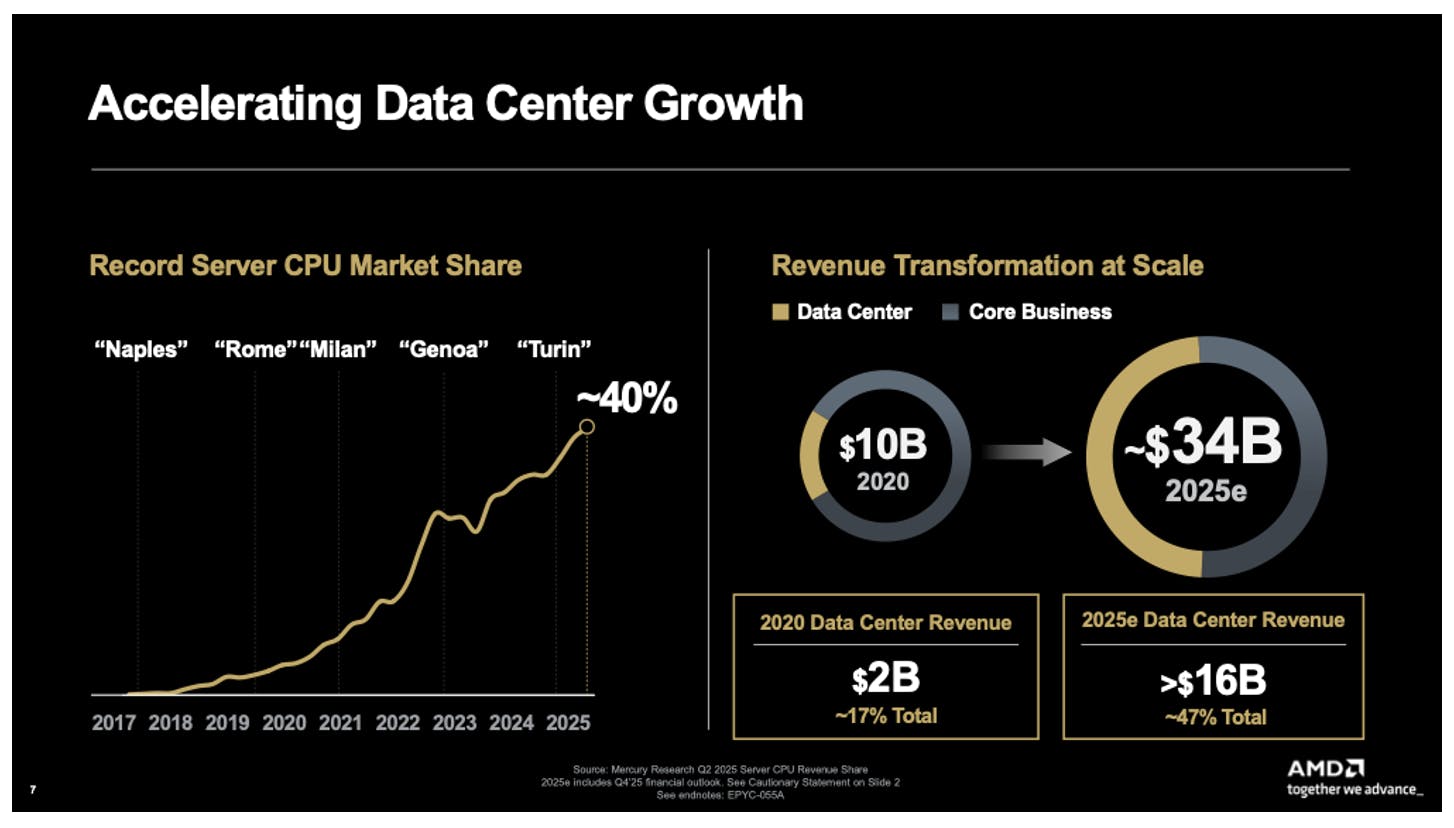
AMD data center revenue growth and server CPU market share approaching 40 percent shown at Investor Day 2025

At Investor Day 2025, Lisa Su said AMD has a clear path to capturing more than 50% of server revenue market share, up from 40% today, alongside a 50% data-center CAGR and a goal of 40% PC revenue share.

AMD, Intel and Arm Market Share Dynamics 

Arm estimates that in terms of chip value, it held 20% of the cloud compute market share at the end of its fiscal year 2025, which ended in March 2025. Considering Mercury’s estimates on x86, or the 80% of the market that is not Arm-based, these figures imply overall market shares of 43% for Intel, 37% for AMD, and 20% for Arm. However, note the figures from Arm are stale. 

Thus, AMD would need to increase its market share by around 2.6% annually through 2030 to achieve its 50% goal. At least in the x86 market, AMD has cleared a much higher bar over the past several years. In Q2 2023, the company’s server CPU revenue share was just 25.1%, meaning that AMD increased its share of the x86 market by more than 7% annually through Q1 2026.  

While this historical pace is encouraging, it shows AMD’s progress only against Intel—not including Arm’s traditional IP business, nor its move to become a CPU designer through its Arm AGI CPU. Additionally, Nvidia is pushing more aggressively into the CPU market, largely through its standalone Vera racks. However, the Diamond Rapids delay is one factor that could give AMD a leg up in continuing to take share from Intel. 

AMD has its hands full as some of the world’s strongest IP and chip-design companies are targeting the same TAM – including the incumbent Intel, mobile-IP superstar Arm, and the newest entrant, Nvidia. 

Nvidia’s CPU Strategy: Expanding Beyond GPUs 

Within AI-specific infrastructure, CPUs have been traditionally deployed as AI head nodes paired with GPUs in the same rack. A critical development to track is the emergence of standalone CPU racks as this marks a significant shift in architecture.  

Customers will increasingly be able to deploy full CPU racks independently without automatically having to increase GPU counts—one of the key arguments for why CPUs can increase their BOM share in AI clusters. 

Nvidia Vera Standalone CPU Rack Overview 

For example, Nvidia’s Vera rack marks the first time that it will market a standalone CPU rack; a clear signal of the current opportunity in this space. With 256 CPUs in the standalone Vera rack, customers can deploy nearly 7X more CPUs in one rack compared to the 36 CPUs in the Vera Rubin NVL72, which also contains 72 GPUs. Total CPU cores sit at 22,528 for the Vera rack versus 3,168 for the Vera Rubin NVL72. Note that Vera is based on Arm architecture, rather than x86 architecture. 

Arm specifically mentioned the standalone Vera rack as a reason why its 4X CPU core count growth estimate is likely conservative. Arm CEO Rene Haas said, “we probably have undercalled the CPU demand in terms of the transition here. We talked about a 4x increase. We could get our heads around a bigger number than that.”  

Haas went on to say that the number of CPU cores “probably will” exceed the number of GPU cores, even though the number of CPU chips may not exceed the number of GPU chips. 

Nvidia Quickly Eclipses AMD with $20 Billion in CPU Revenue in 2026 

Importantly, Nvidia said on its latest earnings call that the Vera rack opens up a $200 billion CPU TAM for the company—dramatically larger than AMD’s +$120 billion estimate. Within this, Nvidia says it has visibility into generating nearly $20 billion in CPU revenue this year, primarily for standalone Vera racks. Meanwhile, about 50% of AMD’s data center revenue comes from server CPUs, putting this at $2.9B or about a $12B run rate. I expect that to change but allows for a baseline comparison, which is that Nvidia is entering the market aggressively. 

When asked whether CPUs are cannibalistic to GPUs, Nvidia CEO Jensen Huang did not offer a direct yes or no, but framed CPUs as additive to GPUs. He argued that more AI agents require more orchestration—increasing CPU demand—but that more agents also require more inference—increasing GPU demand. This lines up with AMD CEO Lisa Su’s statements that CPUs are largely additive/incremental to their overall TAM.  

Additionally, the standalone Vera rack is just one of four ways that Nvidia targets the CPU market—and is the only one that could substantially change its current CPU-to-GPU ratio. Its other markets include selling head node CPUs paired with Rubin GPUs at a 1:2 ratio in the Vera Rubin NVL72. Nvidia also sells Vera alongside its ConnectX-9 SuperNICs for both storage and confidential computing use cases. 

Still, with the standalone Vera rack, Nvidia is indicating that it expects the CPU-to-GPU ratio to shift—creating a need for the product. Ultimately, while the mix of AI BOM should move toward CPUs, Nvidia is still positioned to capture growth from both chip types. It can benefit from the increasing size of the overall pie, rather than CPU spending going up at the expense of GPU spending. 

Arm Makes Historic Move into Merchant Standalone CPU Racks 

Arm is also forwarding the CPU rack approach through its AGI CPU. Leveraging Arm’s history of delivering high performance with low power requirements for mobile devices, the new AGI CPU is designed to offer a similar balance between high performance and low power consumption. 

The AGI CPU was co-developed with key partner Meta, the chip’s first customer, who revealed they turned to Arm almost two-and-a-half years ago to see if there was a CPU option that fit Meta’s needs: “put in a lot more cores per watt, but we do not want to compromise on the performance piece.” Meta had only been finding options satisfying one of the two criteria: meeting the performance but with too much power, or meeting the power but with too little performance. 

Arm CPUs Deliver Higher Performance Per Watt vs x86 

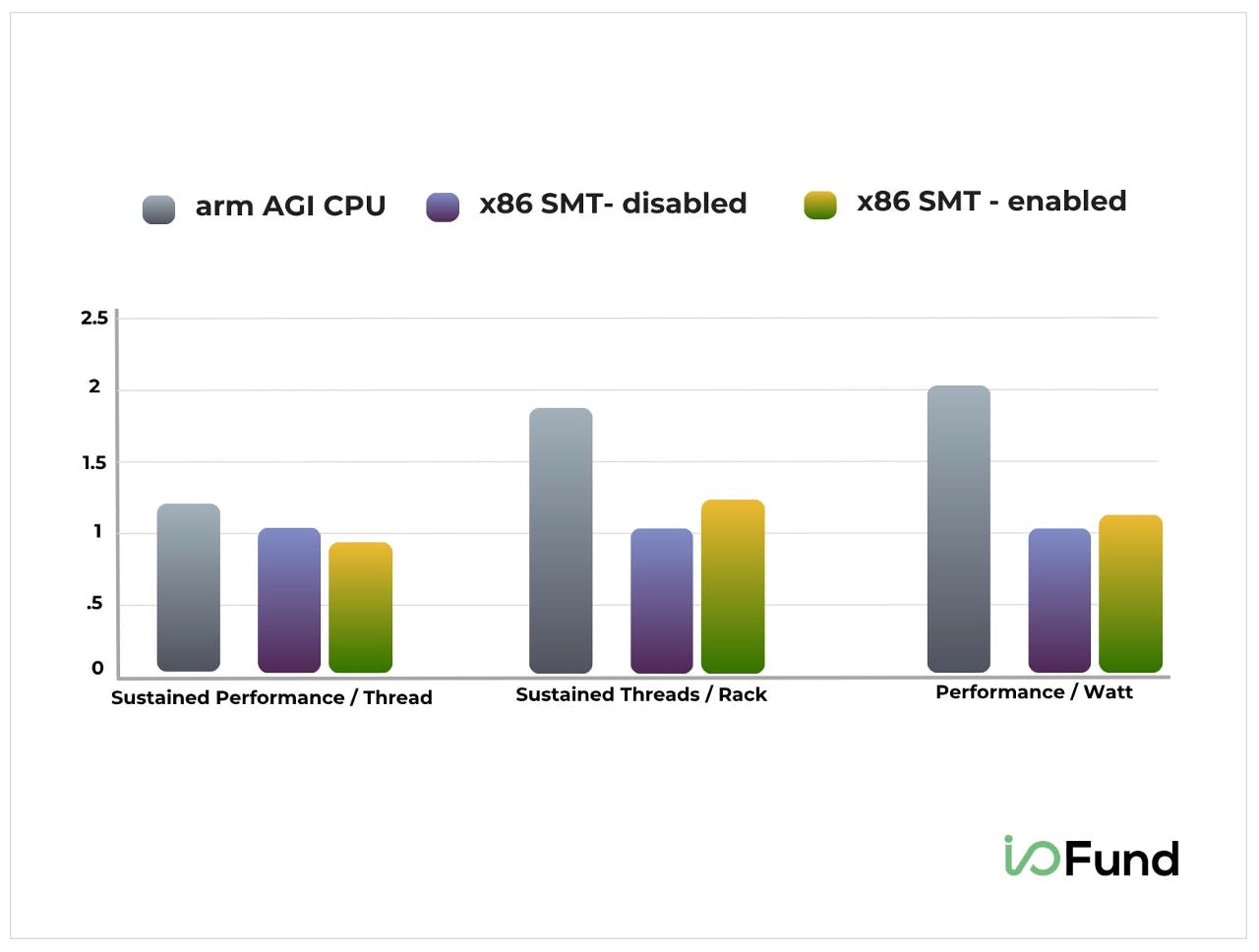
One of the main advantages that Arm touts is higher performance per watt. Based on internal estimates, the firm says the Arm AGI CPU can provide up to 2x greater performance per watt vs. Intel and AMD’s x86.  

Higher performance per watt is a key value proposition for hyperscalers, allowing more power to be dedicated to compute or networking equipment. 

Bar chart comparing Arm AGI CPU and x86 CPUs (with and without SMT) showing higher sustained performance per thread, threads per rack, and performance per watt for Arm in AI workloads

Bar chart comparing the performance of Arm’s AGI CPU against x86 CPUs (with SMT enabled and disabled) across three metrics: sustained performance per thread, sustained threads per rack, and performance per watt. Arm’s AGI CPU leads in all three categories, with roughly 1.2× higher performance per thread, up to 1.8–2.0× higher thread density per rack, and approximately 2× better performance per watt--highlighting Arm’s efficiency advantage in AI data center workloads, particularly for agentic AI applications where CPU orchestration, scalability, and energy efficiency are critical. Source: Arm 

For more details on Arm, see my analysis from April: Arm Stock Could Win as Agentic AI Shifts the Bottleneck to CPUs 

In an air-cooled rack, Arm can pack 30 blades (or 60 CPUs) for a total of 8,160 cores in a 36kW power envelope, saying this configuration can deliver up to 2X the performance per rack versus x86 chips based on its internal estimates. Arm says this 30-blade design is “setting records for air cooled” racks that is not feasible with other systems, as power consumption is too high. 

Arm is taking this a step further with a fully-liquid cooled, 200kW open-standard rack in partnership with Super Micro, packing 168 blades, or 336 CPUs, delivering a total of up to 45,696 cores. Arm EVP of Cloud AI Mohamed Awad stated that while it is a “200-kilowatt rack. We actually will consume about half that much power. We ran out of space. That’s why we couldn’t put more cores in there.” 

This is one of the key advantages – it is not just about offering 2X the performance of x86 chips, but providing that performance boost while freeing up power for more compute or for more networking. 

Intel’s Fight to Maintain Server CPU Market Leadership 

Intel is positioning itself to be a stronger competitor in the server CPU market as it relates to agentic AI, announcing its intention to deploy rack-scale CPU systems at Computex. Intel’s new racks look to have quite an edge over Arm when it comes to core density, benefitting from its lead in cores at the individual chip level.  

Intel revealed two blueprints for its upcoming rack-scale CPU systems, with one design targeting maximum density and the other targeting latency-sensitive agentic AI workloads. The two designs can support 128 of Intel’s Granite Rapids Xeon 6 or Clearwater Forest Xeon 6+ chips, which will provide either 16,384 or 36,864 cores based on the chip of choice, alongside up to 384 TB of DDR5 memory per rack. 

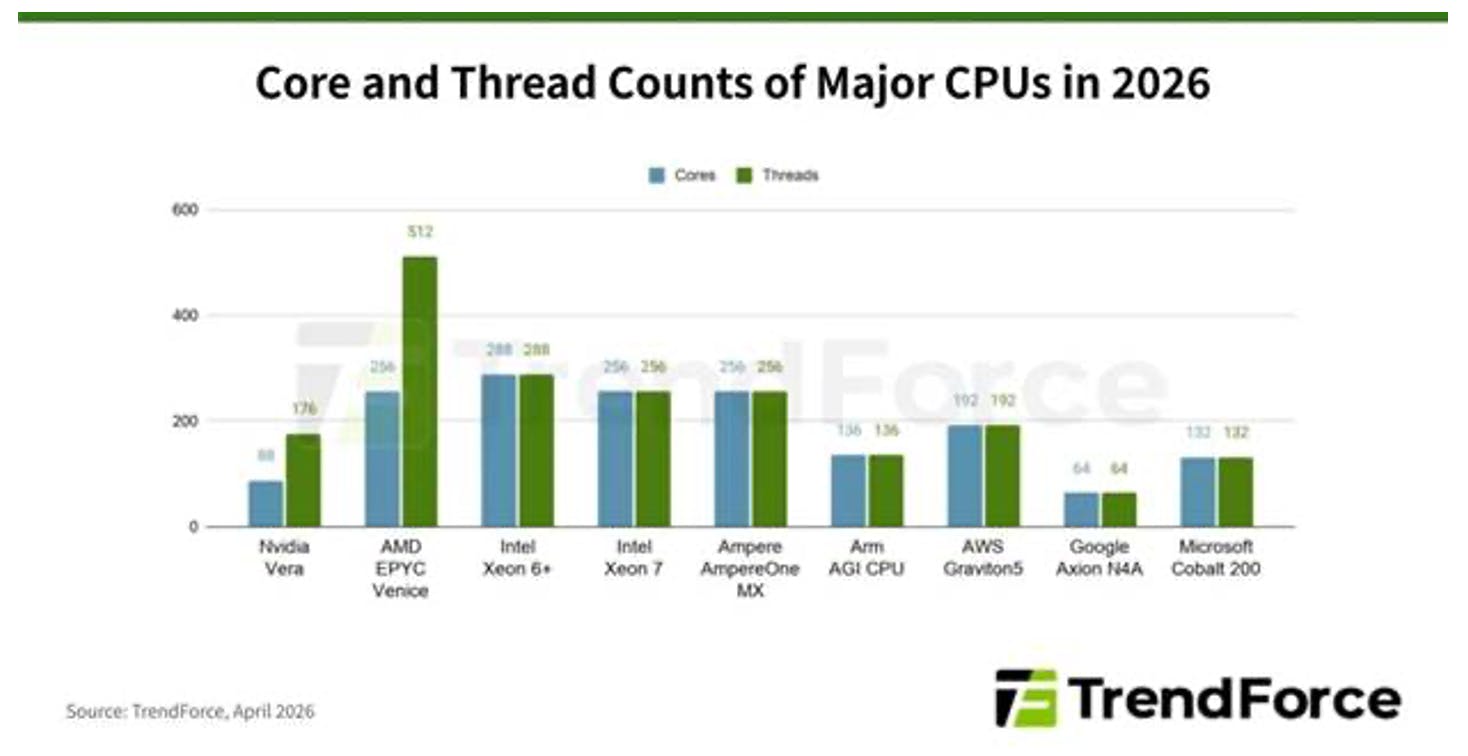
Intel also leads on core counts at the individual chip level. Intel’s Xeon 6+ offers 288 cores per chip, slightly beating out AMD’s Venice at 256 cores and Arm’s AGI CPU at 136 cores; AMD has yet to release Verano’s core count. Despite the lead in core count, Intel’s Xeon 6+ only packs 288 threads whereas Venice offers up to 512 threads via multi-threading, allowing each core to handle two sets of instructions, reducing core idle time and increasing efficiency.

Bar chart comparing core and thread counts of major CPUs in 2026 including AMD EPYC Venice, Intel Xeon, Nvidia Vera, Arm AGI CPU, and hyperscaler chips like AWS Graviton and Google Axion

Bar chart comparing core and thread counts of major data center CPUs in 2026. AMD’s EPYC Venice leads with 256 cores and 512 threads, while Intel’s Xeon 6+ and Xeon 7 offer higher core counts at 288 but fewer threads due to no SMT. Nvidia Vera, AmpereOne, and Arm AGI CPUs have lower counts, while hyperscaler chips from AWS, Google, and Microsoft range from 64 to 192 cores. Source: TrendForce 

Intel vs Arm: Power Efficiency Battle 

Where Intel could find its edge in the rack-scale systems is power, with the blueprints fitting inside a 100kW power envelope. Compared to Arm, Intel is offering more than 368 cores per kW, while Arm’s AGI CPU is offering 228 cores per kW. This can also be viewed at the 200kW envelope of Arm’s AGI CPU, at which Intel could theoretically offer 73,728 cores across two 100kW racks, or more than 60% of Arm’s rack.  

This advantage stems from Intel’s 18A node, which in general offers up to 15% better performance per watt and up to 30% better density versus the Intel 3 node. Manufacturing on more advanced nodes is how x86 is fighting back against Arm – AMD’s Venice is the first CPU to ramp on TSMC’s 2nm (N2) process, which is designed to deliver 10%-15% higher performance at the same power level, or a 25%-30% reduction in power at the same  performance level.  

While Clearwater Forest just launched at the start of June, the most important part of Intel’s story is that its next-gen Xeon 7 ‘Diamond Rapids’ is rumored to be delayed. The new chip was originally expected to launch in the later part of 2026, yet is now expected to launch in 2027, giving AMD a bit more of a head start with Venice. 

CPUs Are the Next Major Bottleneck in AI Infrastructure 

It would be a mistake to think the AI trade begins and ends with Nvidia’s GPUs. Although GPUs are still the heart of AI compute, agentic AI is placing additional emphasis on making sure those accelerators do not sit idle while the rest of the system catches up. 

The addressable market is expanding overnight, as this no longer about adding a few more CPUs as head nodes next to GPU clusters. The bigger opportunity is the move to standalone CPU racks, which is a major architectural change that allows more orchestration capacity to be added without adding more GPUs at the same attach rate. Nvidia’s Vera rack is leading the way, with CEO Jensen Huang projecting roughly $20 billion in standalone CPU revenue this fiscal year, yet AMD, Intel, and Arm are not going to concede the market. 

This is the same framework the I/O Fund has used to identify massive AI winners across memory, networking and energy with CPUs now becoming the next bottleneck. Behind our paywall, we publish over 100 articles on the AI trade per year alongside portfolio allocations and real-time trade alerts.  

For example, we identified lesser-known AI winners, including Bloom Energy, up 1600% since our initial entry last year, a networking player that has delivered roughly 7X Nvidia’s returns YTD and an optical networking stock up more than 810% since November

Don’t miss out on the AI trade.
Join Now

Please note: The I/O Fund conducts research and draws conclusions for the company’s portfolio. We then share that information with our readers and offer real-time trade notifications. This is not a guarantee of a stock’s performance and it is not financial advice. Please consult your personal financial advisor before buying any stock in the companies mentioned in this analysis. Beth Kindig and the I/O Fund own shares in AMD and NVDA at the time of writing and may own stocks pictured in the charts. 

Leo Miller, AI and Semiconductor Investment Writer at I/O Fund, contributed to this analysis. Leo Miller owns shares of NVDA.

👉🏻 Share with a Fellow Investor
Help someone else benefit from this insight.

Recommended Reading:

head bg

More To Explore

Newsletter

Arm and Nvidia standalone CPU servers in an advanced AI data center environment.

AMD, Nvidia, Arm, Intel: Inside the $120 Billion CPU Gold Rush

CPUs have gone from an afterthought to becoming the AI trade’s next great bottleneck – and with AMD, Nvidia, Arm and Intel circling a market that is doubling nearly overnight, the only question left i

June 05, 2026
AI data center infrastructure with NVIDIA and Google highlighting AI networking and semiconductor growth

Google TPU v8 vs Nvidia: How Inference Is Rewriting the AI Market

In April, Google announced it would begin selling its TPUs to select third-party data center operators, which is something the market has anticipated for nearly a decade. The TPU-versus-Nvidia-GPU deb

May 31, 2026
Modern data center corridor with rows of servers and bright blue fiber optic cables, illustrating high-speed AI networking and optical data transmission

The AI Networking Stock That Beat Nvidia by 7X YTD for Returns of 135% YTD

AI networking stock Lumentum is among the key I/O Fund winners in 2026. We allocated heavily to LITE in January—a month before Nvidia backed the company. While most investors couldn’t stomach taking a

May 22, 2026
Bloom Energy fuel cell server units in a high-tech environment, overlaid with green and red financial market chart data.

Bloom Energy — Our 2026 Top Pick Was the Best Performing Stock in April

April was the best month in six years for the Nasdaq-100. The single best-performing large-cap stock wasn't Nvidia, Microsoft, or Meta. It was Bloom Energy, up roughly 109% in one month. As you'll rec

May 17, 2026
NVIDIA Spectrum‑X co‑packaged optics networking switches for AI factories, shown as two floating processor modules with futuristic data‑flow light trails.

Inside Nvidia’s $4B Optical Strategy—and Why CPO Changes Everything

Within the AI investment theme, there is nowhere that the supply chain shifts faster than in networking, leading companies to gain content on new platforms or lose incremental share. The reason is str

May 08, 2026
Stylized illustration of an Nvidia processor chip hovering above a digital grid background, with red glow beneath the chip suggesting market or technical pressure.

Is Nvidia Stock a Buy? Why Semiconductor Strength May Signal a Market Top

In this report, we take a deeper look at the technical scenarios, which suggests that Nvidia’s latest high is shaping up to be a potential bull trap. That view is corroborated by the broader semicondu

May 01, 2026
Nvidia microchip centered between AMD and AVGO chips floating above Earth in space, symbolizing the global semiconductor and AI technology market.

Nvidia’s $20 Trillion Thesis Is Intact. My 2026 Allocation Isn't

The thesis on Nvidia's hardware moat has played out exceptionally well, but that also highlights one of the biggest risks investors face, which is becoming emotionally attached to a winning stock. Whi

April 24, 2026
Illustration of a Bitcoin coin split by contrasting market conditions, with rising U.S. dollar visuals, tightening liquidity effects, and declining price charts symbolizing downside pressure on Bitcoin.

Bitcoin 2026 Price Prediction: Why the Dollar, Global Liquidity and Volume Signal More Downside Ahead 

In our last Bitcoin analysis, "Bitcoin After the Cycle Peak: What Comes Next and How We're Positioning", we argued that Bitcoin was closer to a cycle low than most believed, even if one final drop rem

April 17, 2026
Holographic multi‑layer chart of the S&P 500 showing price fluctuations across transparent data planes, with the “S&P 500” label embedded in the bottom layer, representing sector breakdown and market volatility.

2026 Stock Market Outlook: Cycle Convergence & What's Next

In our last broad market update, the S&P 500 was trading near 6,850, grinding through its fifth consecutive month of going nowhere. I drew a clear line in the sand at the 6,780 level. This was where t

April 10, 2026
An AI CPU chip with abstract blue and magenta neural network waves, symbolizing the growing role of CPUs in agentic AI workloads.

Arm Stock Could Win as Agentic AI Shifts the Bottleneck to CPUs

Arm unveiled an AGI CPU to address one of AI’s biggest bottlenecks, which is orchestration. During the chatbot craze of 2023-2025, GPUs did most of the heavy lifting while CPUs had become an afterthou

April 02, 2026
newsletter

Sign up for Analysis on
the Best Tech Stocks


Copyright © 2010 - 2026