
Ai Platforms

AI Could Be Apple’s Next Chapter

Written by

Beth Kindig

Founder, CEO and Lead Technology Analyst

Published: October 18, 2023

Last Updated: October 18, 2023

This article was originally published on Forbes on Oct 13, 2023,05:15am EDT

After Nvidia added $750 billion in value this year on the backs of surging AI chip demand, investors are quickly searching for the next trillion-dollar AI winner. AI is the best investment opportunity of our lifetimes, and although Apple (AAPL) has been relatively overlooked as an AI play, the tech giant could quickly become a force to be reckoned with in the AI space. The reason for this is simple. Apple can bring AI to the consumer’s pocket by the billions, and is rumored to be sitting on one of the best AI models on the market today, with comparable performance to OpenAI’s ChatGPT.

Two Billion Devices to Lever AI

Apple’s installed active device base surpassed 2 billion last February and “reached an all-time high in every geographic segment” at the end of the June quarter, according to CFO Luca Maestri. The iPhone’s installed base also “grew to a new all-time high,” and is estimated to have nearly 1.5 billion active devices worldwide, after adding around 500 million active devices since 2019—an 11.4% compound annual growth rate since then.
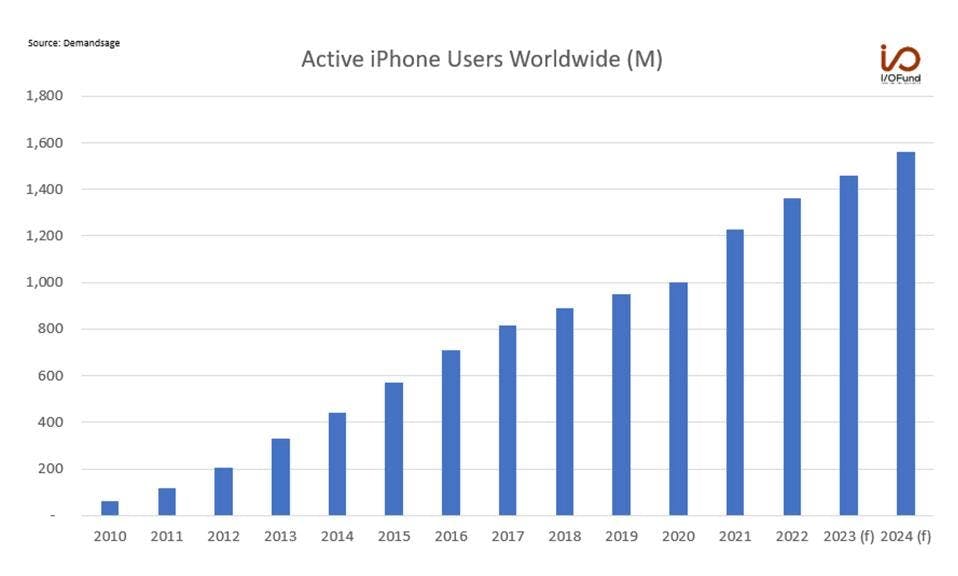
Active iPhone Users Worldwide Chart
Source: I/O FUND

While installed active devices reached a new record, so did Apple’s subscriber base. CEO Tim Cook noted during Apple’s FQ3 report in August that the company hit an “all-time revenue record in Services” with “over 1 billion paid subscriptions,” which are growing at a double-digit rate. Apple has added more than 65 million subscribers in the first half of this fiscal year and more than 300 million subscribers over the past two fiscal years heading into its fiscal Q4.
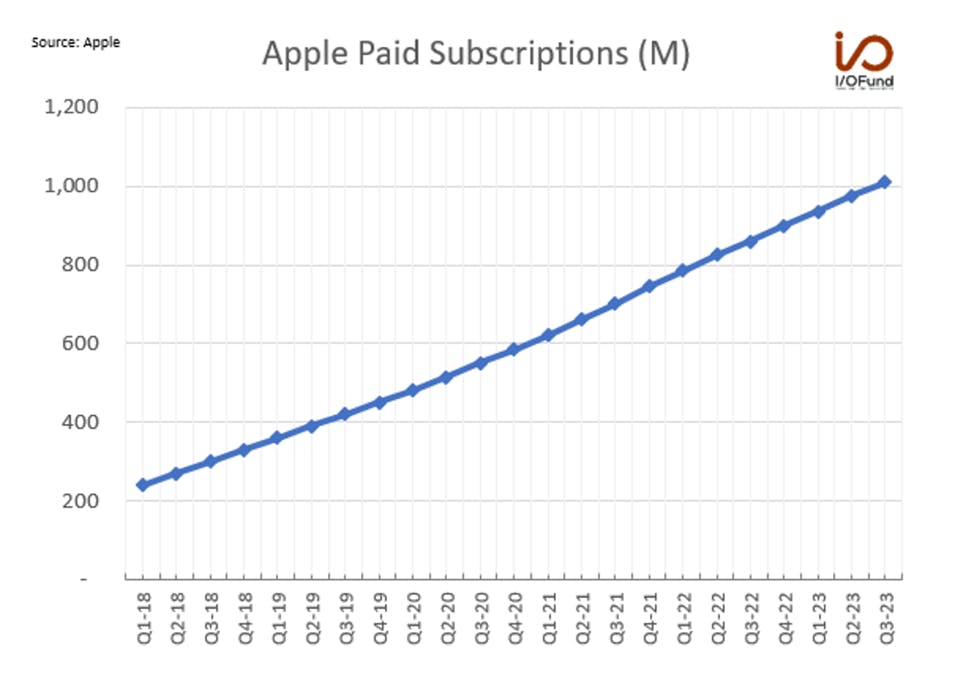
Apple Paid Subscription Chart
Source: I/O FUND

The opportunity for Apple to capitalize on AI arises from the combination of growth within Apple’s installed device base, along with increased engagement and adoption of paid subscriptions over time. Consumer interest in AI surged earlier in 2023 with ChatGPT garnering over100 million active users and more than 1 billion visits monthly. Apple’s installed base offers the chance to more than 10 times the number of individuals with readily available access to AI.

Sign up for I/O Fund’s free newsletter with gains of up to 221% – Click here

Services Is Where AI Can Shine

Apple is witnessing a higher contribution from its services segment to both revenues and margins—the segment is approaching a $100 billion annual run rate, accounting for nearly 26% of revenue with a 70.5% gross margin.

In other words, services is contributing 41.1 cents to each dollar of gross profit, up from 34.6 cents just eight quarters ago. The segment has seen its contribution to gross profit increase steadily, rising 46% from 23.7 cents per dollar in FY18 to 34.6 cents per dollar to date in FY23. It is not out of the picture for services to soon contribute 50 cents of each dollar of gross profit as the segment surpasses $100 billion in annual revenue.
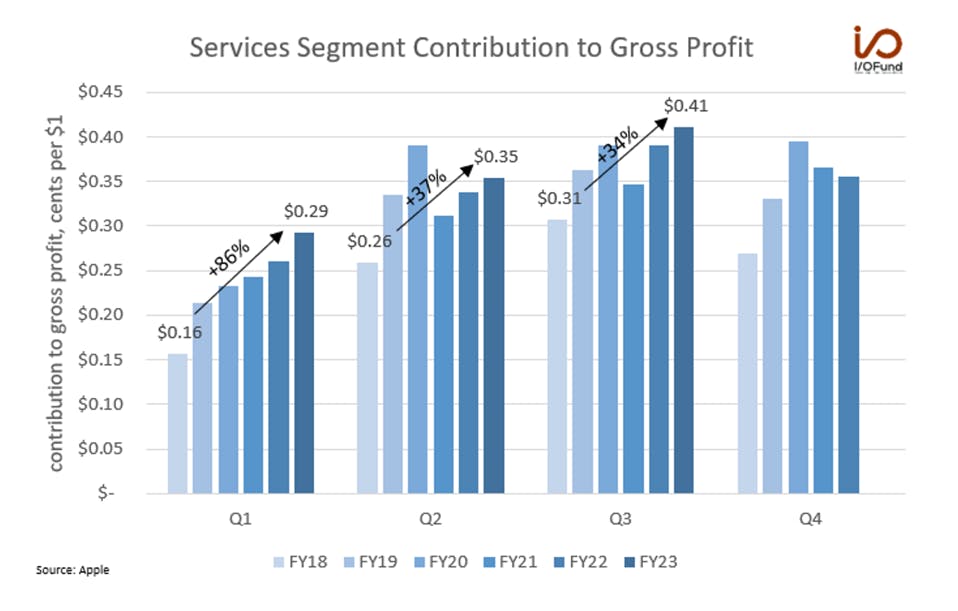
Services Segment Contribution to Gross Profit Chart
Source: I/O FUND

The importance of services to Apple’s bottom line cannot be overstated—that 70% gross margin level combined with its nearly $100 billion revenue scale has pulled Apple’s margins higher over the past few years and will likely continue to do so in the future as transacting accounts and paid accounts continue to grow to new all-time highs.

This is exactly where AI will have the most profound impact on Apple, and why the tech giant could emerge as a strong AI contender.

Google and Microsoft demonstrate the revenue potential of AI subscriptions at scale—for Microsoft’s Copilot, a 2.5% take rate of the ~382 million commercial Office 365 users would equate to nearly $3.5 billion in annual revenue, while a 10% take rate would see annual revenue reaching $14 billion, according to Macquarie.

In Apple’s case, it has nearly three times the paid subscription base as Microsoft that it could target with an AI product, via a stand-alone service or in one of its three pre-existing service bundles. Regardless of the route that Apple chooses, there remains billions in revenue potential. Offering a stand-alone AI subscription for $2.99 per month could rake in ~$10.8 billion in annual revenue at a 15% attach rate based on Apple’s more than 2 billion active devices, while boosting the prices of its subscription bundles could by $0.50 per month could add more than $5 billion annually.

Beth Kindig, founder and lead tech analyst of I/O Fund

Get Our Free Weekly Stock Newsletter

Get weekly stock insights, market analysis, and technology updates straight to your inbox.

  • Weekly stock insights
  • Market analysis
  • Technology updates

Every Thursday at 4:30 pm Eastern, the I/O Fund team holds a webinar for premium members to discuss how to navigate the broad market, as well as various stock entries and exits. We offer trade alerts plus an automated hedging signal. The I/O Fund team is one of the only audited portfolios available to individual investors. Learn more here.

Apple Can Bridge the Gap with Mass-Market Consumer AI

Apple is spending millions of dollars per day in a quest to develop a conversational AI model, potentially for Siri, that would allow iPhone and iPad owners to use voice commands for automating multi-step tasks with the voice assistant. As such, Apple is uniquely positioned to both monetize and implement advanced AI in a mass-market consumer application.

Consumers, especially Millennials, are very willing to adopt and pay for such voice assistants that are as smart and as reliable as a human. According to a PYMNTS survey from April, more than 42% are willing to pay $10 or more per month for an assistant.

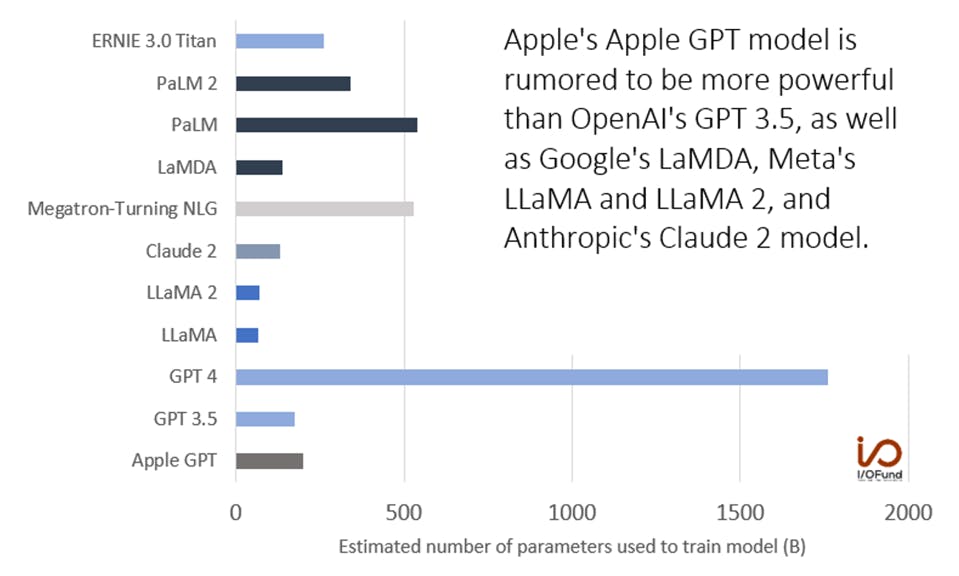
Although Apple is tight-lipped about the progress of its AI projects, the so-called Apple GPT chatbot is rumored to be more powerful than Open AI’s GPT 3.5 model, according to The Verge. Apple is spending millions of dollars a day training the large language model Ajax on more than 200 billion parameters.

The project could find life integrated within Siri, given the applications within automating multiple tasks and range of capabilities stemming from image and video recognition.

Apple GPT Projection
Apple’s Apple GPT model is rumored to be more powerful than OpenAl’s GPT 3.5, as well as Google’s LaMDA, Meta’s LLaMA and LLaMA 2, and Anthropic’s Claude 2 model. – Source: I/O FUND

Apple noted back in 2020 that Siri had more than 25 billion requests made per month, a figure that could easily be increased with a ChatGPT-like chatbot installed across billions of devices. That is how Apple can be the first big stock in consumer driven AI uptake.

On Real Vision, I previously pointed out that “if you take a consumer-facing company like Google,” that they are in a good position because Google doesn’t “have to go out and try to get lots of consumers to adopt something new, consumers will continue to use Search, it’ll just be improved Search; advertisers will continue to use Google, it’ll just be improved ROI.”

For Apple, it’s the same case – it does not have to try to convert millions of users into a paid subscriber in the way that OpenAI does; rather, it could easily integrate an advanced conversational AI model within Siri for example, and quickly convert already-paying subscribers over to those AI services.

Damien Robbins, Equity Analyst at the I/O Fund, contributed to this article

The I/O Fund was early to AI with a 45% allocation in 2023. For more in-depth research from Beth, including 15-page+ deep dives on the 10 stock positions the I/O Fund owns, subscribe here.

Recommended Reading:

About the author

Beth Kindig

Beth Kindig

Profile

Beth Kindig is the Founder, CEO and Lead Technology Analyst at I/O Fund, with more than 15 years of experience covering private and public technology companies. Known for her early Nvidia research beginning in 2018 and bold, high-conviction calls on emerging technology trends, Beth also manages I/O Fund's audited technology portfolio, which has returned 326% since May 2020, or 29.2% annualized. She is a regular guest on Fox Business and Bloomberg and has appeared on Real Vision, CNBC, Yahoo Finance, BBC, MarketWatch, Forbes, and more.

Curation

Expand your knowledge

View all posts
3 AI Trends Driving the 2026 Cybersecurity Stocks Rally
CYBERSECURITY STOCKS

3 AI Trends Driving the 2026 Cybersecurity Stocks Rally

Cybersecurity stocks surged in 2026 as AI-enabled attacks rose 89%. We look at how AI threats, AI labs and platform consolidation are driving demand.

CYBERSECURITY STOCKSOCT 31, 2026
Beyond Hyperscalers: Here’s the Next $1 Trillion AI Infrastructure Opportunity
AI STOCKS

Beyond Hyperscalers: Here’s the Next $1 Trillion AI Infrastructure Opportunity

Since 2022, Big Tech capex has been the clearest barometer of AI demand. But the market’s reaction to Google’s latest earnings shows investors are questioning how long that spending can last. While the market frets over hyperscalers’ cash flows, a second wave of AI infrastructure spending has quietly emerged, driven by enterprises and neocloud customers.

AI STOCKSOCT 30, 2026
Google’s $250 Billion AI Chip Opportunity Takes Aim at Nvidia
AI PLATFORMS

Google’s $250 Billion AI Chip Opportunity Takes Aim at Nvidia

In April, there was a major shift in the AI accelerator market, and for once, it didn’t come from Nvidia. Six months later, merchant TPUs are moving from announcement to commercial execution, with Google recognizing its first revenue from TPU systems in Q2 (from a small base). Last quarter, Cloud revenue growth accelerated to 82% for $24.8 billion, compared to $22.5 billion expected. In addition, new details around the TPU 8t show that Google’s threat to Nvidia is not limited to inference. At the time, we pointed out that Google may be one of Nvidia’s strongest AI challengers, as Big Tech is closest to the problems that accelerators must solve. The problem that Google is prioritizing is lower cost per token, with token economics becoming a predominant concern as AI spending is pushing Big Tech’s free cash flows into the red. Below, we discuss two reasons why Google’s AI story is about to change, not from advancements in AI software, but by going after one of the most profitable hardware businesses the tech industry has ever seen.

AI PLATFORMSOCT 23, 2026