NASDAQ REBALANCE: WHAT YOU NEED TO KNOW
August 01, 2023
Beth Kindig
Lead Tech Analyst
This article was originally published on Forbes on Jul 28, 2023,12:07am EDT
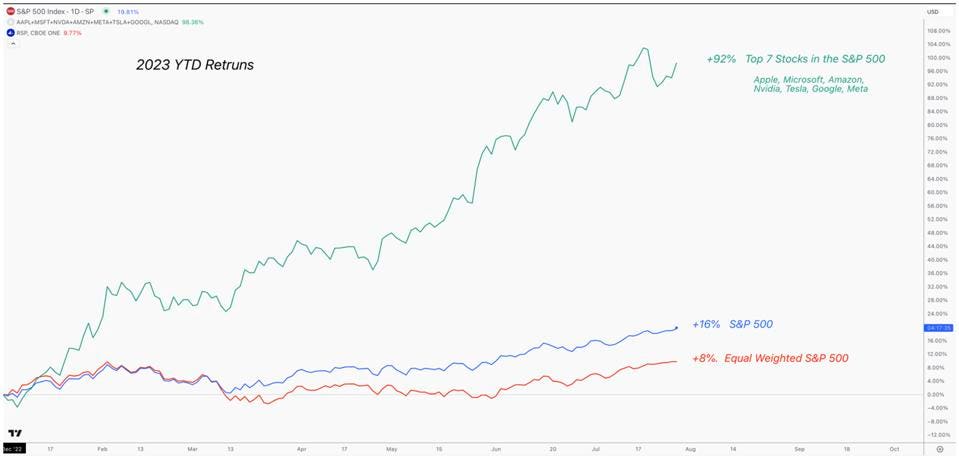
On June 30th, the NASDAQ posted the strongest first six months in the index’s history, dating back to 1971. The 6-month returns of 30.5% in 2023 easily beats the prior record of 25.2% in 2019. The majority of the rally was driven by seven stocks: Apple, Microsoft, Nvidia, Amazon, Tesla, Meta, Google. These 7 stocks are up a collective 98% YTD, while the equal weight S&P 500, which provides an equal weighting to all 500 stocks in the index, is up only 9%.
Source: I/O Fund
Sign up for I/O Fund's free newsletter with gains of up to 221% - Click here
This level of narrow leadership continues to pose a problem for active managers who are more diversified than the NASDAQ-100. In fact, by Q1 of 2023, only 1/3 of active managers were ahead of their benchmark in 2023.
As a result, the NASDAQ is being forced by the SEC to rebalance their tech-heavy index, the NASDAQ-100, which will shift the focus away from the top seven stocks in the market, and redistribute weightings to less popular names in the index, like Starbucks and Broadcom, to name a few.
The reason for the rebalance is due to the Magnificent Seven taking up 55% of the Index’s weighting prior to the rebalance. Here was the NASDAQ-100’s weighting prior to the rebalance (as of July 18)
MSFT – 12.7%
AAPL – 12.1%
NVDA – 7.4
GOOGL – 7.3%
AMZN – 6.8%
TSLA – 4.5%
META – 4.4%
On July 14th, the new weighting was announced: NVDA and MSFT would receive the biggest cuts of about 3% each, while AAPL only got shaved by 1% (making it the new top position). Google was cut by 2%, while META and TSLA by 1%. The new rebalance dropped the overall weighting from 55% to ~38%. The NASDAQ-100 topped about 4 days later, and has since been in a minor correction.
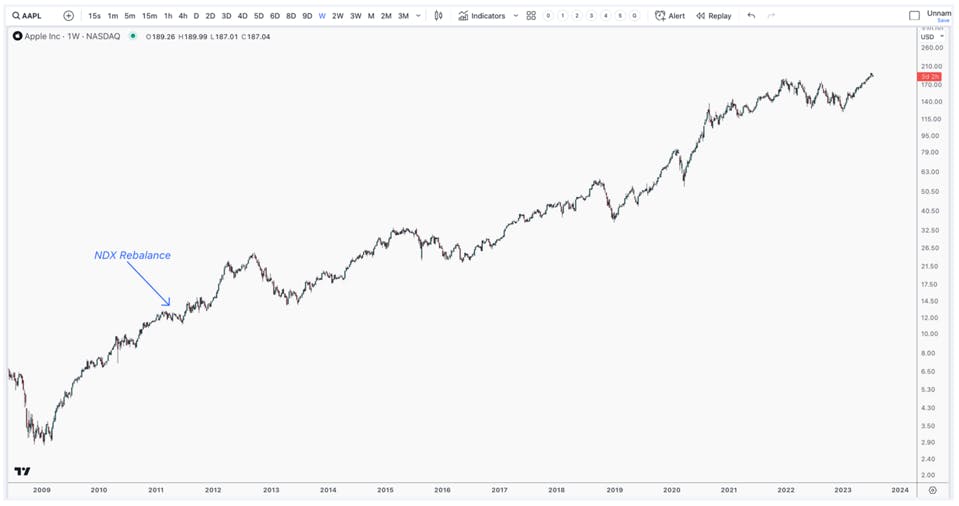
Being a static index, a rebalance is a rare occurrence, as it has only happened twice since 1998. The last time was in April of 2011 and was focused on Apple’s outsized weighting in the index. At the time it accounted for just over 20%, and was rebalanced back to 12%. Below shows when this was announced and how it affected the stock. Though the macro environment was much different in 2011, it’s worth noting that Apple had an immediate dip that was quickly bought.
Every Thursday at 4:30 pm Eastern, the I/O Fund team holds a webinar for premium members to discuss how to navigate the broad market, as well as various stock entries and exits. We offer trade alerts plus an automated hedging signal. The I/O Fund team is one of the only audited portfolios available to individual investors. Learn more here.
Source: I/O Fund
We believe this is worth monitoring as $209 Billion is currently in QQQ, an ETF that tracks the NASDAQ-100. This means that MSFT, for example, lost $18.8 Billion in demand from this single ETF having to rebalance in accordance with the new changes. Furthermore, many institutional funds are benchmarked to this index, and are in the process of rebalancing their portfolios to coincide with these changes, which should further affect demand.
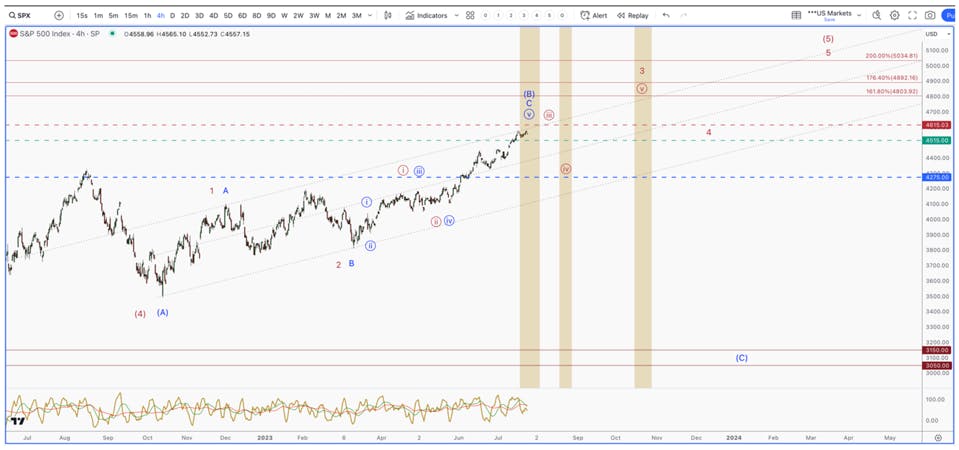
Our current take on the market is that if SPX break below 4515, then the market has likely topped. Below 4275 and SPX has put in a big top and this would be bearish. On the other hand, if 4275 is defended, then our firm will layer into more stocks as this would be bullish. The level of 4275 is of critical importance and we will update our Premium Members with our buy plan if we get here.
Source: I/O Fund
I/O Fund Portfolio Manager, Knox Ridley, contributed to this article .
Recommended Reading:
More To Explore
Newsletter
Top 10 Tech Stocks of 2025: How the AI Trade Defied the Skeptics
The stock market in 2025 was a high-stakes tug-of-war between geopolitical tensions and the AI trade. Headlines were dominated by the DeepSeek fears, trade wars, tariffs, and persistent whispers of th
Nvidia & Beyond: I/O Fund’s Best Free AI Stock Research in 2025
We describe our newsletter as “free,” however the resources required to produce the research behind our weekly analysis are substantial. Delivering early, actionable insights consistently—and making t
AI Stocks & Nvidia: I/O Fund’s 2025 Tech Media Highlights
As we close out a defining year for tech, we’re proud to share a few media moments where our theses met the mainstream. We are grateful that our readers trust us to cut through the noise - and we want
The AI Revenue Leader Nobody Is Talking About—Second Only to Nvidia Stock
Meta’s stock sits at the center of the AI spending debate, as Big Tech continues to shock markets with outsized AI-driven capital expenditures. What is being overlooked is that Meta’s stock is already
Broadcom Stock: The Silent Winner in the AI Monetization Supercycle
The AI accelerator market will inevitably widen beyond Nvidia’s GPUs - the keyword is widen. More players will sell more AI systems as the market expands, and that growth supports both the clear leade
Nvidia Stock and the AI Monetization Supercycle No One Is Pricing In
Two weeks ago, Nvidia blew the doors off with an earnings report that defies the company’s mega-cap scale. The long-awaited Blackwell and Blackwell Ultra architectures are shipping in volume, leading
I/O Fund Called the Bitcoin Selloff: What Liquidity & DXY Data Predict Next
In August, the I/O Fund warned that Bitcoin was entering a high-risk phase as global liquidity stalled, and sentiment patterns flashed caution. Since then, Bitcoin has fallen more than -35%. In this a
Why Nvidia Stock Could Reach a $20 Trillion Market Cap by 2030
The headline that Nvidia could reach a $20 trillion market cap by 2030 will trigger plenty of emotion — it sounds fantastical, full of hype, or like a prediction made far too early in the AI cycle. Ye
Big Tech’s $405B Bet: Why AI Stocks Are Set Up for a Strong 2026
AI accelerators such as GPUs and custom silicon need no introduction. Compute has led the AI boom; a trend so powerful, it is displacing the FAANGs of the last decade with Nvidia firmly the world’s mo
Market Cycles, Not Headlines: What History Says About the 2025 Rally and What Comes Next
Despite how it may seem, modern-day narratives rarely drive market swings. Tariffs, political headlines, niche trends like rare earth materials, or speculation about which company OpenAI partners with