

- AI data centers could need up to 6 billion cubic feet of natural gas per day by 2030 to meet the industry’s rabid energy demand, up from near zero today.
- Natural gas is the top fuel used to generate electricity in the United States.
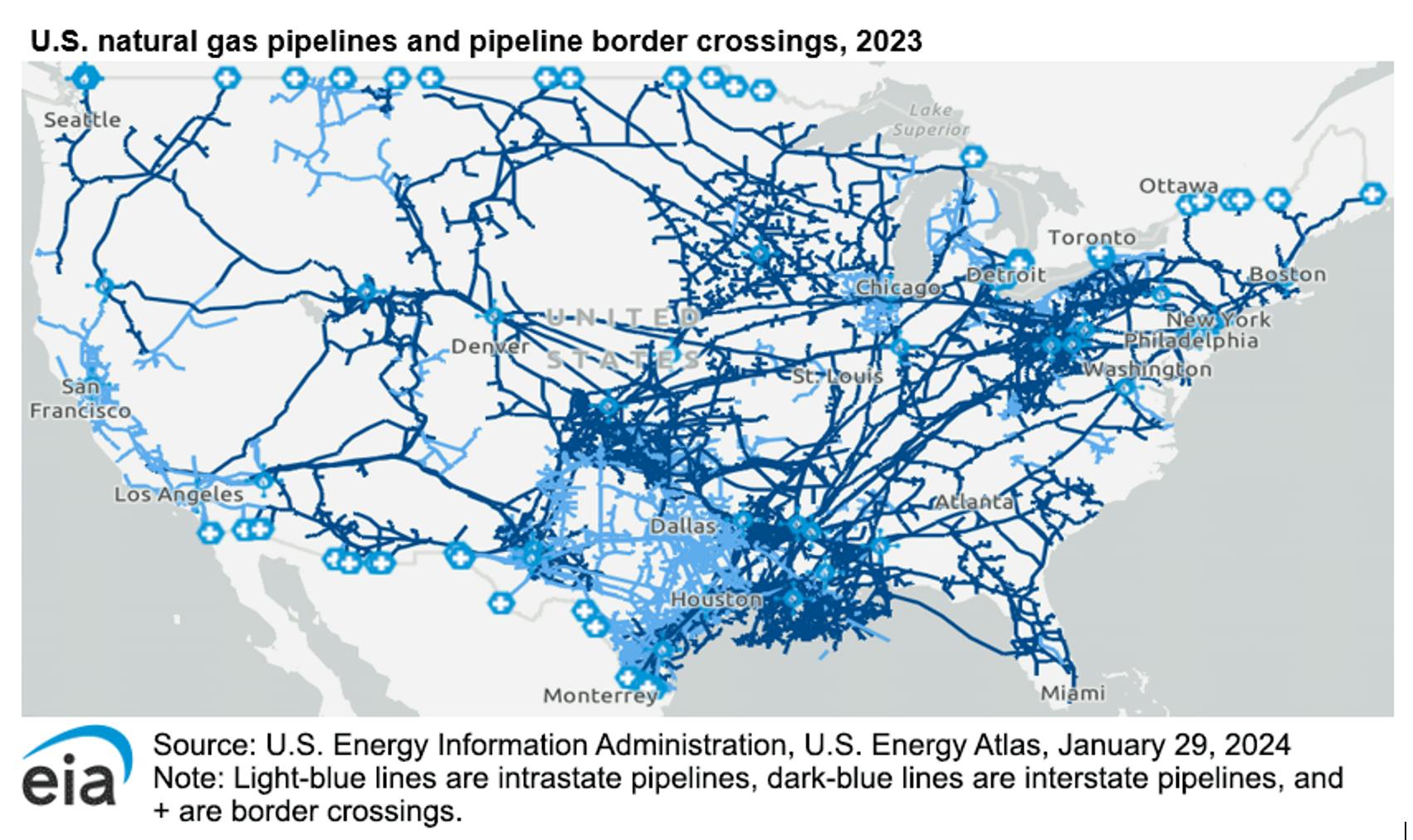
- Some of the largest AI data center projects are located in regions with the densest gas pipelines, like Texas and Louisiana.
Artificial intelligence (AI) data centers are thirsting to feed their growing electricity demands. While there have been a lot of headlines regarding hyperscalers choosing to go with nuclear, new buildouts are still years away. When AI data centers need power now, they are left with the obvious choice of using the electrical grid or setting up co-location deals powered by the nation’s most abundant fuel, natural gas. Natural gas is the top fuel source for powering the electrical grid, accounting for 43% of the power in 2023. However, that fuel has to reach the data centers and that involves pipelines, lots of natural gas pipelines. For this reason, natural gas pipelines are the unsung heroes of AI data center expansion.
AI Data Centers Will Need 3 to 6 Billion Cubic Feet of Natural Gas Per Day by 2030
An October 2024 report from S&P Global found that the additional demand for natural gas to support data centers could reach three to six billion cubic feet per day (bcf/d) by 2030 as the industry struggles to find power for AI data center buildouts. The shocking part is that this figure starts from nearly zero bcf/d today, rising to upwards of 6 bcf/d by 2030.
The Three Types of Natural Gas Pipelines Need for AI Data Centers
Between early 2023 and mid-2024, the U.S. natural gas pipeline infrastructure saw a slight growth across all 3 types of pipelines:
- Gathering Pipelines are used to transport the natural gas (or crude oil) collected from the wellheads at production sites to a central collection point like a storage facility, a processing plant or a transmission pipeline. Gathering pipelines are the smallest in diameter and operate at low pressure and flow. Gathering pipelines increased 0.97% between 2023 and mid-2024 from 496,051 miles to 500,854 miles.
- Transmission Pipelines are the larger pipelines that move high volumes of natural gas from the production and processing plants, storage facilities, and distribution centers. These pipelines operate at pressures up to 1,000 pounds per square inch (PSI) and range from a hundred feet to hundreds of miles. Transmission pipelines increased 0.58% between 2023 and mid-2024 from 361,945 miles to 364,030 miles.
- Distribution Pipelines are the smaller pipelines that deliver natural gas to end-users like individual homes, businesses and facilities. These operate at low pressure and can be made of plastic pipe instead of steel as underground pipes to smaller service lines connecting to properties. These are regulated by the local distribution companies (LDCs) that use them. Distribution pipelines grew 1.14% between 2023 to mid-2024 from 103,897 miles to 105,082 miles.
Join thousands of investors who trust I/O Fund’s expert stock analysis on AI, semiconductors, cryptocurrency, and adtech — sign up for free! Click here!
Location, Location, Location of Gas Pipelines is Key
AI data center construction tends to be concentrated in regions where gas pipeline infrastructure is densest. Here’s a breakdown of the top regions with dense and bountiful gas pipeline infrastructure:
Texas leads with over 58,500 miles of natural gas transmission pipelines. It’s the epicenter of the Permian Basin and connects to Gulf Coast liquefied natural gas (LNG) export terminals and petrochemical hubs. Project Stargate is the $500 billion joint venture investment by Oracle, Softbank and OpenAI to grow America’s AI infrastructure by 2029. Its first AI data center is under construction in Abilene, Texas. Oracle CEO Larry Ellison stated. “the data centers are already under construction here in Texas. Each building is half a million square feet. There are 10 buildings currently being built, but that will expand to 20 other locations beyond the Abilene location, which is our first location.”