
Nvidia has traversed choppy waters so far in 2025 as concerns have mounted about how the company plans to sustain its historic levels of demand. It began with DeepSeek in late January, was furthered by suppliers providing mixed signals on the timing of its premiere Blackwell NVL systems, then saw rumors of data center cancellations from a major customer in February.
What better place to address these issues than the GPU Technology Conference (GTC) in San Jose, now dubbed the Super Bowl of AI. In the keynote held on Tuesday, Jensen Huang threw cold water on many of Wall Street’s assumptions, helping to alleviate concerns that demand for Nvidia GPUs will slow. In addition, I appeared on Fox News during the keynote to discuss why valuation is the great equalizer for this stock – along with my prediction for which quarter this year Nvidia will likely explode higher.
Nvidia Explains Why Cheaper Models Will Not Result in Less Compute
CEO Jensen Huang kicked the conference off with a wild remark about the current pace of progress in AI and the need for compute: “the scaling law of AI is more resilient, and in fact, hyper-accelerated, and the amount of computation we need at this point, as a result of agentic AI and reasoning, is easily 100x more than we thought we’d need at this time last year.”
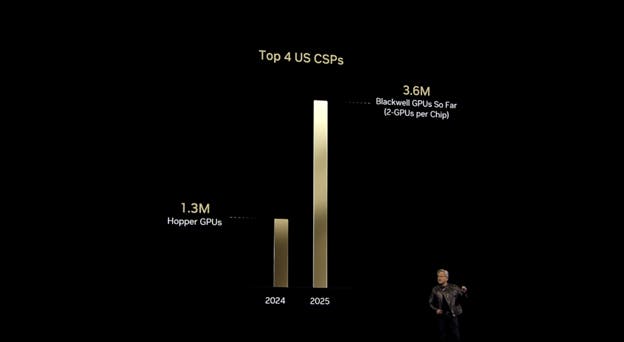
The proof of this is easily seen as Blackwell chip sales have significantly outperformed Hopper year-over-year, with 3.6 million GPUs ordered so far in 2025 by the top 4 CSPs, versus a peak of 1.3 million Hopper GPUs in 2024. And this is just sales to the 4 largest CSPs, not including CoreWeave, Meta, xAI, Tesla, Nebius and many others that will be acquiring the chips. Huang added that “demand is much greater than that, obviously” — with the readthrough being this is what they’re able to ship, with demand that exceeds current capacity.
Huang further illustrated that due to AI being able to reason beyond pretrained data, it now generates more tokens at 10X for a complex model, yet compute has to be 10X faster, resulting in 100X more computation.
“Well, it could generate 100x more tokens and you can see that happening, as I explained previously, or the model is more complex, it generates 10x more tokens. And in order for us to keep the model responsive, interactive so that we don’t lose our patience waiting for it to think, we now have to compute 10x faster. And so 10x tokens, 10x faster, the amount of computation we have to do is 100x more easily. “
Models will need to generate more tokens, more quickly; meaning, AI remains a hardware problem that Nvidia is uniquely positioned to solve. The amount of computation required for inference is significantly higher than previously estimated – and it’s this demand that Nvidia’s future generations of GPUs will aim to meet.
Huang Forecasts Capex to Grow more than 300% in 3 Years
Nvidia has been a massive beneficiary of big tech capex budgets. Our firm has been tracking Big Tech capex as a proxy for AI spending since 2022, when I publicly stated in my newsletter: “However, it has been our stance for some time that Big Tech capex is the true leading indicator for AI semiconductor companies. Despite an enormous increase in Big Tech capex primarily driven by data centers, this line item does not get the attention it deserves in terms of follow-through to the semiconductor industry.”
We’ve continuously reminded our readers that data center capex provides visible read-throughs for Nvidia as it captures a lion’s share of that spend, and GTC provided another clear signal that not only is capex not slowingnot slowing as analysts fear, but is accelerating ahead of expectations.
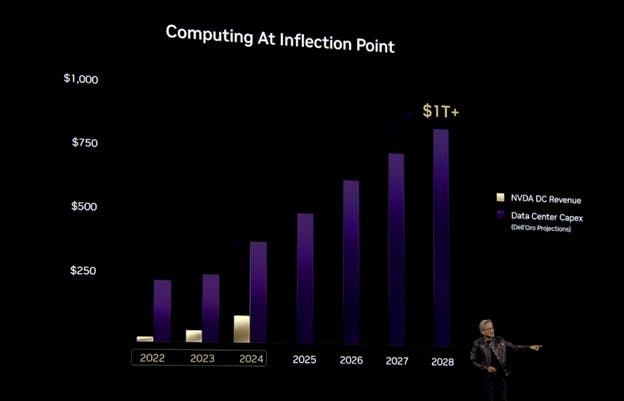
At GTC, Huang pulled forward his view for $1 trillion in data center buildouts, saying he now sees the $1 trillion mark being reached as soon as 2028, ahead of prior expectations for 2030, representing an expansion of Nvidia’s addressable market.
Huang explained that he was confident that the industry would reach that figure “very soon” due to two dynamics – the majority of this growth accelerating as the world undergoes a platform shift to AI (the inflection point for accelerated computing), and an increase in awareness from the world’s largest companies that software’s future requires capital investments.
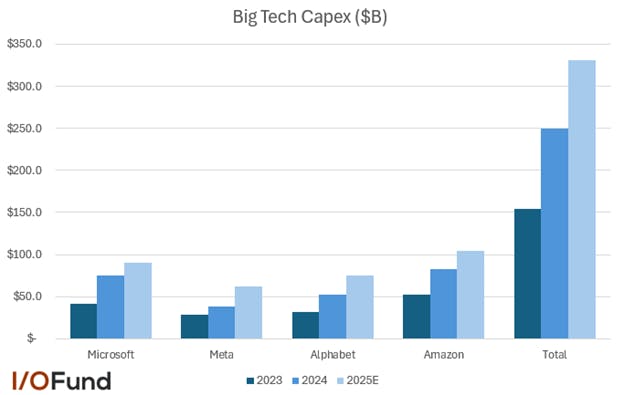
Not only did Big Tech hit the $250 billion threshold in 2024, but these companies are on track to significantly exceed that in 2025, with Microsoft, Meta, Alphabet and Amazon likely to spend close to $330 billion on capex this year. This is easily more than double what was spent in 2023, and as whole, that represents 33% YoY growth for the four purchasing Blackwell en masse.
Based on Huang’s prediction that data center expenditures could reach $1 trillion by 2028, that’s 3x growth in 3 years, and Big Tech alone (not even including Oracle and others) is already at one-third of that this year.
China’s tech firms are also quickly raising capex to remain competitive in the global AI war, with Alibaba signaling capex of $52 billion over the next three years, more than what it has spent over the past decade, while Tencent outlined faster capex growth as it purchases more AI chips. I have said previously on Fox Business News that AI spending goes up in times of war – and neither China nor the US will want to lose to the other when it comes to AI dominance.
The I/O Fund specializes in covering lesser-known AI stocks on our research site with trade alerts and weekly webinars. Learn more here.
Huang Explains Why Nvidia’s GPUs will Remain in High Demand
The breakthroughs we’ve seen in recent months and the rapid progression to complex problem solving and reasoning are increasing token usage by 100x and resulting in 10x faster computing power required to power the next stages of AI.
Tokens are the core factor going into the economics of an AI model – tokens for training represent the core part of the model costs, while tokens for inference generate revenue and thus profit. In a demo at GTC, Nvidia showed that for a complex problem with multiple constraints, a reasoning model like DeepSeek’s R1 would reason through the possibilities and answer with 20x more tokens using 150x more compute than a traditional model like Meta’s Llama 3.3-70B.
Translating this to the data center shows why Blackwell is in such high demand, to the tune that it has sold more than 2.5x as many GPUs already in 2025 versus Hopper’s peak. With Blackwell, which delivers up to 30x faster performance on inference versus the HGX H100, at 116 tokens per second per GPU versus 3.5 tokens per second, with 25x better energy efficiency. For a reasoning model, Huang explained that with Nvidia’s new Dynamo inference serving library, Blackwell can deliver up to 40x performance for reasoning models.
Here’s why this is important. We explained last week in a brief writeup Unlocking the Future of AI Data Centers: Which Fuel Source Reigns Supreme in Efficiency? that power was the core chokepoint and the key enabler for AI’s future, as AI cannot exist without new sources of electricity to power its applications. Huang highlighted this at GTC, explaining that data centers are power limited, meaning revenues are power limited, hence why customers are looking for the most energy efficient chips they can get.
A 100MW data center (which is becoming more commonplace for hyperscalers) could house 1,400 H100 NVL8 racks and produce a maximum of 300 million tokens per second. With Blackwell, the same data center could house 600 racks but produce a maximum of 12 billion tokens per second, in theory a 40x increase. Increased inference performance leading to higher token outputs both lowers costs and increases revenue potential – Nvidia pointed out that DeepSeek-R1 based software optimizations improved token output and revenue generation by 25x and lowered inference costs by 20x.
While these maximums are theoretical in nature, the underlying notion that a data center can serve substantially more tokens at a lower cost supports Blackwell’s high demand, from a superior TCO profile and increased revenue generating ability.