


The rise of AI marks a transformative technological, economic, and societal inflection point — one with extreme implications for how we live and invest. So, how can investors take advantage of the trend? Jordi Visser, CIO and Chairman of Weiss Multi-Strategy Advisers, spoke to Beth Kindig on the Real Vision podcast on March 20th, to dive deep into AI’s potential for explosive economic growth, how to find winners in this theme, sectors that benefit from AI, the potential for crypto to decentralize AI, and more.
Watch the full interview on Real Vision here: Real Vision Video: AI Opportunity (youtube.com)
AI’s Impact Much Larger Than Mobile
The multi-trillion dollar impact to global GDP is the reason AI will shape up to be such a transformative and explosive trend – much like smartphones, which revolutionized countless facets of our lives, added trillions to the global economy, and created multiple trillion-dollar companies and billion dollar industries.
AI is shaping up to be multiple times larger than mobile – to the tune of 3x to 5x larger over the course of the next decade. Beth explains to Jordi that for AI’s impact on GDP, she has “seen $15 trillion, but McKinsey and others are now raising it to a $25 trillion impact on GDP. You can assume mobile is $3 to $4 trillion, maybe $4 to $5 [trillion], depending on how you chop up smartphones, applications, app stores, things like that. Let’s just give it the highest estimate of $5 trillion – [for AI], we’re looking at 3x minimum, 5x right now and these estimates keep getting raised […].”
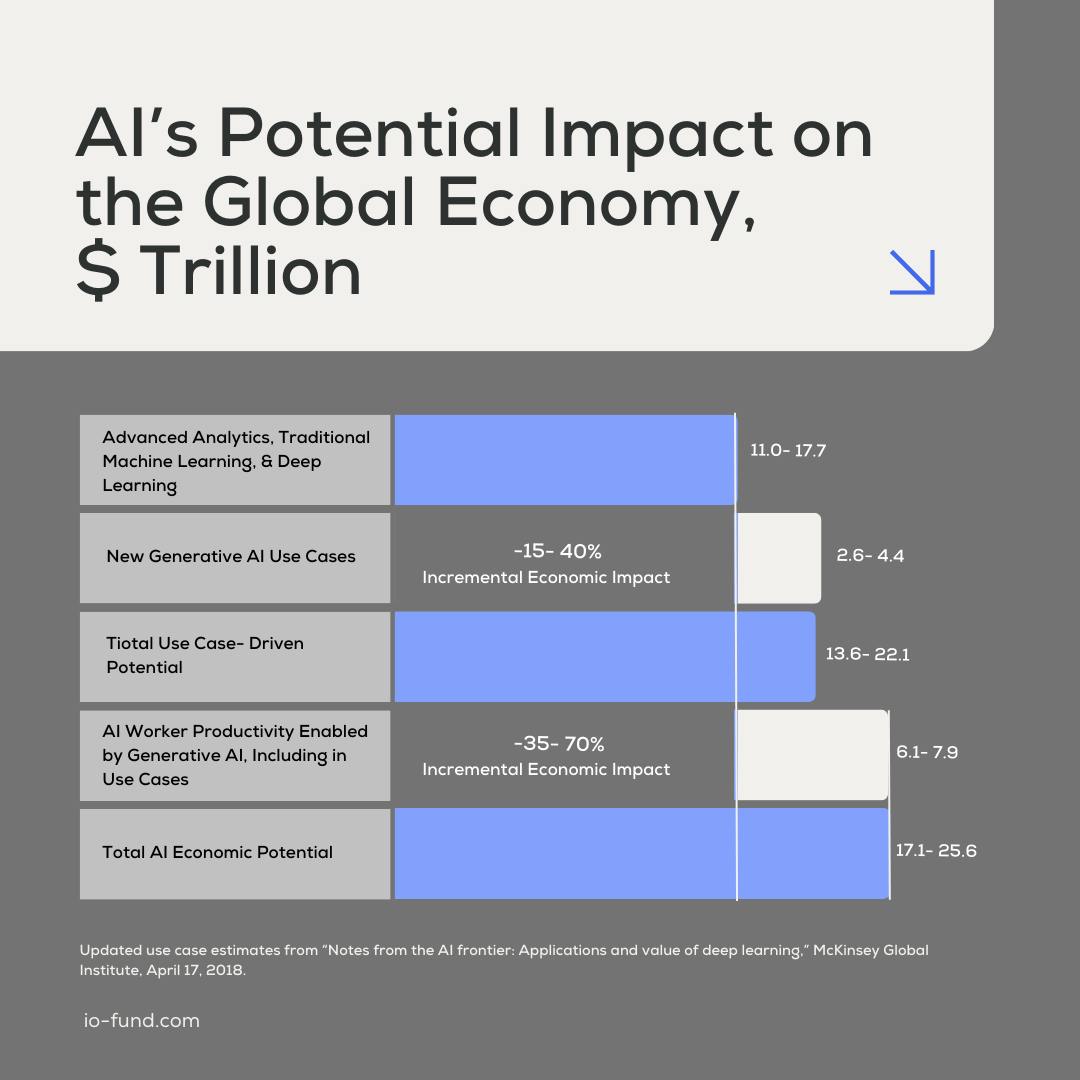
This profound economic growth opportunity from AI is “something we’ve never seen before.” It stems from AI’s product-market fit — solving clear problems, driving down costs for enterprises and boosting worker productivity — and when you “match it with the right product, what you have is this hockey stick explosive growth.”
A Cautionary Tale of Consolidation
Even with such an explosive growth forecast for AI, it may still face a similar hype cycle trajectory as many other facets of tech do.
Just as with other innovative technologies, for AI, it’s likely that we will “go through a lot of innovation that is absolutely necessary… but then over time, the hype phase on the user side [fades] and those businesses don’t last.” This has happened in all facets of tech, from mobile to gaming to one of the most notable for tech investors, the dot-com bubble.
Beth cautions that you can “expect something similar to happen with AI as what we’ve seen in mobile, [and] maybe even at a higher rate.” For context, “a wave of innovation such as mobile will often put on the market 2 million apps, but in the long run, fast forward 10 years, most people use about 10 [apps].”
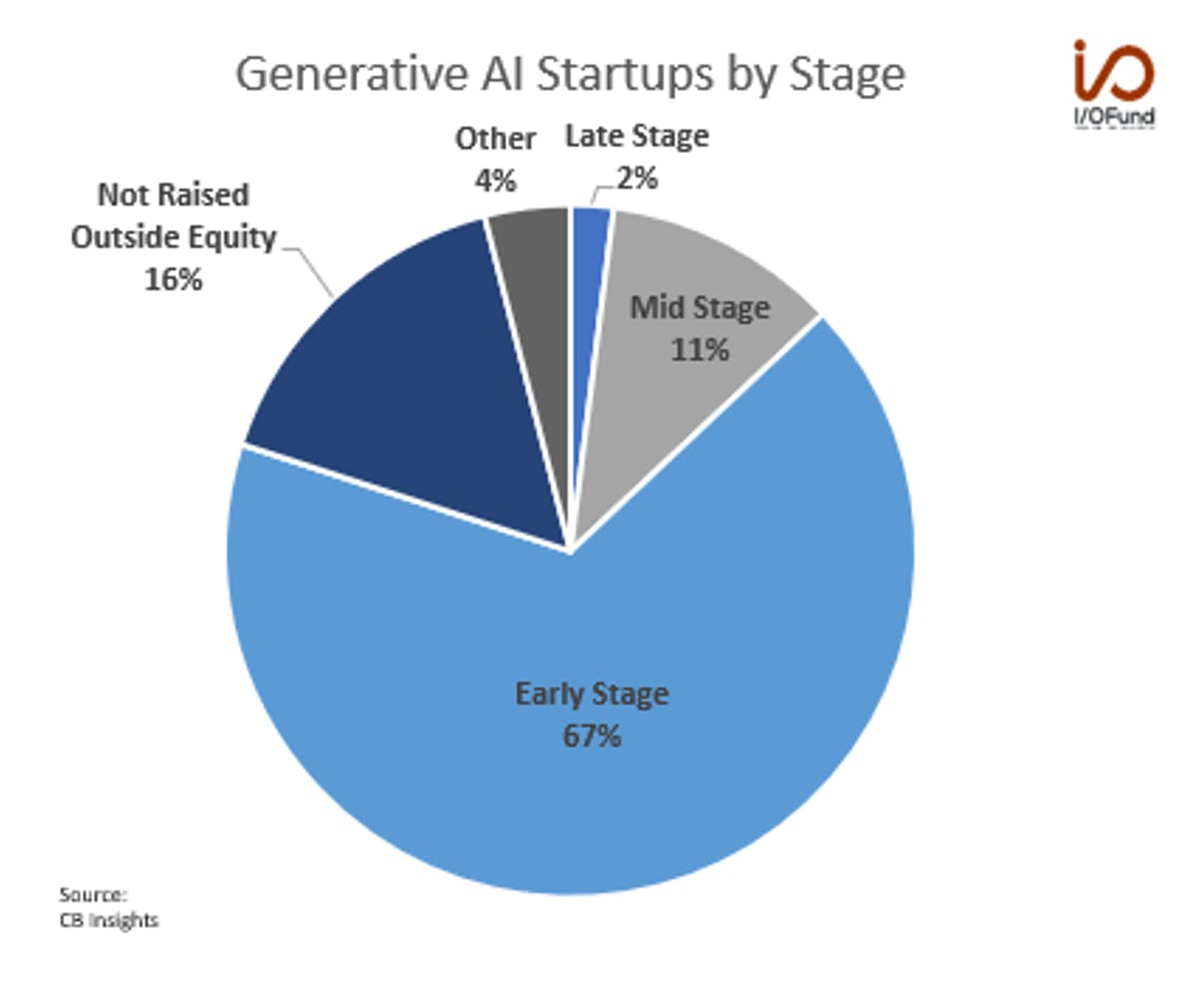
According to Crunchbase data, there are nearly 10,000 AI startups, while a more specific look in generative AI shows nearly 800 startups. Of that 800, 67% are still early stage, while only 2% are late stage. This comes despite a 5x surge in generative AI investments to almost $22 billion in 2023, with funding concentrated in OpenAI, Anthropic, and Inflection AI.
This sort of proliferation of companies creating different AI apps and use cases is definitely a positive outcome, but it’s extremely unlikely that all 10,000 companies participating in the AI economy survive, with consolidation occurring via acquisitions to even bankruptcies for the smaller bootstrapped startups.
There will ultimately be winners in AI, and there’s one critical piece that sets these companies apart: data.
Data Will Create the Winners
For AI, data will separate the winners from the rest of the pack, due to the high costs of training AI models and the need for high-quality data sets to train said models.
Google, Meta, Amazon, and Microsoft have all invested tens of billions into AI development for years, and can quickly and effortlessly integrate AI into their established business models. For example, Beth explored in June 2023 how AI could drive $100B in revenue for Microsoft by 2027, from OpenAI’s APIs running on Azure, to AI integrations and partnerships via Bing, and the rollout of Copilot, among other drivers.
Sign up for I/O Fund’s free newsletter with gains of up to 221% – Click here
What sets Big Tech, and these four companies apart, is that they have huge proprietary data sets that they can use to train AI models for various different purposes. Beth points out that “now we have an issue where, if you are a startup or small company, do you even have the data set to train these models? A lot of people have followed Tesla for a long time, what are the chances that Tesla would ever give away the data set that their fleet has created and generated over the last however many years. They’re going to protect that with everything they have, not only because of the costs that it required to create that data set, but because it’s really their secret sauce.”


