

Cloudflare’s stock rose 20% in the days following Q4 earnings with strong momentum for its Workers AI platform and accelerations in multiple key metrics, paving the way for the stock to potentially reaccelerate revenue growth while driving a shift to GAAP profitability. Management also expressed a high degree of optimism for AI inference and growth opportunities through 2025, especially for its Workers AI platform.
I break down the growth in the most important key metrics, Workers AI momentum, and commentary about AI opportunities below.
Workers Developers Grew from 2 Million to 3 Million in 2024
Cloudflare has quietly amassed a large developer base with tens of millions of developers, allowing for a rather frictionless ramp for its Workers AI platform, with 2024 seeing the platform record more than 50% growth. Workers AI positions Cloudflare to capitalize on the growing AI inference market via its unique approach that offers performance at or exceeding hyperscalers’ at a lower cost.
In Q4, management noted that active Workers developers crossed 3 million, marking a 50% growth from 2 million active developers in Q1 and 25% growth from 2.4 million developers in Q2. Since November 2023, active Workers developers have risen more than 200%.
The Workers platform essentially is Cloudflare’s moat, and what separates it from the rest of software in terms of what it can provide for AI. With Workers, Cloudflare eliminates cold starts, allowing code to be executed the moment it is received – we had explained to our premium members in 2023 that it is a “combination of competing with the hyperscalers, delivering app performance at faster speeds — while keeping prices low — that is unique to Cloudflare,” and what will help the platform drive growth down the road.
Management hammered home the significance of Workers in Q4’s earnings call, emphasizing that the “killer application for Cloudflare Workers is turning out to be AI. The model of programming is uniquely suited for building tools like AI agents, and our serverless architecture, which allows you to pay only for what you use based on CPU or GPU type, positions Workers to become the go-to platform for developers who want the best price performance for AI inference and agentic workflows.”
Cloudflare is now capitalizing on the developer moat that it has built with Workers over the past few years, as developers continue to choose the platform due to the unparalleled efficiencies and cost advantages it can offer when it comes to AI inference. Customers executing inference tasks could pay up to 250% more with hyperscalers than with Cloudflare’s pay-per-use model, per management.
Workers also saw significant deal momentum in the fourth quarter. Cloudflare reported its largest customer win in Q4, a $20 million contract with a Fortune 1000 tech firm, that includes Workers and application security, while a leading AI firm expanded with a $13.5 million deal for services including Workers, R2, and more.
What could easily be overlooked (and what arguably is very important) was management’s discussion on GPU utilization rates. Management explained that while a typical customer at a hyperscaler “is seeing sub-10% utilization across their GPUs, our peak utilization of GPUs is now around 70%,” though troughs are much lower with room to improve in 2025. What this means is that Cloudflare “can get effectively 7 times today the amount of work out of $1 of CapEx spent,” allowing them to capture the excess either in margins or pass it on to customers via lower costs. Improving troughs in utilization should theoretically lead to faster processing times and an ability to handle more requests for customers, all while doing so for cheaper and at a higher margin.
Multiple Key Metrics Support Confidence in Cloudflare’s Revenue Reacceleration
Though Workers growth and commentary on improving GPU utilization rates were quiet drivers of the report, multiple key metrics showed growth in Q4, supporting management’s confidence that the first half of 2025 would mark a turning point with the strength of its business accelerating in the second half.
Cloudflare guided for 23.7% growth in Q1 to $468-469 million in revenue, and that is currently forecast to be the bottom for the year, with revenue expected to reaccelerate to the 27% level exiting the year. All it would take is a few beat-and-raise quarters to put Cloudflare on track to surpass the 30% growth level by the end of 2025.
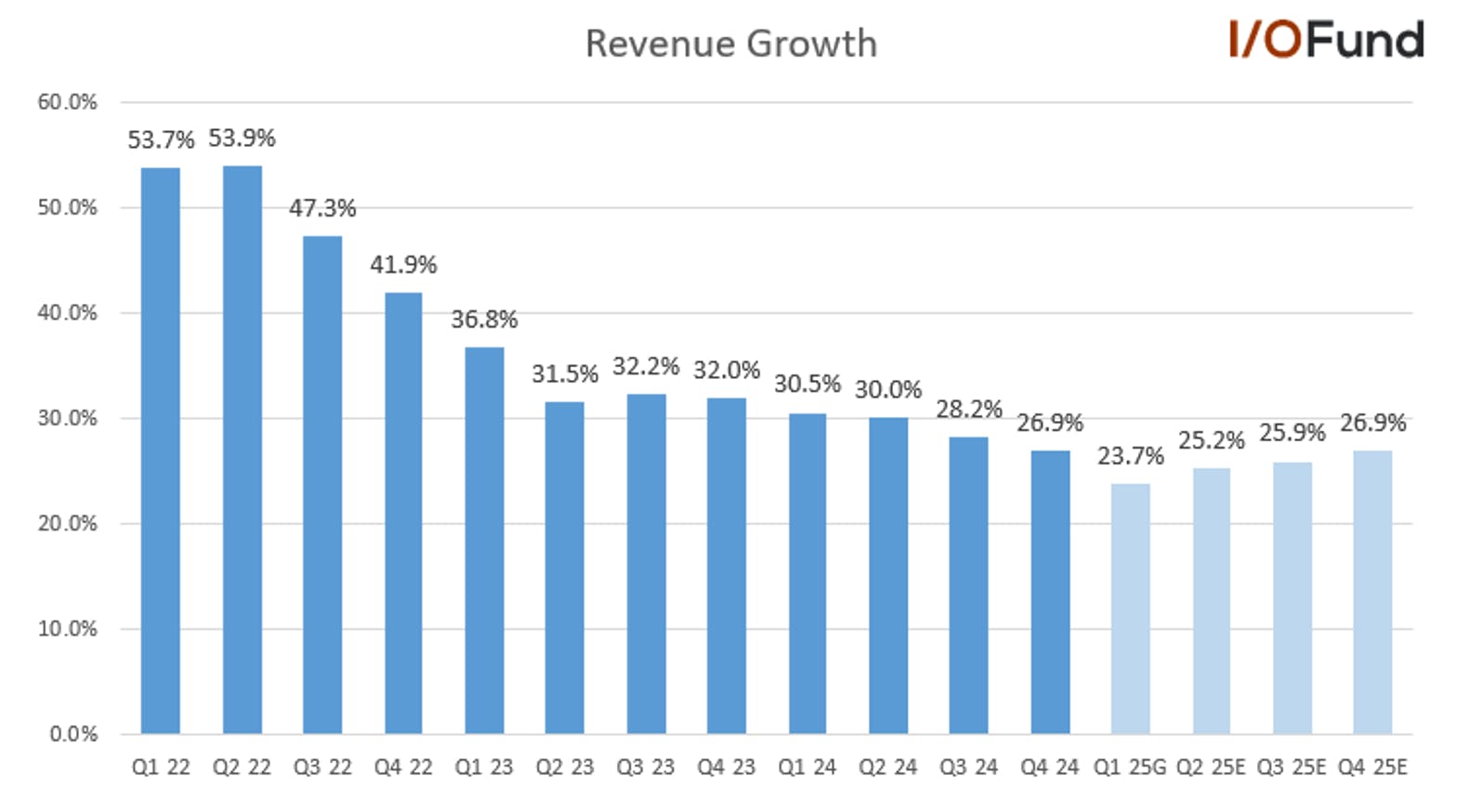
Multiple key metrics showed strong growth in Q4, with a handful of analysts praising the productivity strides and strong execution on these key metrics in the quarter:
- Acceleration in growth in >$1M customers
- High concentration of net new adds for >$1M customers in Q4
- Acceleration in paying customers
- Acceleration in billings and strong Pool of Funds activity
- DBNRR expanding
The I/O Fund first covered Cloudflare’s AI inference story for premium members in October 2023, recently closing the position for a gain of 97% and making multiple purchases in small and mid-cap AI beneficiaries. Learn more here.
Cloudflare’s Paying Customer Growth Accelerates
Cloudflare reported 173 customers in the >$1M cohort at the end of 2024, for 47% YoY growth, up from 37% growth last year. Management noted that of the 55 of the net new adds in 2024, more than half came in Q4, implying at least 28 in the quarter, and 27 combined for the other three quarters; a significant uptick.
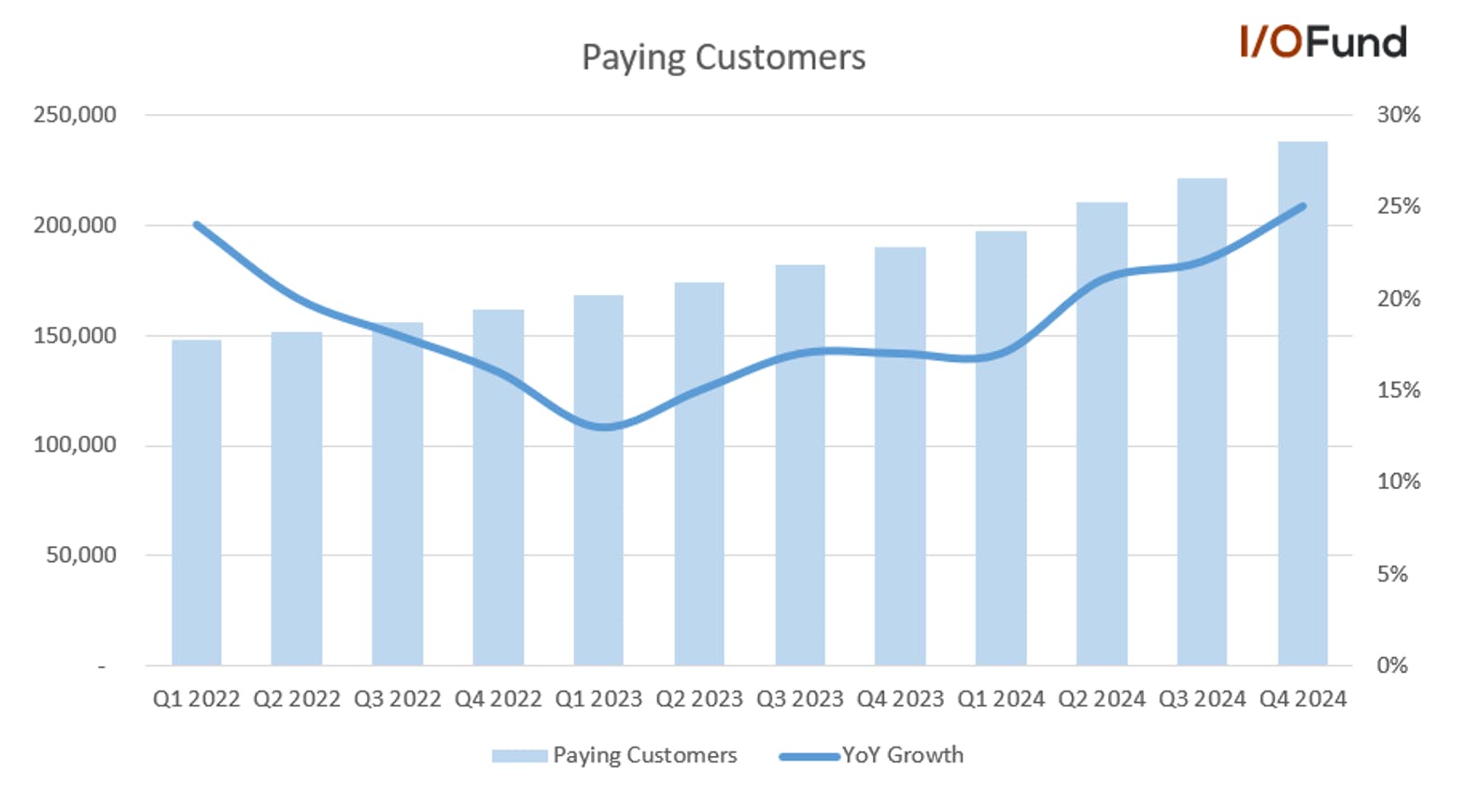
Paying customers increased 25% YoY to 237,714 at the end of Q4, an 8-point acceleration from the start of the year. From late 2022 through 2023, growth had remained in the mid-teens, with the recent uptick in paying customers coming alongside growth in AI applications and more mainstream AI usage with numerous consumer-facing and enterprise-focused models being released. What’s impressive is that Cloudflare is matching 2022 growth rates at a nearly 100,000 larger paying customer scale. Additionally, 2 of the past 3 quarters have seen paying customers grow at 7% QoQ, suggesting that a further acceleration could be still in store.
Cloudflare’s Billings Growth Tops 30% Again
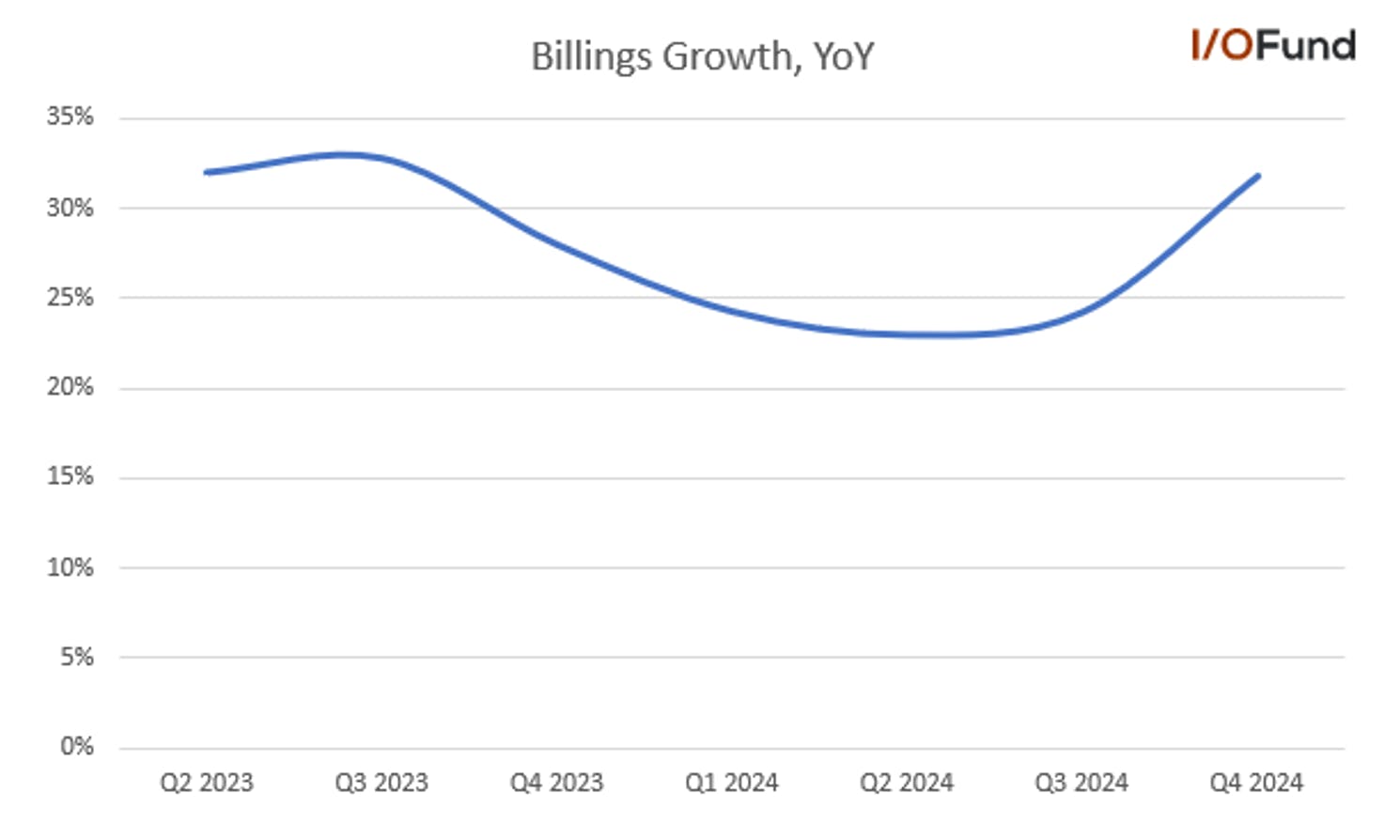
Billings meaningfully inflected in Q4, rising nearly 32% YoY and 22% QoQ to $548 million. Growth had previously been in the low-20% range for the first three quarters of 2024. Billings likely benefited from a “notable uptick in close rates” and “an improvement in sales cycles,” with management mentioning that the majority of large customers “whose deals had slipped from Q3, reengaged and signed significant contracts in Q4.”
Pool of Funds activity was quite strong as well, with activity comparable to Q3 at around 9 percentage points; management noted that a $20 million Pool of Funds contract with a Fortune 100 tech company was the largest new customer win in company history, along with a $13.5 million deal with a leading AI firm. Pool of Funds is expected to pick up strength in the second half of the year after leading to some near-term headwinds as customers transition to these contracts.
There were other encouraging signs within ramped account executives, with management saying that they “delivered a 10 percentage point increase in ramped AEs achieving over 80% of quota compared with 2023, with most gains coming in the 125% or higher attainment cohorts.” For 2025, management is expecting YoY growth in ramped account executives to “accelerate each quarter throughout 2025, further laying the foundation for Cloudflare’s next phase of growth at scale.”
DBNRR Ticks Higher to 111%
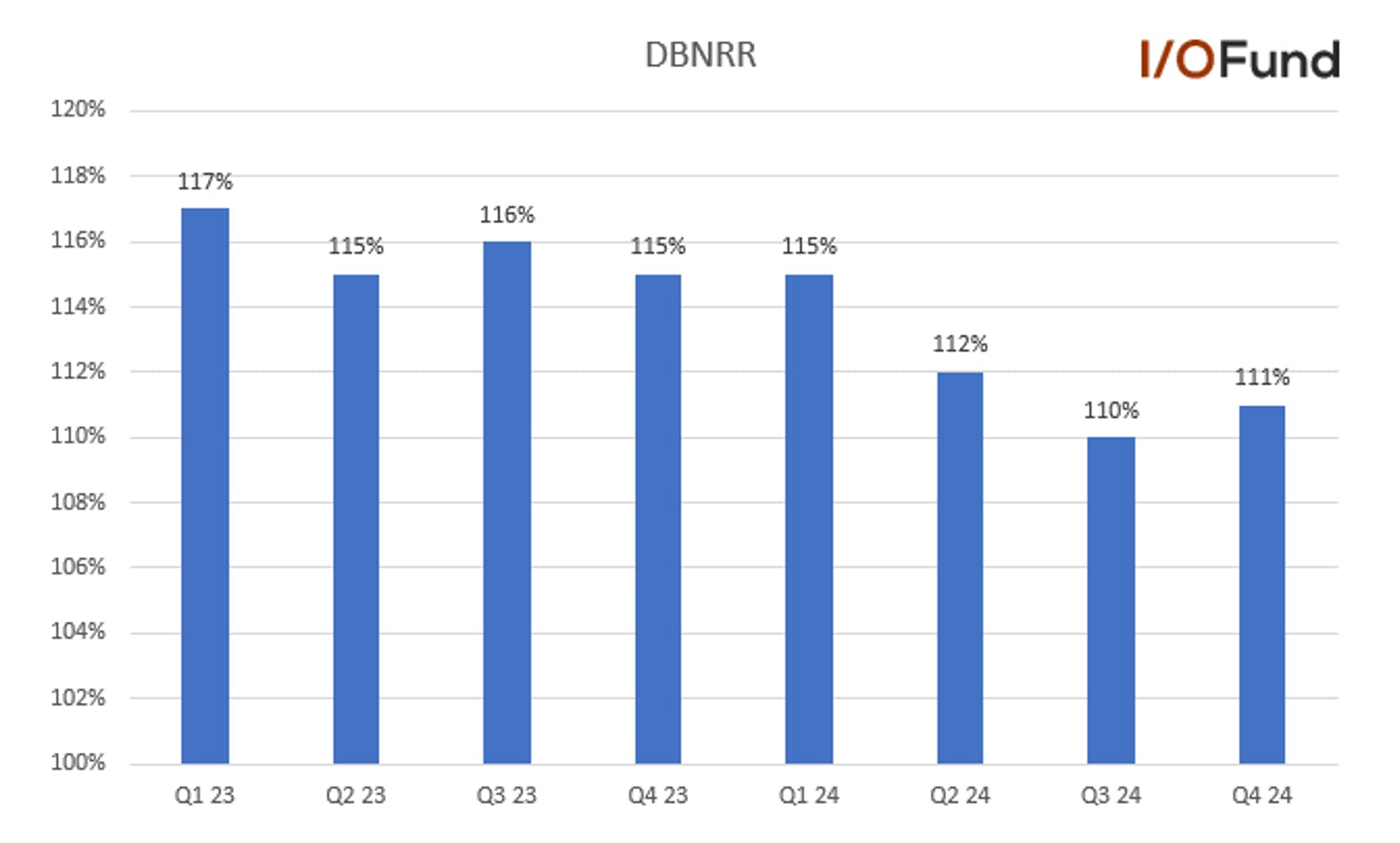
Cloudflare reported that its dollar-based net retention rate (DBNRR) ticked 1 point higher to 111%, marking the first time the metric has grown since Q3 2023. Management commented that “there can be some variability in this metric quarter-to-quarter, but we believe the recent decelerating trend in DNR is stabilizing despite continued near-term headwinds from increased traction with pool of fund contracts.”