
Semiconductors

NVIDIA Blackwell Ultra Fuels AI & HPC Innovation, Efficiency and Capability

Written by

I/O Fund Team

Research Team

Published: March 21, 2025

Last Updated: March 21, 2025

NVIDIA’s groundbreaking hardware technologies and AI are unlocking unprecedented computational power. At the NVIDIA GTC 2025, NVIDIA unveiled its Blackwell Ultra GPU designed for the “Age of Reasoning” at its 2025 GPU Technology Conference (GTC). AI accelerators like GPUs are well suited for AI training and inference due to parallel processing, which allows for many calculations to be performed simultaneously. Only 30% of the top 500 supercomputers relied on accelerated computing; today, 80% do. The Green 500 ranking of supercomputers by energy efficiency shows an even more pronounced trend.
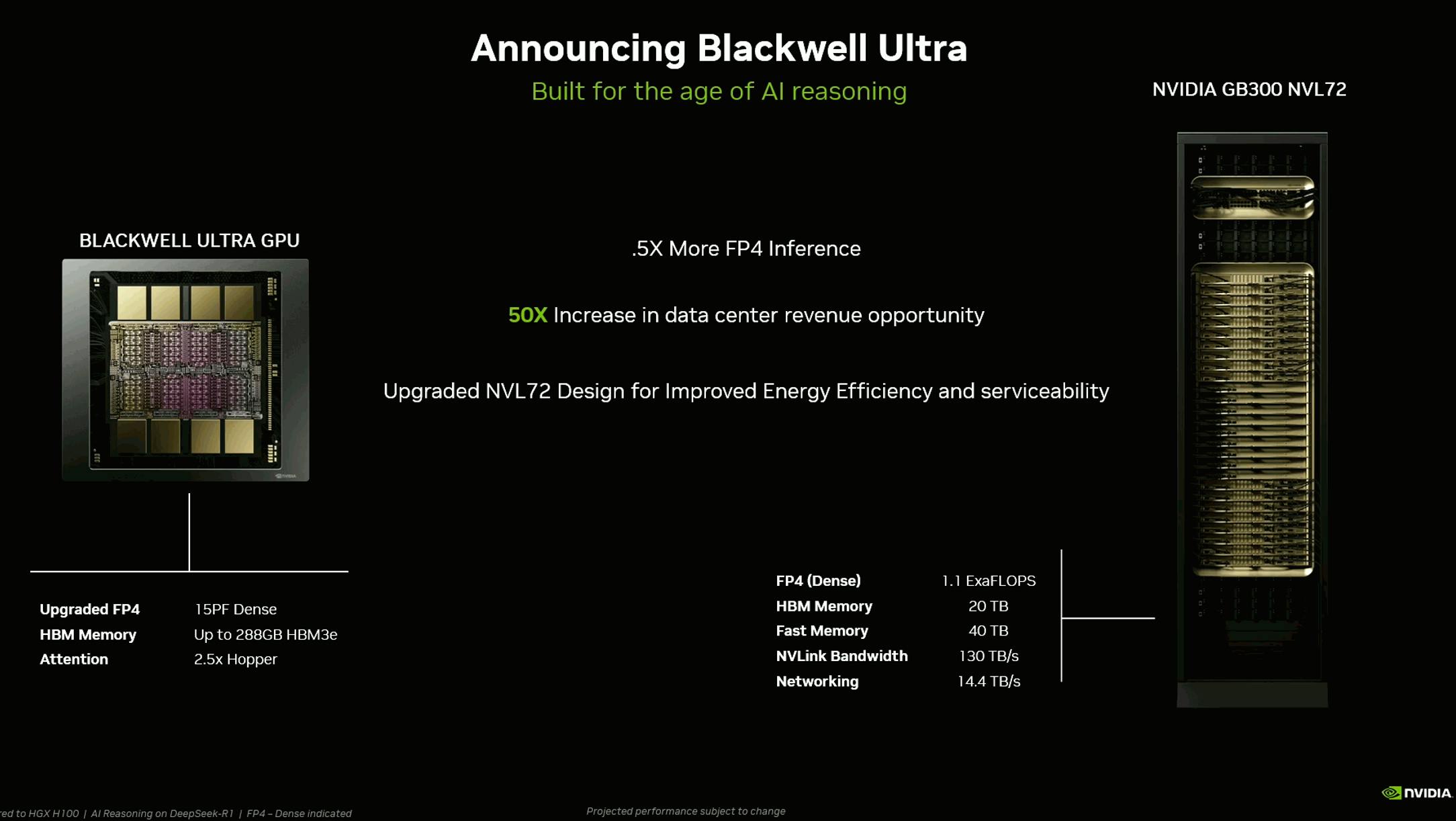
NVIDIA Blackwell Ultra GPU and GB300 NVL72 server unveiled at GTC 2025.
NVIDIA Blackwell Ultra GPU and GB300 NVL72 server key specifications included. Source: NVIDIA

Blackwell Ultra GPUs for the Age of Reasoning

AI reasoning models emulate how the brain thinks to render a conclusion, popularized by OpenAI’s o1, Google’s Gemini 2.0 Flash Thinking and DeepSeek’s R1 A1  models. Reasoning models improve responses to queries and more powerful GPUs improve the performance of these models. Blackwell Ultra GPUs are the next generation of the evolution of the GB200 bolstered by more inference power horsepower, packing 50% FLOPS at 1.1 exaFLOPS of FP dense compute.
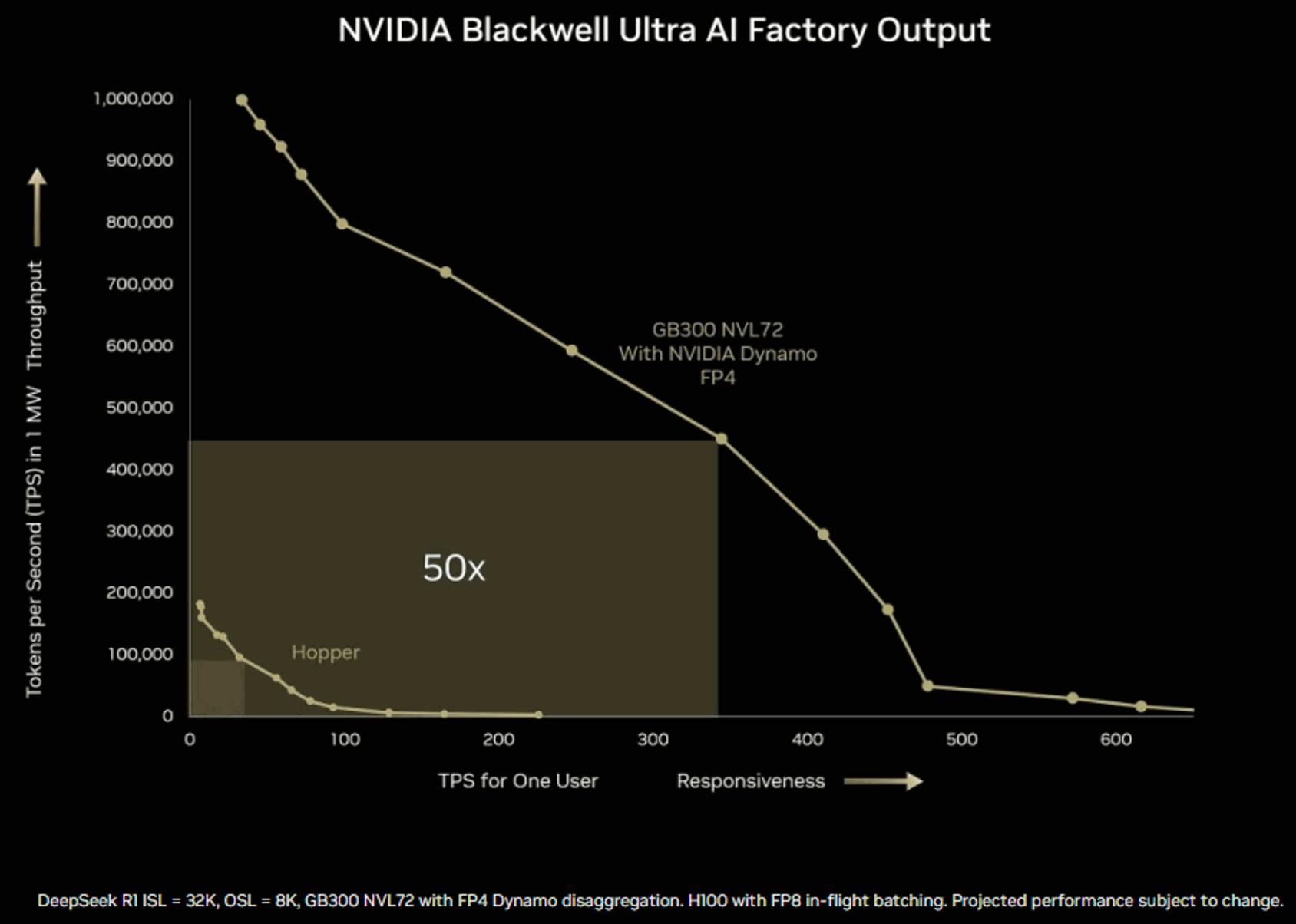
NVIDIA Blackwell Ultra GPUs deliver a 50x performance boost in AI reasoning and HPC.
NVIDIA Blackwell Ultra AI Factory Output chart shows 50x performance increase. Source: NVIDIA

At the NVIDIA GTC 2025, in his March 18 presentation titled, “The Next Frontier of AI Supercomputing: Efficiency With Unprecedented Capability”, NVIDIA’s Vice President of Hyperscale and HPC Computing, Ian Buck, stated, “Blackwell Ultra takes GB200’s 40x data center revenue opportunity to 50x”, citing faster token serving and higher throughput ideal for post-training for models like DeepSeek, which chomp through 100 trillion tokens.

NVIDIA GB300 NVL72 Unleashes Inference Horsepower

NVIDIA’s GB300 superchip combines two Blackwell Ultra GPUs with one Grace CPU. Blackwell Ultra GPUs can be used in the NVL72 rack server, which integrates 72 Blackwell Ultra GPUs and 36 Grace CPUs. The NVIDIA GB300 NVL72 has a fully liquid-cooled rack-scale design. AI factories achieve 50X higher output for reasoning model inference with the NVIDIA GB300 NVL72 compared to the NVIDIA Hopper platform when used with the NVIDIA Quantum-X800 InfiniBand or Spectrum-X Ethernet paired with ConnectX-8 SuperNICS.

Blackwell Ultra’s Silicon Photonics Slashes Power Consumption by Up to 77%

NVIDIA’s Blackwell Ultra GPUs use co-packaged optics with silicon photonics, which integrates optical and silicon components onto a single substrate. This reduces power consumption by eliminating the need for external lasers and pluggable transceivers to achieve a significant reduction in power from 39 watts to 9 watts. Buck said that silicon photonics “… gives you that benefit from going from 30 watts of power down to only 9 watts of power for the same number of ports, and that’s huge. It doesn’t sound like 39 sounds a lot. But if you get 400,000 GPUs in an AI supercomputer, there’s like 24 megawatts of lasers like so that’s a lot of laser light that could be optimized and made more efficient.”

Join thousands of investors who trust I/O Fund’s expert stock analysis on AI, semiconductors, cryptocurrency, and adtech — sign up for free! Click here!

Beth Kindig, Lead Analyst at the IO Fund, pointed out in her “AI Power Consumption: Rapidly Becoming Mission-Critical” blog article that, “In my analysis last month on the Blackwell architecture, I made the argument these estimates are too low and that my firm expects we will see a $200 billion data center segment by end of CY2025 propelled forward by the B100, B200 and GB200, including the following points: “Taiwan Semi’s CoWos capacity, which is essential for Blackwell’s architecture, is estimated to rise to 40,000 units/month by the end of 2024, which is more than a 150% YoY increase from ~15,000 units/month at the end of 2023. Applied Materials has boosted its forecast for HBM packaging revenue from a prior view for 4X growth to 6X growth this year.””

Beth Kindig, founder and lead tech analyst of I/O Fund

Get Our Free Weekly Stock Newsletter

Get weekly stock insights, market analysis, and technology updates straight to your inbox.

  • Weekly stock insights
  • Market analysis
  • Technology updates

The Next Generation CPU: Vera CPU: Grace’s Successor

NVIDIA’s next-generation CPU is Vera, a follow-on to Grace. With 88 cores (176 threads via spatial multithreading), Vera doubles Grace’s performance 2X, memory bandwidth by 5X per watt, and has a beefier chip-to-chip link for the upcoming Rubin GPU. “Every core talks to every other core,” Buck stressed, contrasting x86’s front-end focus. Vera’s 12-thread memory saturation trounces traditional CPUs, feeding GPUs for AI and HPC back-end tasks. Vera Rubin will launch in 2026. Vera Rubin NVL 144 will launch in the second half of 2026. FYI, Vera Rubin was an American astronomer who discovered dark matter. Rubin will mark the shift from HBM3/HBM3e to HBM4 and HBM4e for Rubin Ultra.

The Next Generation GPU Architecture: Rubin Ultra

NVIDIA will be launching Vera Rubin NVL 576 in the second half of 2027, which will have 14X the performance of GB300 NVL72. Rubin will have 1.2 ExaFLOPS of FP8 training compared to just 0.36 ExaFLOPS for B300, resulting in 3.3X compute performance. Bandwidth will improve from 8 TB/s to 13 TB/s. It will have 576 Rubin GPUs in a rack. Compute density is boosted by featuring four dies per package. Rubin Ultra NVL576 will have 365 TB of memory. The inference compute with FP4 rises to 15 ExaFLOPS with 5 ExaFLOPS of FP8 training compute. NVIDIA hinted the next-generation architecture after astronomer Vera Rubin will be named after theoretical physicist Richard Feynman.

The I/O Fund recently entered five new small and mid-cap positions that we believe will be beneficiaries of this AI spending war. We discuss entries, exits, and what to expect from the broad market every Thursday at 4:30 p.m. in our 1-hour webinar. For a limited time, get $110 off an Annual Pro plan with code PRO110OFF [Learn more here.]

Please note: The I/O Fund conducts research and draws conclusions for the company’s portfolio. We then share that information with our readers and offer real-time trade notifications. This is not a guarantee of a stock’s performance and it is not financial advice. Please consult your personal financial advisor before buying any stock in the companies mentioned in this analysis. Beth Kindig and the I/O Fund own shares in NVDA at the time of writing and may own stocks pictured in the charts.

Recommended Reading:

About the author

I/O Fund Team

I/O Fund Team

Team

Curation

Expand your knowledge

View all posts
Beyond Hyperscalers: Here’s the Next $1 Trillion AI Infrastructure Opportunity
AI STOCKS

Beyond Hyperscalers: Here’s the Next $1 Trillion AI Infrastructure Opportunity

Since 2022, Big Tech capex has been the clearest barometer of AI demand. But the market’s reaction to Google’s latest earnings shows investors are questioning how long that spending can last. While the market frets over hyperscalers’ cash flows, a second wave of AI infrastructure spending has quietly emerged, driven by enterprises and neocloud customers.

AI STOCKSOCT 30, 2026
Google’s $250 Billion AI Chip Opportunity Takes Aim at Nvidia
AI PLATFORMS

Google’s $250 Billion AI Chip Opportunity Takes Aim at Nvidia

In April, there was a major shift in the AI accelerator market, and for once, it didn’t come from Nvidia. Six months later, merchant TPUs are moving from announcement to commercial execution, with Google recognizing its first revenue from TPU systems in Q2 (from a small base). Last quarter, Cloud revenue growth accelerated to 82% for $24.8 billion, compared to $22.5 billion expected. In addition, new details around the TPU 8t show that Google’s threat to Nvidia is not limited to inference. At the time, we pointed out that Google may be one of Nvidia’s strongest AI challengers, as Big Tech is closest to the problems that accelerators must solve. The problem that Google is prioritizing is lower cost per token, with token economics becoming a predominant concern as AI spending is pushing Big Tech’s free cash flows into the red. Below, we discuss two reasons why Google’s AI story is about to change, not from advancements in AI software, but by going after one of the most profitable hardware businesses the tech industry has ever seen.

AI PLATFORMSOCT 23, 2026
AI Debt Nears $500 Billion in 2026: What It Means for Nvidia, Oracle, CoreWeave and AI Stocks
AI STOCKS

AI Debt Nears $500 Billion in 2026: What It Means for Nvidia, Oracle, CoreWeave and AI Stocks

AI-related debt reached $466 billion through September 2026, more than four times last year’s pace. We break down who is borrowing, the three ways new AI chip deals are being structured, and where interest costs land across Nvidia, Oracle, CoreWeave, Broadcom and Big Tech.

AI STOCKSOCT 23, 2026