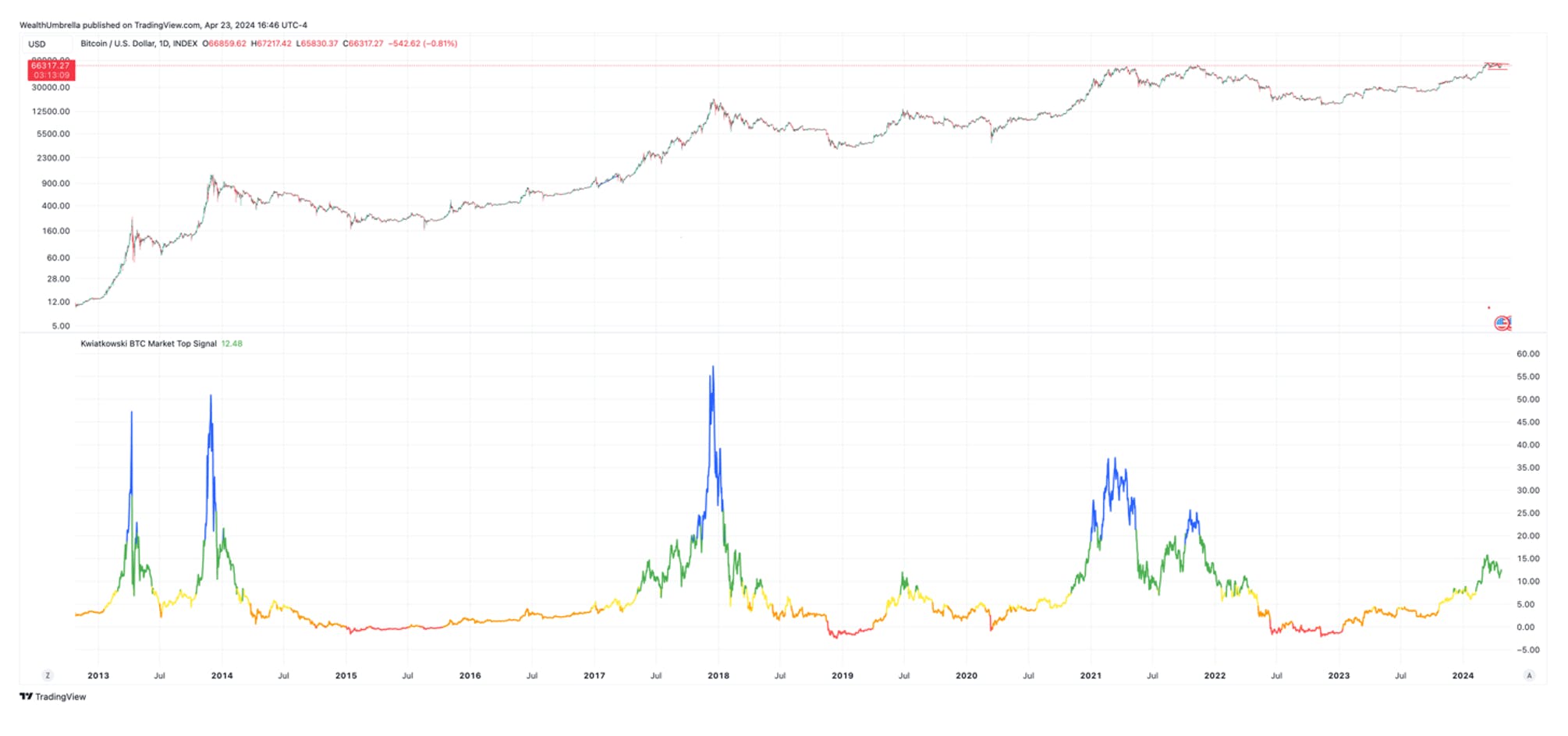


Bitcoin is an asset where the bulls pound the table to “buy, buy, buy,” and the bears relentlessly and stubbornly call it a scam. In reality, both are the wrong approach. This is because although Bitcoin is the highest performing asset in the past ten years, it’s also the one of the most volatile. Consider that it was trading at $58,000 in March of 2022, and by December of 2022 had lost 72% of its value. That year, the loud and proud Bitcoin bulls were not your friends.
Timing is everything. When it comes to timing, our firm has a proven track record of navigating the life-changing bull case that crypto offers while minimizing the volatility associated with different coins – we achieve this via a unique approach combining technical and on-chain analysis to identify major lows and major tops in each cycle. For example, we diligently detailed to our readers in December of 2022, when Bitcoin was trading in the $16,000 region, that we are “Bullish on Bitcoin”:
“Though we are in the 4th bear cycle in Bitcoin’s history, the prior 3 cycles suggest where we are is a rare buying opportunity. There is ample evidence to support the $15,500 level is either a major low or very close to a major low. Both the technical and on-chain analysis support this. As Bitcoin continues to integrate into the global economy, we expect both the volatility and epic returns to calm down. For now, we are content buying Bitcoin at these lows with a long-term mindset.”
One year later, our most recent Bitcoin article stated that the coming pullback into the $39,000 – $35,000 region would likely be “the last great buying opportunity” in this bull cycle. At the time our upper targets were between $75,000 – $132,000. That correction bottomed around $38,500 then led to 90% rally, which topped less than 2% from our $75,000 target.
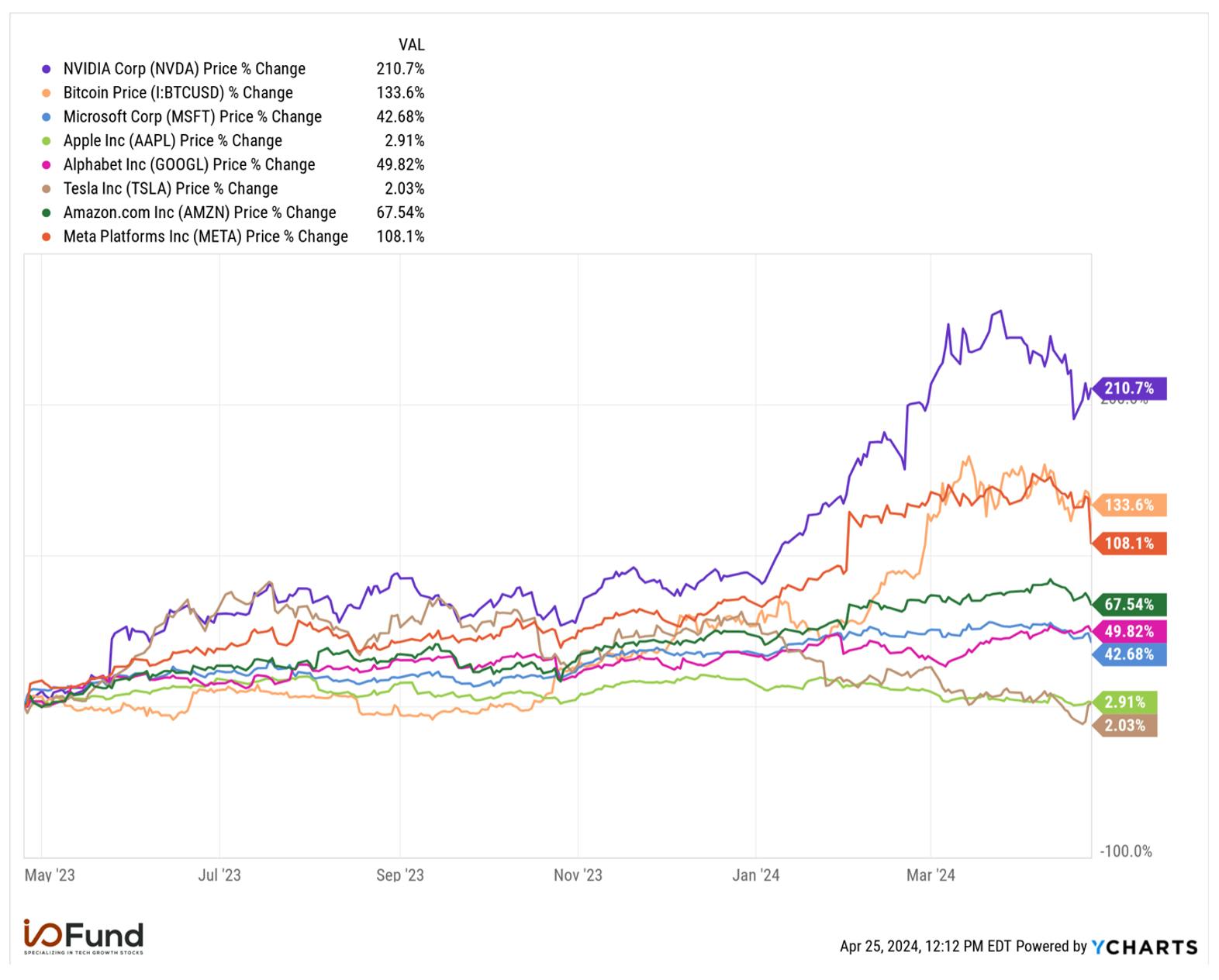
If Bitcoin were in the Mag 7, it would be the second strongest performer both YTD and on a 1-year basis, edging out Meta at returns of 133% in 1-year and 52% YTD. Had you bought in the $16,000 region, the returns would be 300% in about 17 months’ time.
Looking forward, an important question to ask is, are we at the end of a bull cycle or do we have more room to run? We believe that there is more room within this uptrend. As a result, we are raising our upper Bitcoin targets, as the current volatility appears to be another correction within a much larger uptrend.
In this article, we will support this thesis through on-chain analysis as well as technical analysis. We will also address how Bitcoin appears to be setting up for higher levels while equities look like they’re topping. The popular narrative is that crypto and stocks – especially tech stocks — are correlated. It’s our stance that these two investments are not as correlated as many believe, which lends credence to this potential divergence.
Updated Bitcoin Game Plan
We have remained steadfast on the long-term pattern for Bitcoin, which you can see was intact as far back as July of 2022. While the 2022 drawdown went lower than we anticipated, once we got signs of a bottom, we maintained this pattern around the $15,000 lows. The implication was that 2022 was a correction within a much larger uptrend, and that we were going to see a new bull cycle into 2023 – 2024.
As of today, we are more than halfway into the current bull cycle, which is the final 5th wave in a very large 5 wave uptrend that started in late 2018. What this means is that as we approach our upper targets, our game plan will shift from accumulation to distribution.
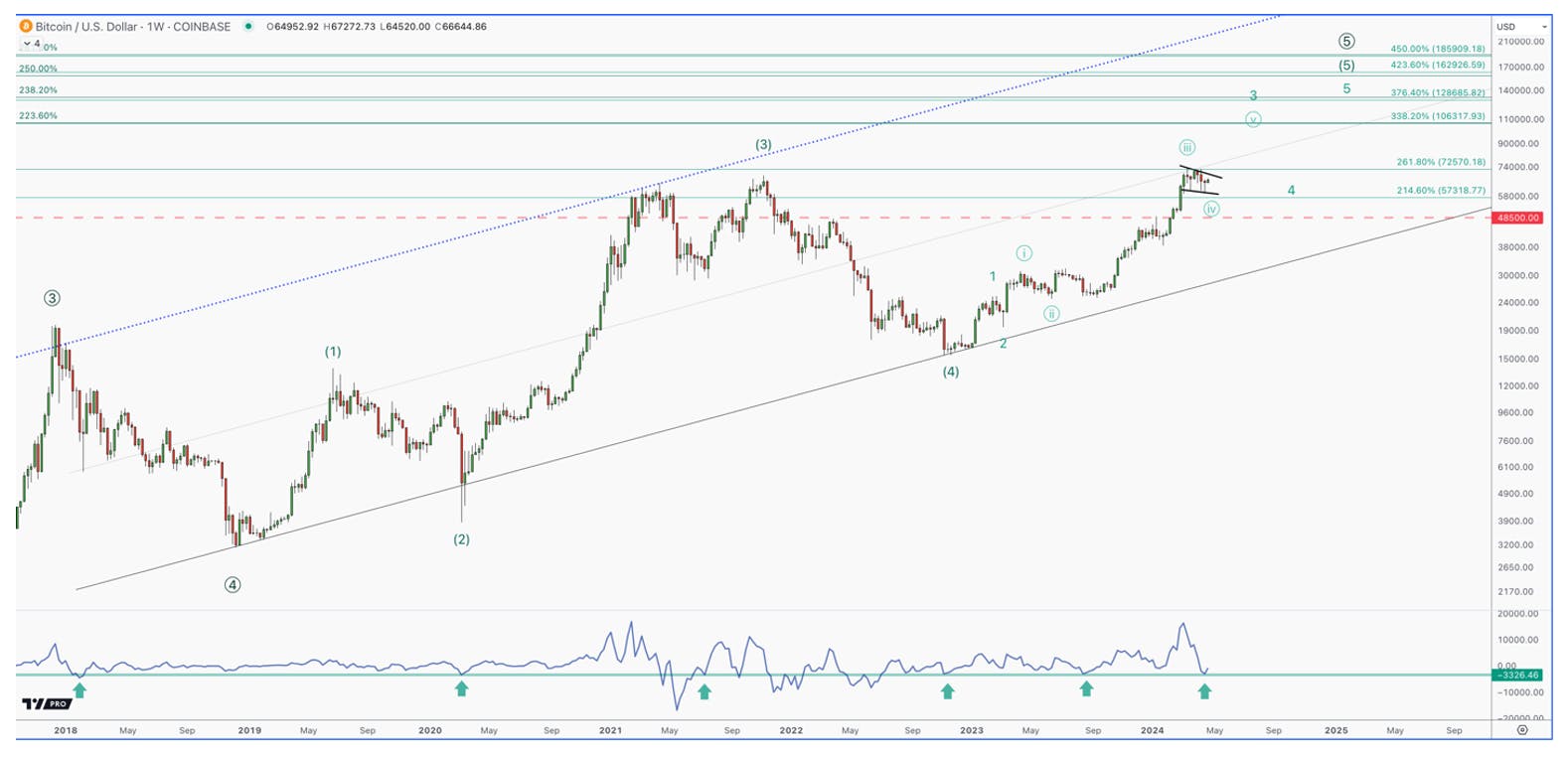
The current drawdown appears to be tracing a bull flag, which is a correction within an uptrend. The $57,000 region is very strong support, which is the upper range of our support zones that need to hold in order for us to push higher. This is over 25% lower than price currently is, which shows the level of strength still in Bitcoin. If we do see another drop, we can go as low as $42,750 without invalidating the larger uptrend in play. So, this ongoing pattern is comfortably intact and has ample room to drop, if we see more volatility.
While the pattern appears to be corrective, and tracing a standard pattern we see within larger uptrends, the momentum oscillator below price is at a major support zone. Note how this support region acted as key lows, especially in the current uptrend that started in late 2022. Also, note how much higher price is compared to other instances where this support was tested. This suggests a low being put in, while also suggesting that we have ample room to push higher in the coming weeks to months.
Because of this development, we are increasing our upper target zone from $75,000 – $130,000 to $106,000 on the low end, and $190,000 on the high end. As long as the $42,750 support region holds on any on-going volatility, then we have no reason to doubt the uptrend in place. That being said, we do not see the same upside within the equity markets, which begs the question – is Bitcoin highly correlated to tech stocks?
Bitcoin vs. Tech
On April 18th, we saw an escalation of the concerning geopolitical conflict between Iran and Israel. As a result, the NASDAQ-100 closed down over 2% the following day, with AI leaders like NVDA giving back 10% in a single day.
There were not many areas of tech that were spared on that day of selling, as investors sought to de-risk at any price. One would think Bitcoin would follow tech on this day, but it was instead up nearly 1%. In fact, many alt-coins shrugged off this news and pushed higher. Granted this is only one day, but it is an intriguing development. This was the first instance of panic selling in over 6 months where we saw investors dumping high risk tech stocks, and Bitcoin not only did not participate, but saw buyers.
If we look back at the long-term correlation to Bitcoin and the heavily focused NASDAQ-100, you will note that the majority of times, these two investments are closer to having minimal to to no correlation. This is in contrast to being highly correlated, as many would believe.
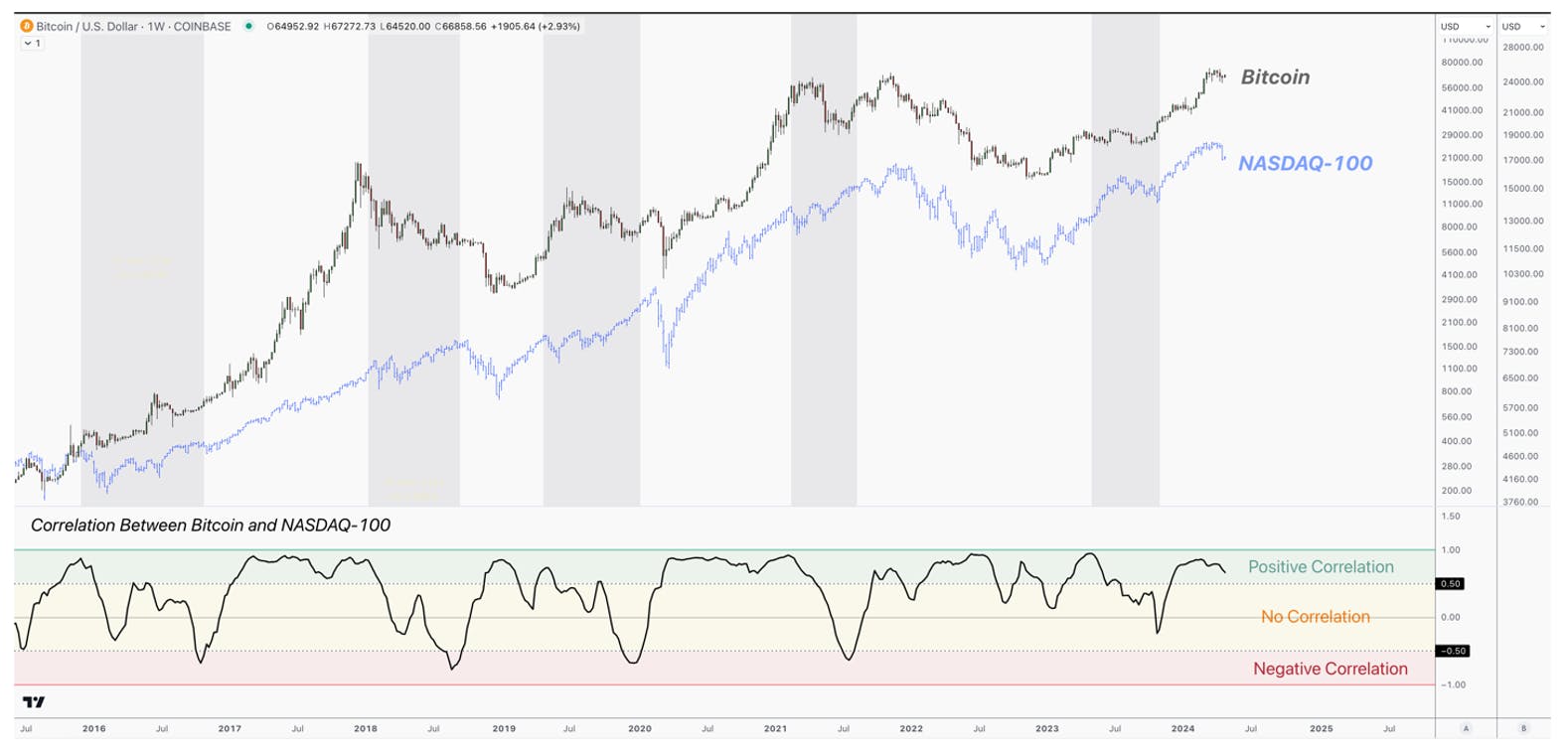
The above chart measures the correlation between these two investments. The best way to read the chart is when the line is moving up, it means the two are correlated and heading in the same direction, while the inverse indicates they are moving in opposite directions. Also, when the cumulative reading is above 0.5 (green), the two investments are highly correlated, between 0.5 and -0.5 (yellow) the two have minimal to no correlation, and when the reading is below -0.5 (red) they have an inverse correlation and are moving in the opposite direction.
Considering the correlation is cumulative on a weekly scale, the two investments have to stay inversely correlated for some time in order to cross below 0. As you can see, there are significant periods where the two have been inversely correlated, which I’ve marked with the gray vertical shades.
For reference, the below chart shows the correlation between the S&P 500 and the NASDAQ-100 through the same period. While there are brief periods where the two indexes have diverged, the cumulative correlation rarely goes below 0.5% (green), and only briefly crossed the 0 line.
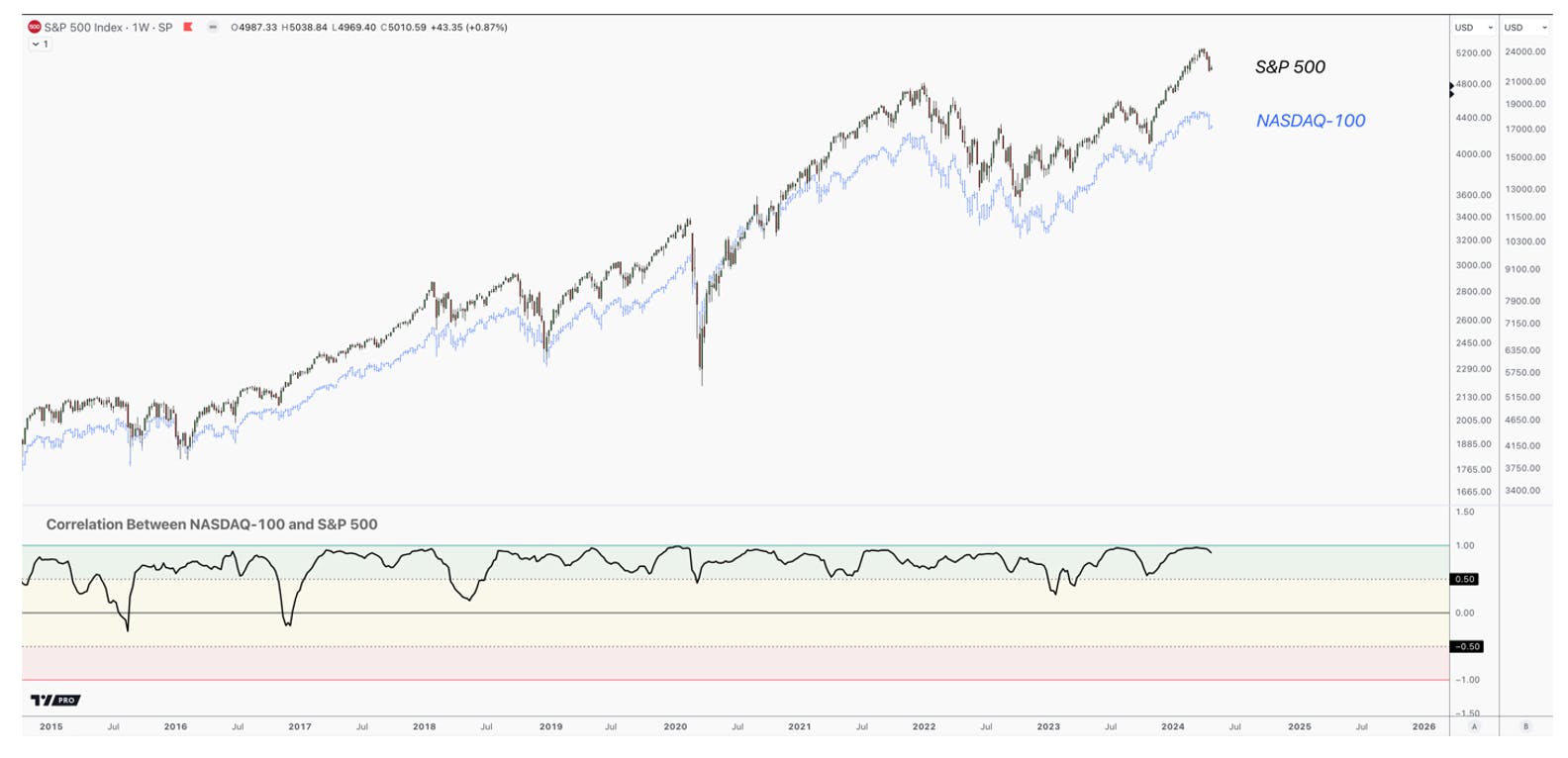
The point is to show actual data in regards to the popular narrative that Bitcoin is just another tech equity play. The data shows that the cumulative correlation has periods where it is highly correlated to tech, but what is key to understand, is that it also has extended periods where it is inversely correlated. The norm is that the two investments have had a low to no correlation, which supports the inverse move that we saw between Bitcoin and tech stocks on April 19th.
This supports a probable scenario where equities could put in a top while Bitcoin continues to run higher.
Sign up for I/O Fund’s free newsletter with gains of up to 221% – Click here
Equities Topping While Bitcoin Goes Higher
In our March report, we showed how the current bull market leaders, the Magnificent 7, were topping, one at a time, while the broad market was continuing to push higher. At the time of the report, only 3 of the Mag 7 were making new highs with the broad market. We then saw the AI leaders within the semiconductor space, including Nvidia, top around early March, while the broad market pushed higher into April.
Seeing the bull market leaders diverge from the broad market is usually a sign of coming weakness, not strength. More times than not, we will see the leaders top first when a meaningful change in trend is about to happen, which we warned our readers about. If we were going to push higher, these leaders needed to breakout to new highs, and until then, we were at risk of a trend change.
This lines up with the potential topping pattern we are seeing within the equity markets, compared to Bitcoin, which appears to have more room to run.
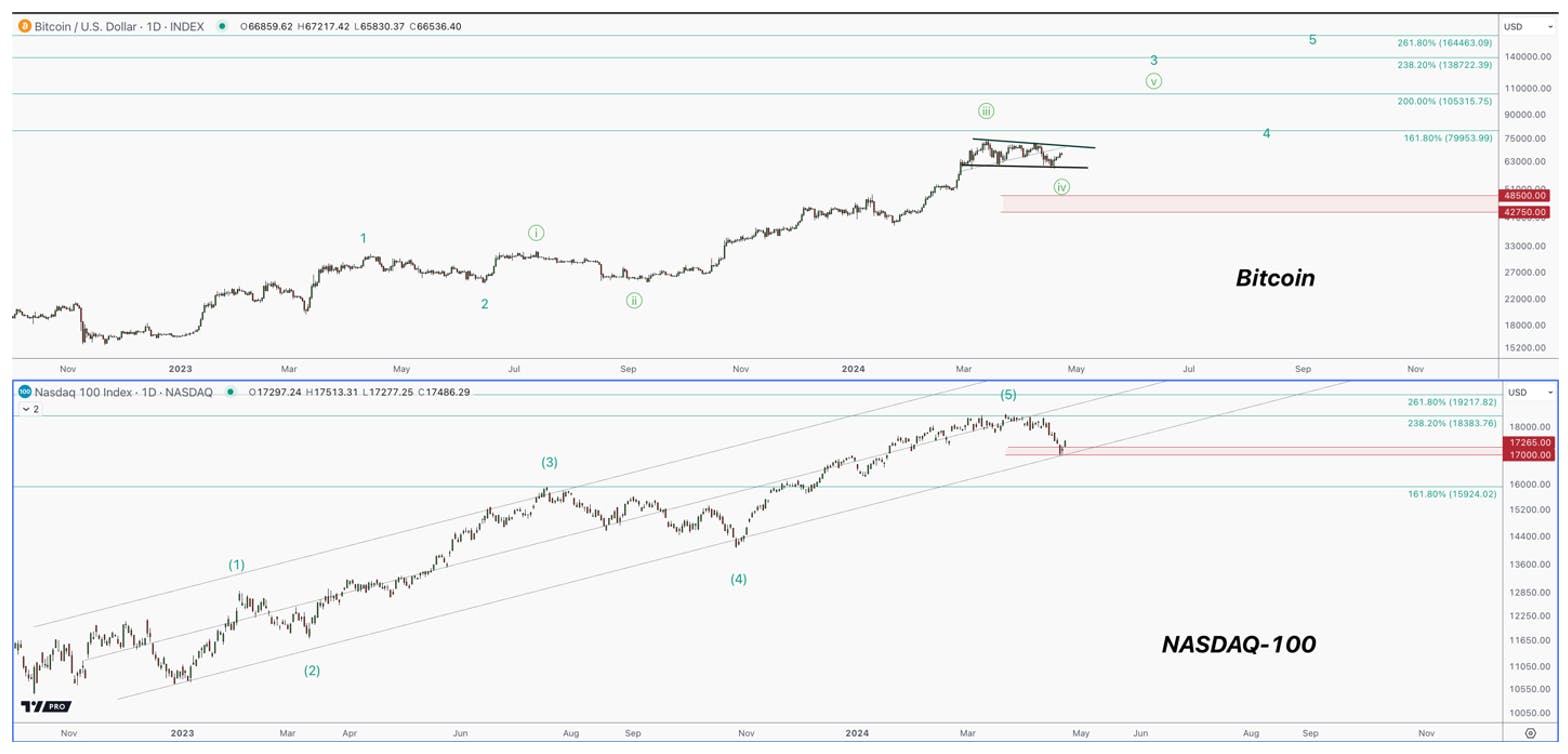
The above chart shows the NASDAQ-100 has completed a mature 5 wave pattern off the 2022 low, and has broken the first of two major supports – 17,265 and 17,000. Bitcoin, on the other hand, is still in an incomplete 5 wave pattern, which is still tracing the 3rd wave higher. Note the current correction is taking the shape of a bull flag, and is nearly 25% above the first critical support level.
The reason for this could have several explanations. For one, it’s worth noting that the demand for Bitcoin has increased substantially, while its supply has remained the same. Spot Bitcoin ETFs have quickly become a popular investment vehicle, and have seen a surge in net inflows, surpassing more than $30B AUM in mid-April after amassing $17B in funds in less than two months after a launch in mid-January. For example, BlackRock’s iShares Bitcoin ETF recorded 71 consecutive days of net inflows. In addition, trading volume on the ETFs nearly tripled in March, reaching $111 billion – for an asset class that launched only two months prior, that’s a significant figure.