

Bitcoin is the best performing asset in market history. There is no stock or asset that has come close to delivering the returns of this digital currency — it has greatly outperformed all FAANGs, and all outliers in the history of the markets. Yet, Bitcoin is also unusual in that its volatility is equally as historic, capable of regular +70% drawdowns that inevitably push to new highs within an average of 2.5 years.
The sane approach to the immense, yet volatile, opportunity that Bitcoin provides is to use risk management. Understanding what Bitcoin is and why governments have been unable to squash the currency is also instrumental to being a successful Bitcoin investor. Since 2019, our firm has helped our readers understand this unique protocol and why it’s worthy of rivaling the world’s most valuable stocks.
However, with that said, it’s technical and on-chain analysis that keeps you in the game with Bitcoin. Our goal with Bitcoin and other life-changing tech stocks is to participate in the outsized returns, while side-stepping painful periods of volatility.
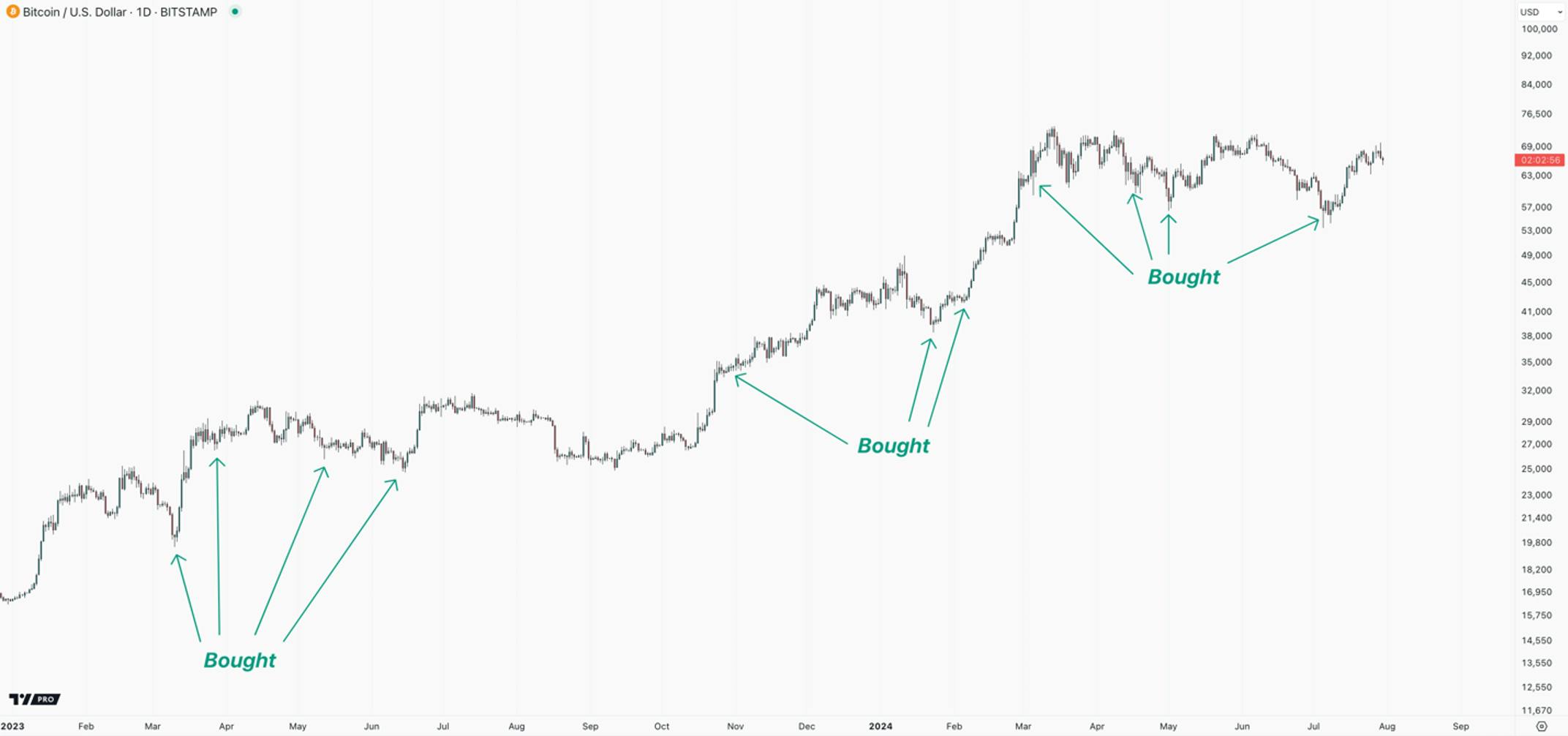
For example, in early 2021, we cut our position in half when Bitcoin was trading between $50,000 – $64,000. This was after accumulating between $7,000 – $20,000. We then started accumulating again in December of 2022, when we went on record stating that Bitcoin was a buy in the $16,000 region.
“Though we are in the 4th bear cycle in Bitcoin’s history, the prior 3 cycles suggest where we are is a rare buying opportunity. There is ample evidence to support the $15,500 level is either a major low or very close to a major low. Both the technical and on-chain analysis support this.”
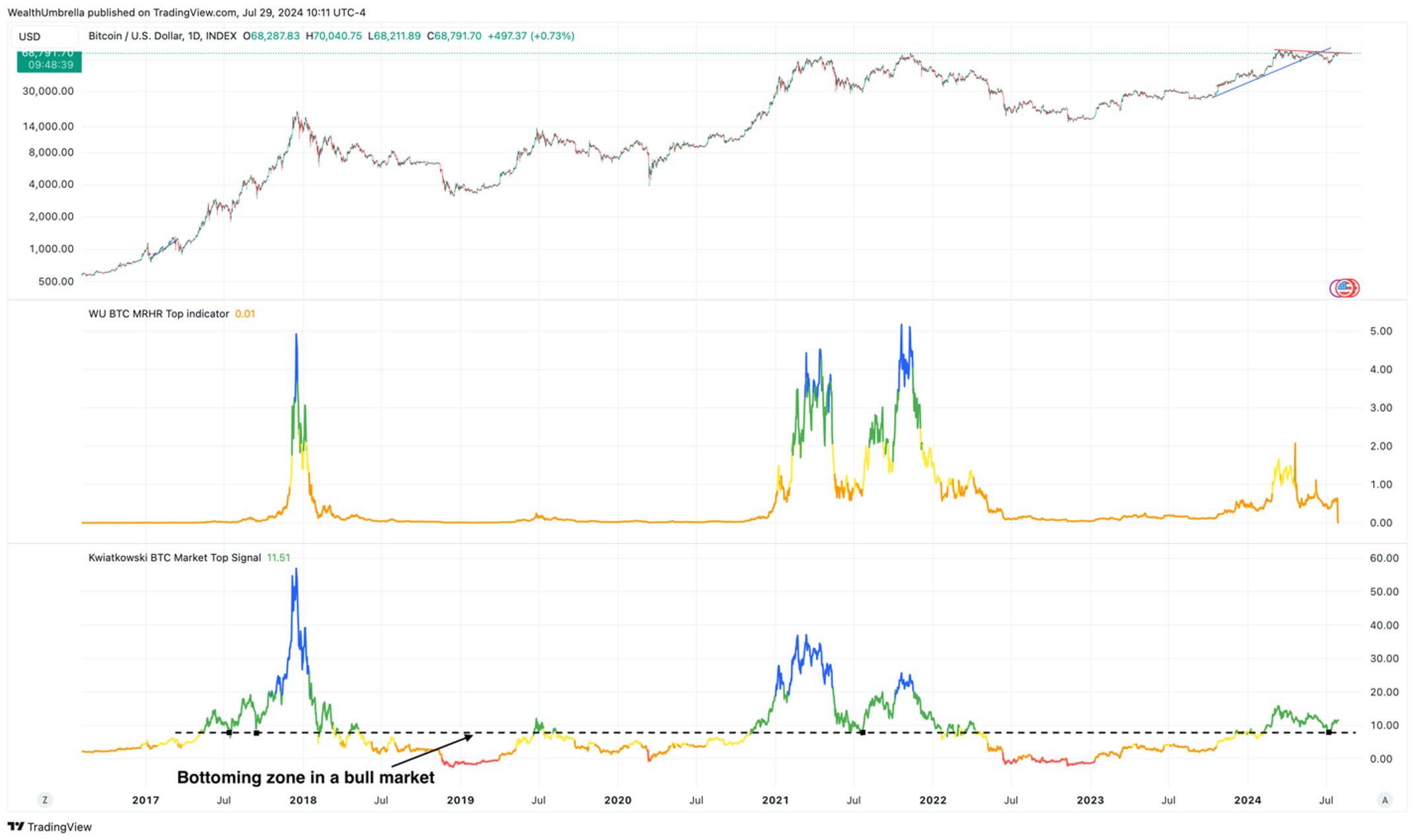
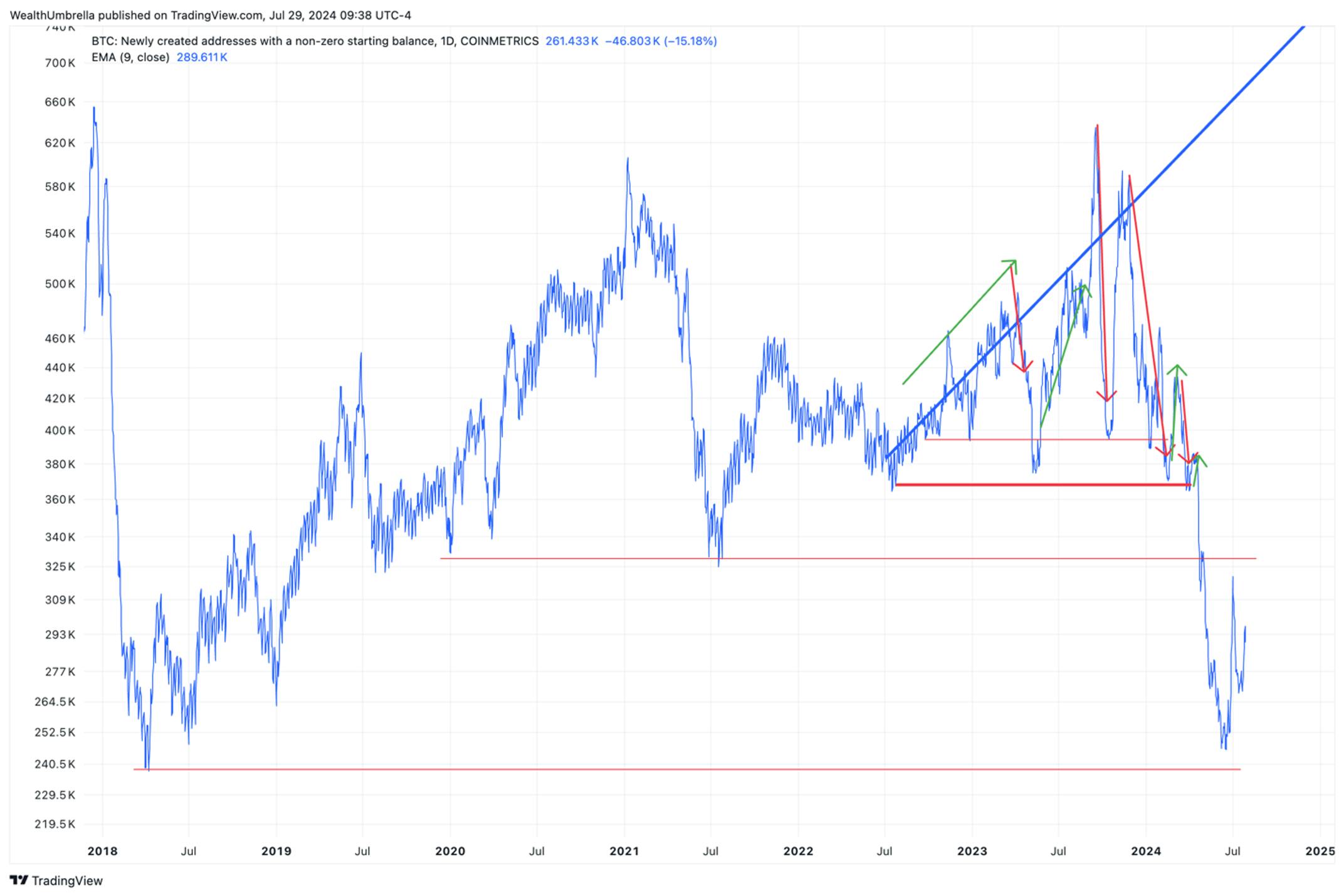
Bitcoin does not have classic fundamental analysis to guide investors, therefore, technical analysis and a new field of on-chain analysis has been a rewarding approach to managing Bitcoin’s risk.
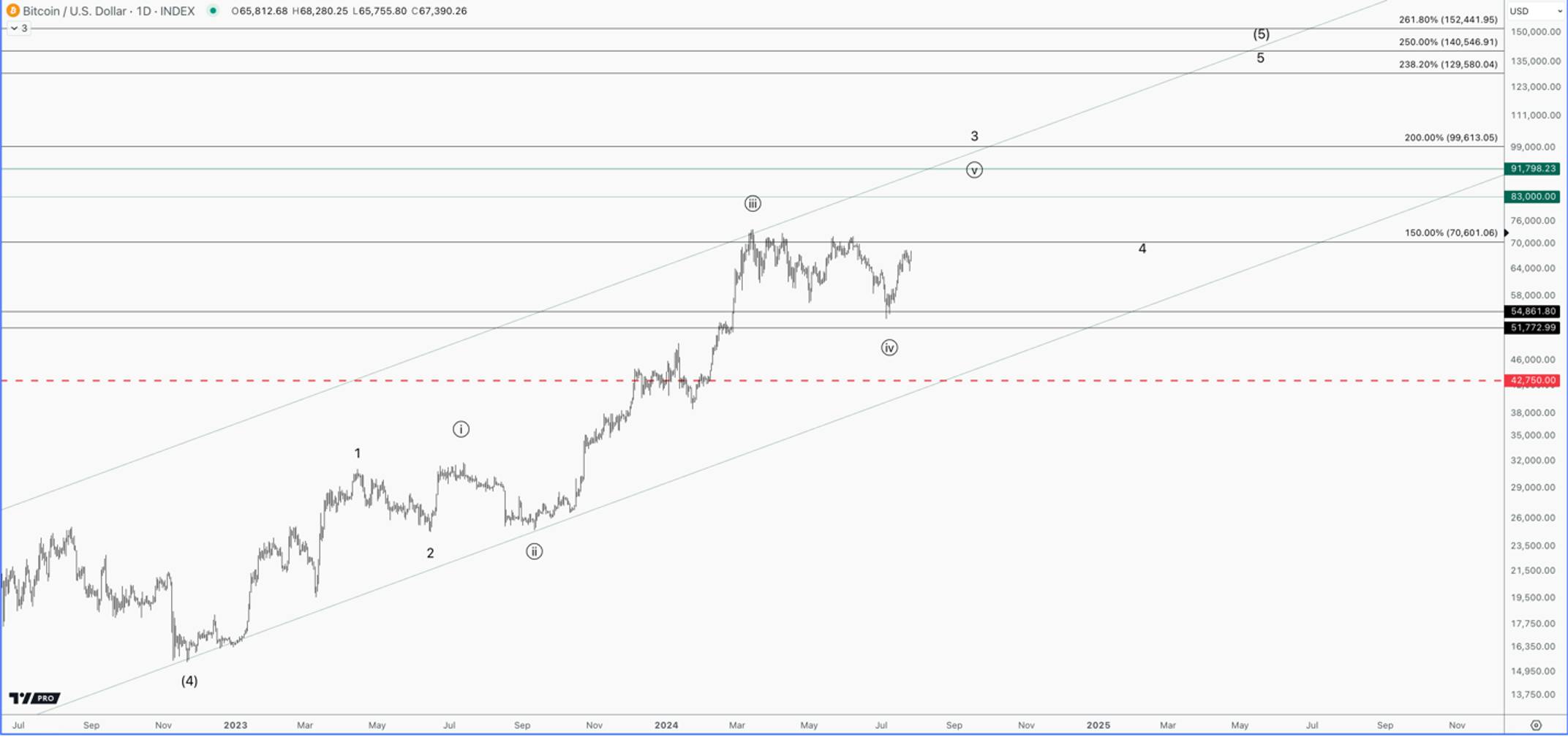
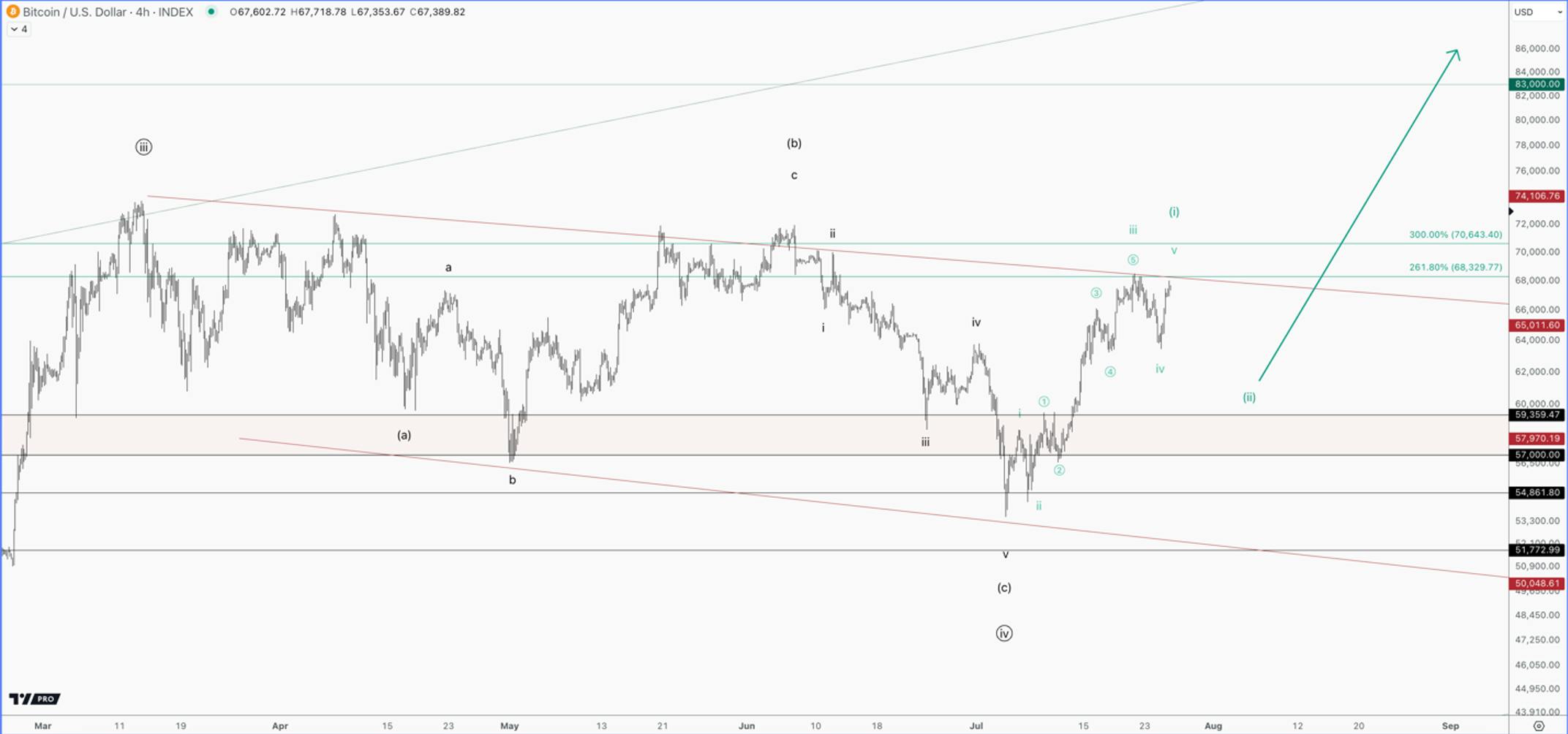
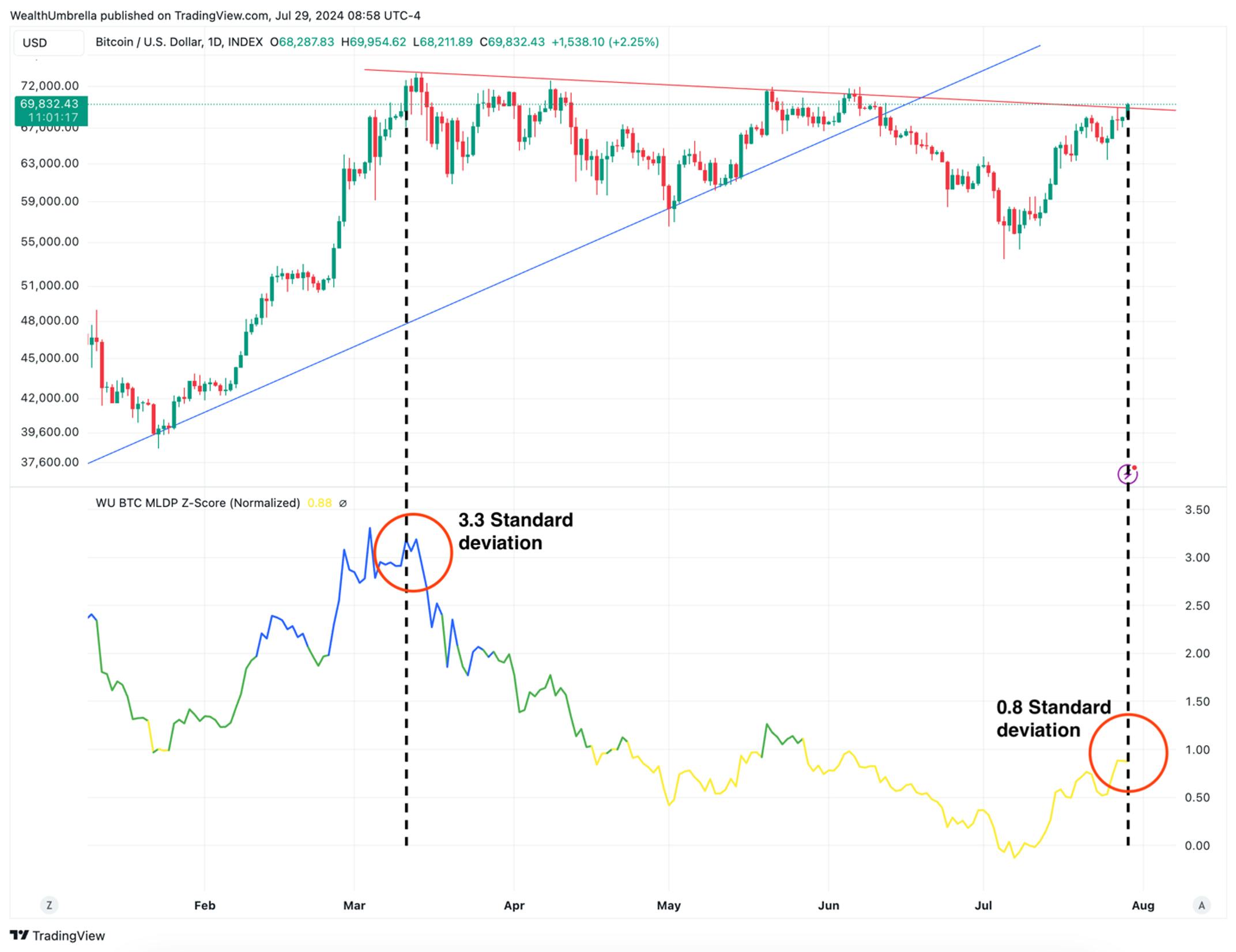
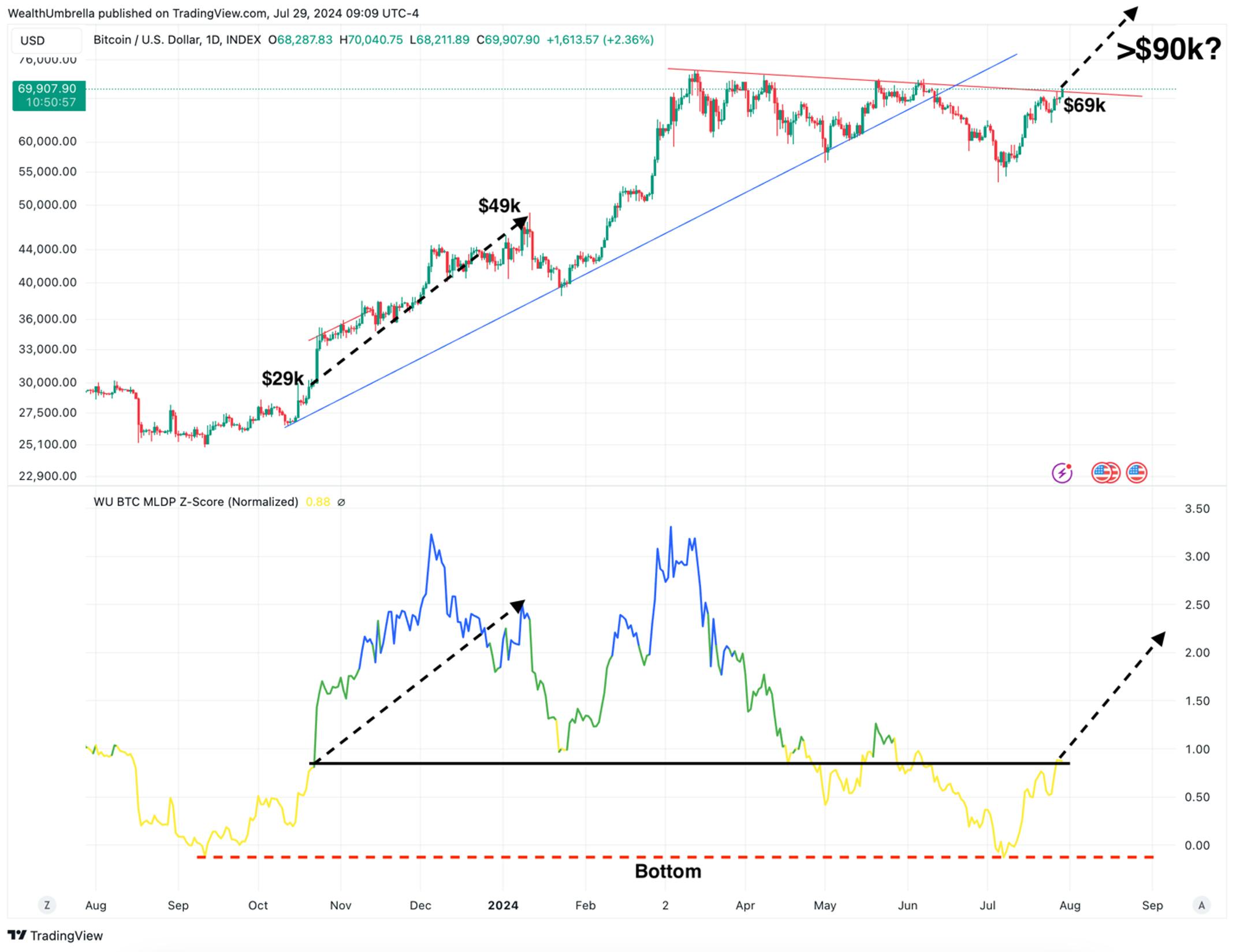
In our last report, we stated that we are raising our overhead targets to $106,000 – $190,000. The technical and on-chain analysis supported this stance, and still does. While bitcoin tested the upper region of our support zone, we believe that the low is likely in. We are setting up for the next leg higher, and setting up our final purchase within the current Bitcoin bull cycle.
The Truth About Bitcoin’s Upside and Downside
The below chart shows four of the best investments in US market history. from their IPOs, Apple is up +143,000%, Berkshire Hathaway is up +215,000%, Nvidia is up +285,000%, Microsoft is up +445,000%.
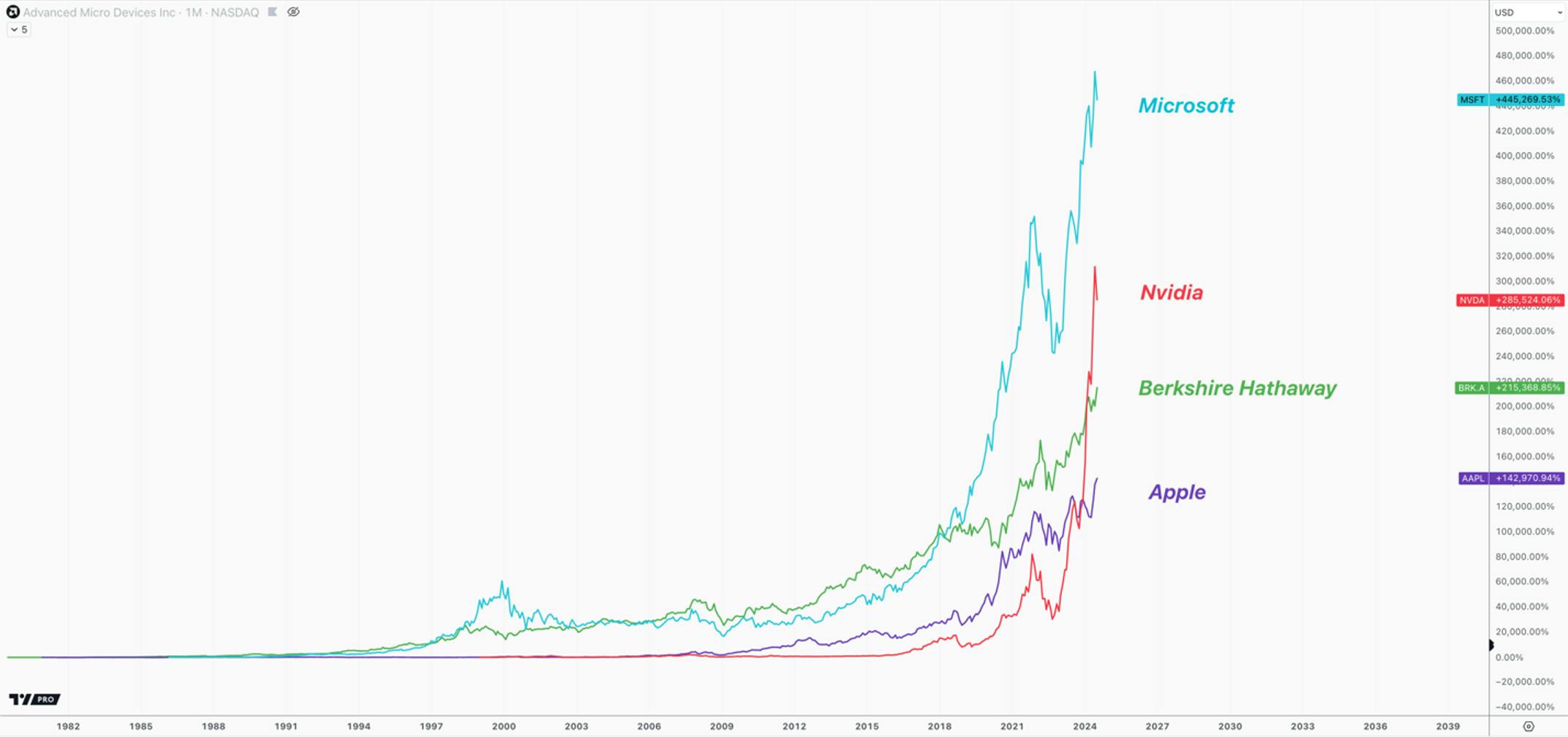
Here is the same chart, measured in percentage increase, when we add Bitcoin in with the four of the best stocks in history.
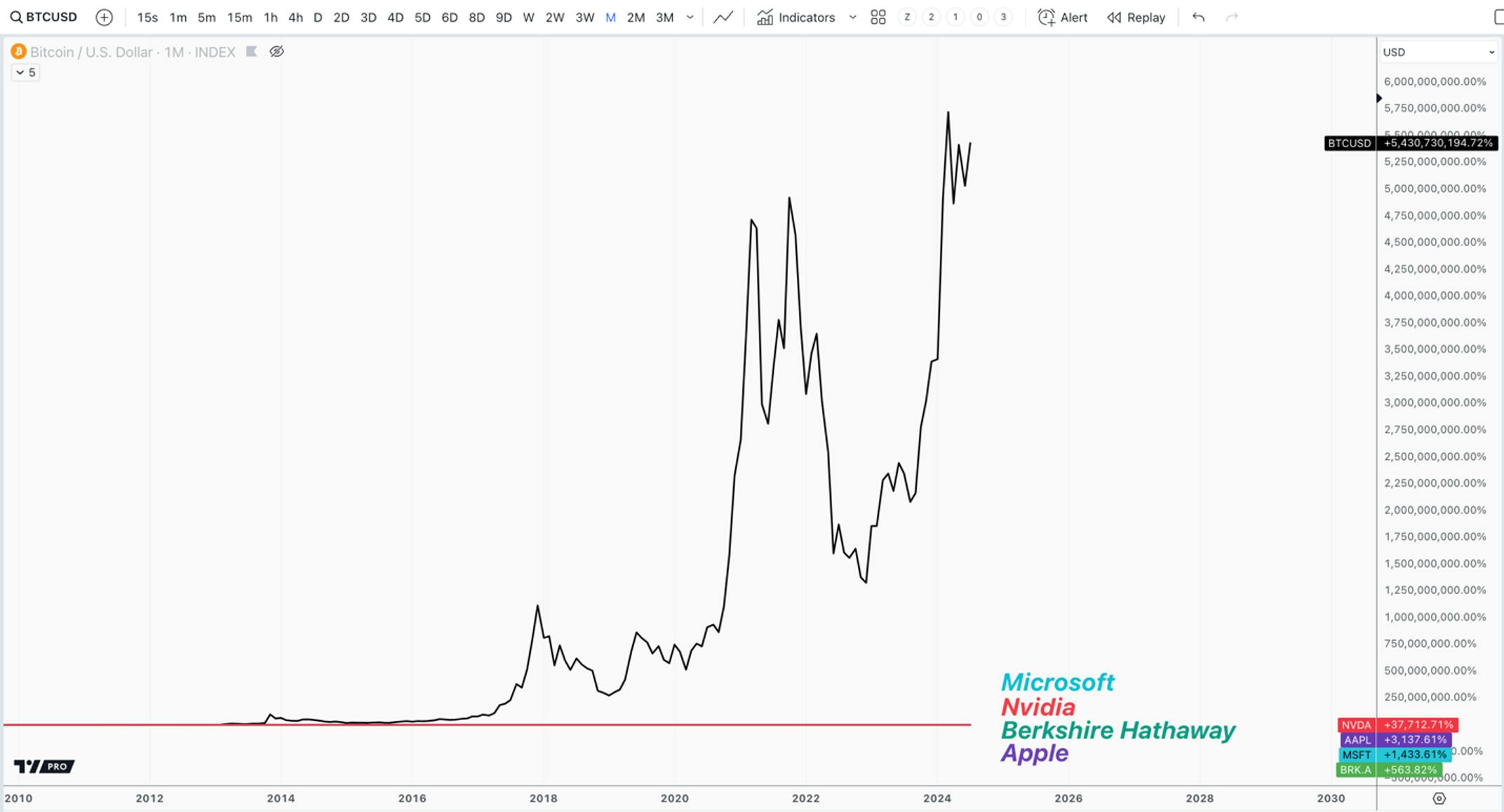
These stocks don’t even register in comparison to Bitcoin’s returns since it began mysteriously trading in October of 2009. Since this release, it is up an incredible +8 billion percent (not a typo). However, many have argued that it did not really start gaining public recognition until one year later, and that should be the true starting point for measuring it’s returns. So, to be fair, from October of 2010, it is still up a staggering 665,000,000%.
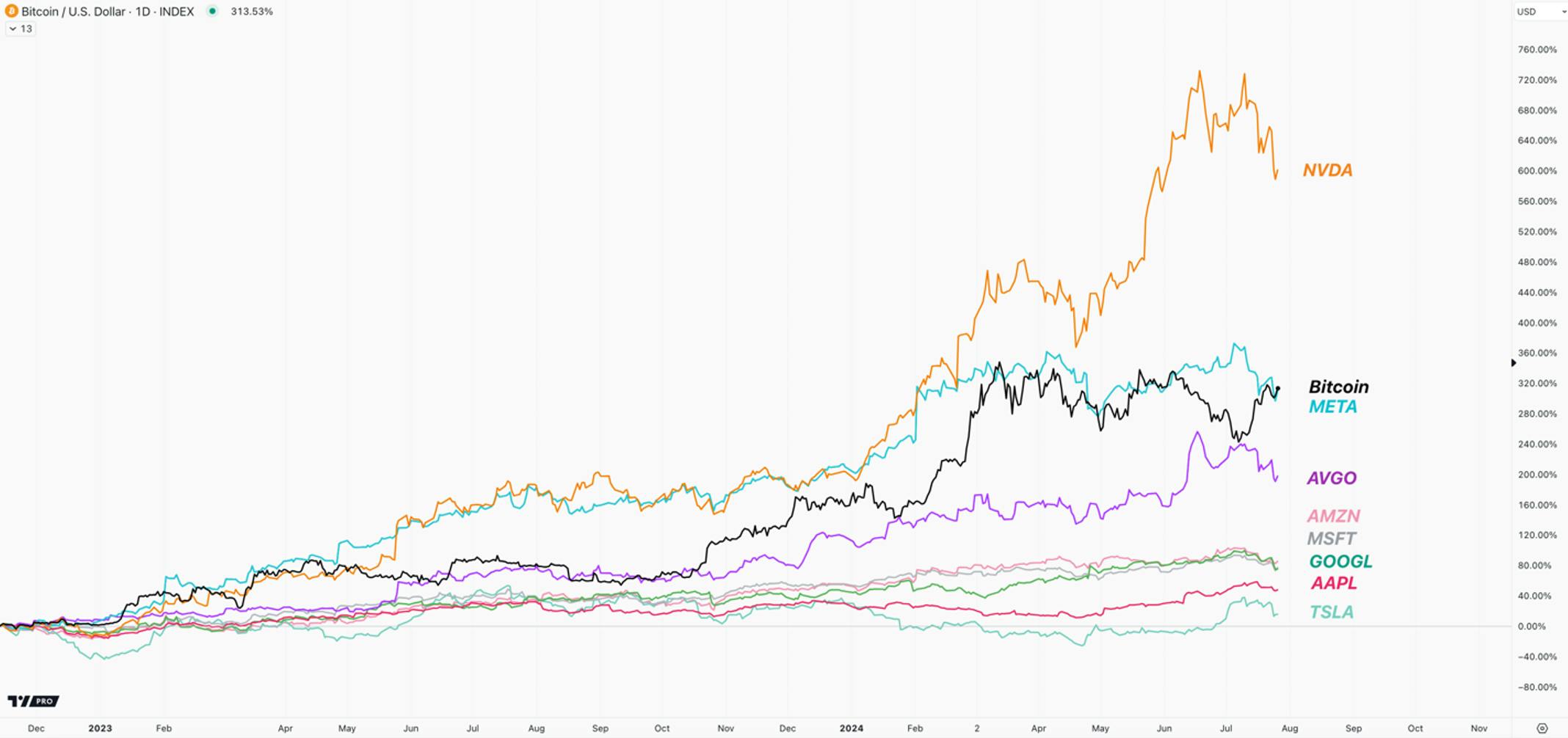
This is not a feature of the past. Since its recent low in 2022, Bitcoin is up 336%, outpacing all but one of the Mag 7 including AI stocks such as, Broadcom (AVGO).
What makes this valuable to a portfolio is not only the alpha it has generated, but the fact that it has such a low correlation to tech stocks. The below chart measures the correlation coefficient between Bitcoin and the Mag 7 + Broadcom. Anything between +50 and +100 means the two are highly correlated, between +50 and -50 means no correlation, and between -50 and -100 means inversely correlated.
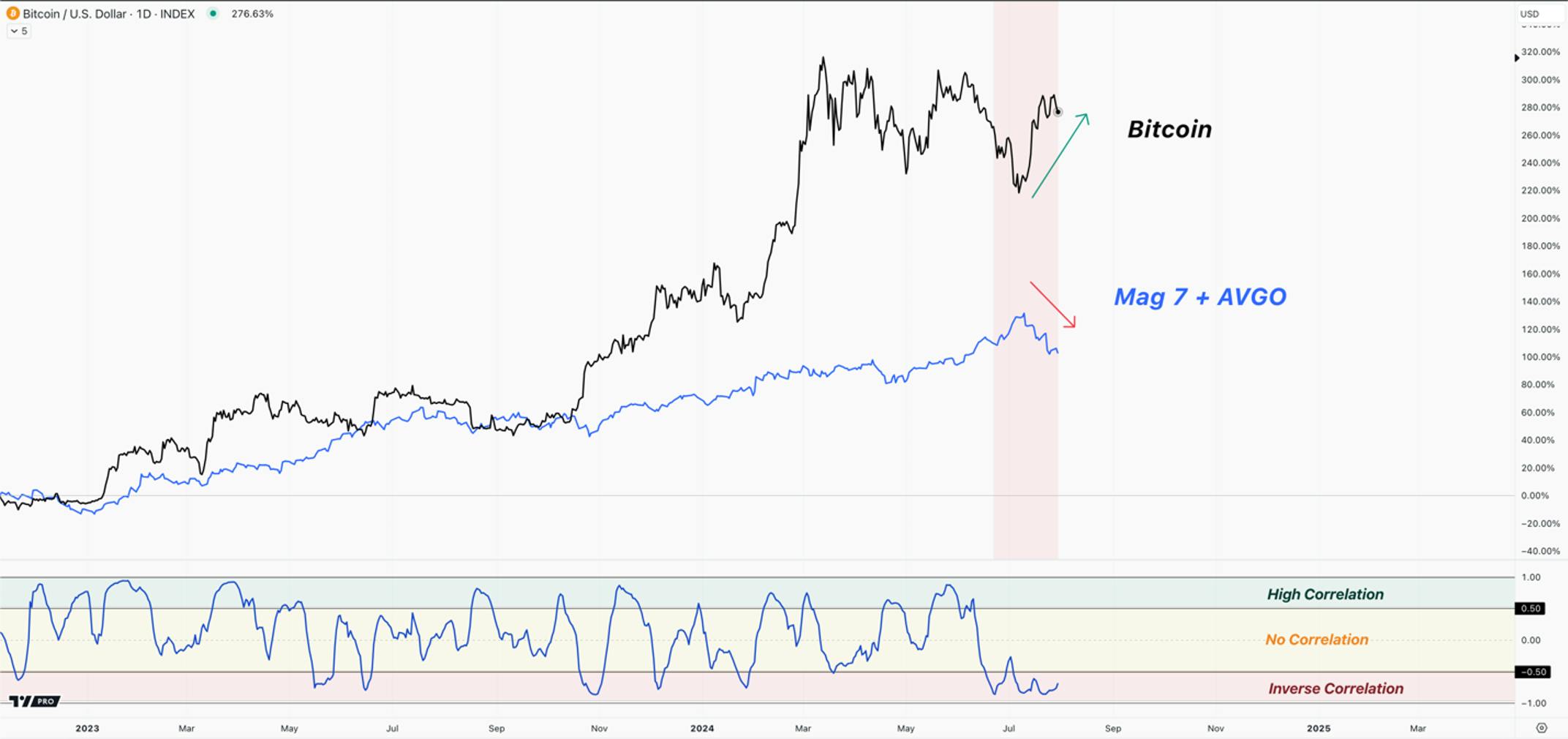
While delivering superior returns than all of the great large-cap tech stocks in this bull cycle, minus Nvidia, it did so while having a low inverse correlation to tech. As of right now, while tech is seeing outsized volatility due to a much needed rotation in the equity markets, Bitcoin has an inverse relationship to these stocks, moving higher against the volatility. As a portfolio manager who seeks unique diversification in the form of a growth asset, this is very valuable. It’s easy to miss this key quality to Bitcoin’s price action without looking closely at the data.
Unusual Volatility
Another intriguing point about Bitcoin’s performance can be found in analyzing its volatility. Most investors are well aware it’s highly volatile, and thus stay away. Since inception, it has seen four drawdowns of 70% or greater. These are drops that most assets rarely recover from, and if they do, it takes years to decades before reclaiming those highs.
However, every time bitcoin has seen one of these large drawdowns, it has fully recovered within 2.5 years, on average. This is rare, and I don’t know any other asset that has done this multiple times.
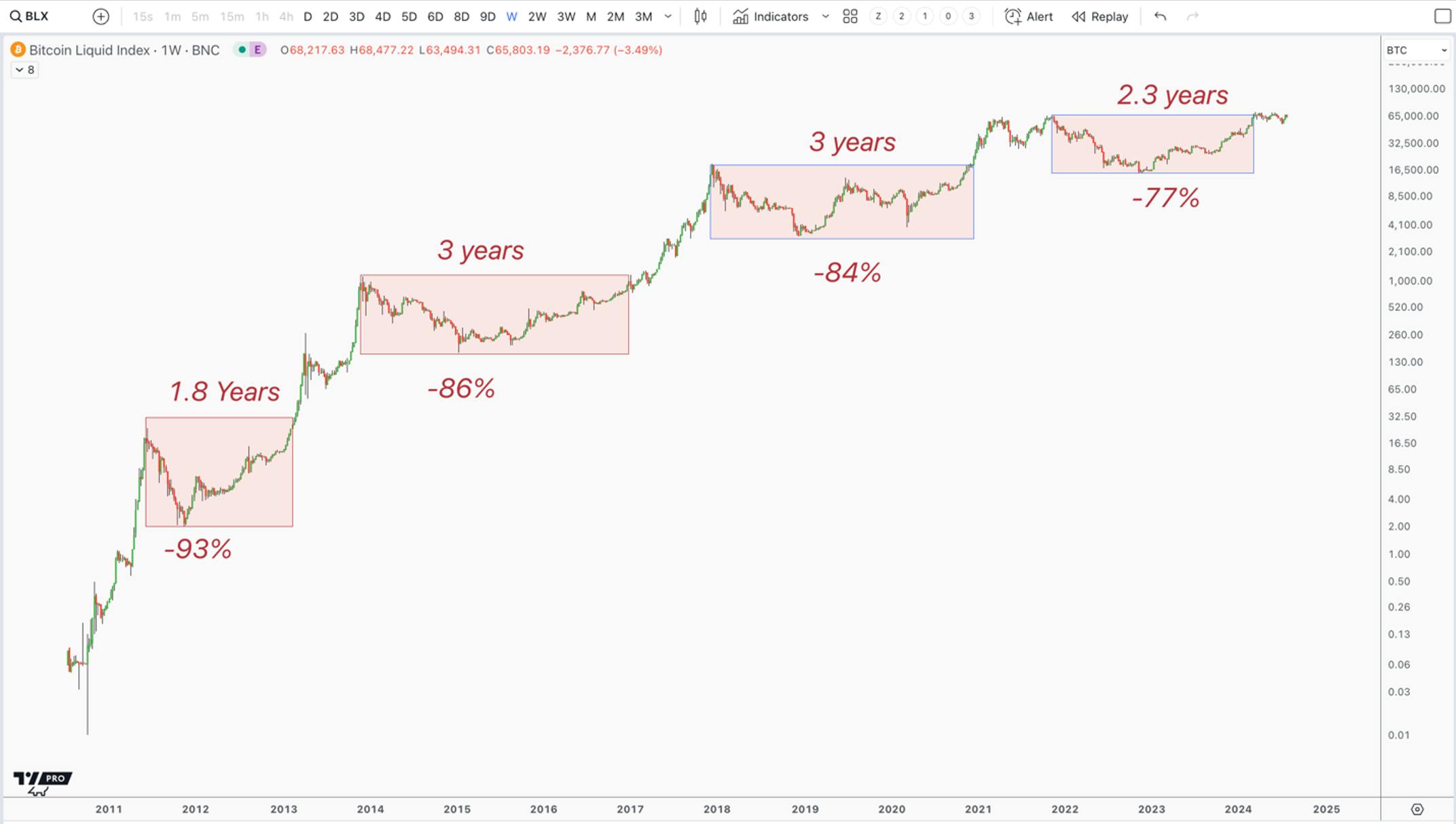
Regardless of your feelings toward this polarizing asset, it’s worth asking why it is up so much, and why it quickly recovers unlike any asset the market has ever seen? If it truly were a bubble, then why doesn’t the bubble pop? Instead, the asset comes back stronger than ever and reclaims all-time highs. Bitcoin is here to stay, and it is worth understanding why this is.
Revolutionary Tech That Solves a Problem
Bitcoin was designed to disrupt the oldest and most powerful system in the global economy – centralized banking. It is a global asset that offers an exit from the centralized fiat system. This is a concept that is new to everyone, as all money is understood in relation to personal banks, and centralized banking.
During the great financial crisis, Satoshi Nakamoto released a white paper on Bitcoin, introducing it to the world. In that paper, the intended purpose of Bitcoin was stated:
“The root problem with conventional currency is all the trust that’s required to make it work. The central bank must be trusted not to debase the currency, but the history of fiat currencies is full of breaches of that trust. Banks must be trusted to hold our money and transfer it electronically, but they lend it out in waves of credit bubbles with barely a fraction in reserve.”
Bitcoin is a value exchange that needs no intermediary. It sidesteps counterparty risk that is inherent to banking and cannot be inflated through politics and questionable centralized policies. It was designed to be a hedge against another banking crisis, and potential inflation crisis.
Over the last decade, we have been forced into the greatest monetary experiment in recorded history. Central banks held interest rates at zero for nearly a decade, while some held them with a negative rate. In all of recorded history, there has never been an instance where a debtor was charging interest to give them a loan. Yet, this is what we saw in many industrialized nations for many years.
No one knows how this experiment will end, as there is no precedent for it in history. As a result, investors continue to see unsettling stats, like: Global Debt/GDP at 90.8%, U.S. Debt/GDP is 127%, Japan Debt/GDP 268%, $517B in unrealized losses on bank balance sheets while FDIC now has 63 banks on problem list in 2024.
Maybe this gets resolved without any concern. But if it doesn’t, we may actually get a chance to see if Bitcoin’s stated purpose can offer an alternative to what the unwinding of this excess may do to a currency.
Our firm understood this, and regularly published on the bigger picture for our readers since 2019. We publicly established a position in Bitcoin at $7,717 within a month of launching our site following a free article we wrote in 2019 where we predicted Bitcoin will exceed the markets cap of the world’s most valuable companies.
“My prediction is that once the Lightning Network is built out, bitcoin will surpass the market cap of Apple, Google, Microsoft and Amazon to reach a minimum of $50,000 per token. This is because the protocol solves critical needs for global populations, including the reduction of financial fees for 7 billion people, and offers a need to store money during times of inflation…Technically speaking, bitcoin is also the world’s most secure financial network. The transfers eliminate 3% in processing fees and hedges against inflation. This can, and should be, worth as much as a search engine, enterprise software, a social media network, warehouse fulfillment (AMZN) or iPhone hardware.
The problem that bitcoin solves is underestimated (or worse, not understood). Bitcoin offers global populations a digital alternative to centralized fiat currency. The masses have been quite clear, whether from El Salvador, Venezuela, Japan or Africa, — the 7 billion+ people in this world seek a way to sidestep risks that global citizens face by handing over their assets to centralized banks and governments. These people seek a true and secure way out of the centralized banking world, and those who do not embrace this will be left behind by holding only centralized currency without diversification.
Sign up for I/O Fund’s free newsletter with gains of up to 2600% because of Nvidia’s epic run – Click here
Technical Analysis
Bitcoin has no management team, no earnings reports, and no fundamentals to base an investment decision. The large swings in both directions are seemingly at random. Through technical analysis, we can determine these swings are not random, and instead, get a reasonable means to both establish risk controls and determine buy and sell targets.
From an aerial view, it’s important to identify the direction of the trend. The easiest way to do this is to look for the vertical moves and the overlapping/messy corrections. In other words, which way are the vertical moves – up or down? This is your dominant trend.
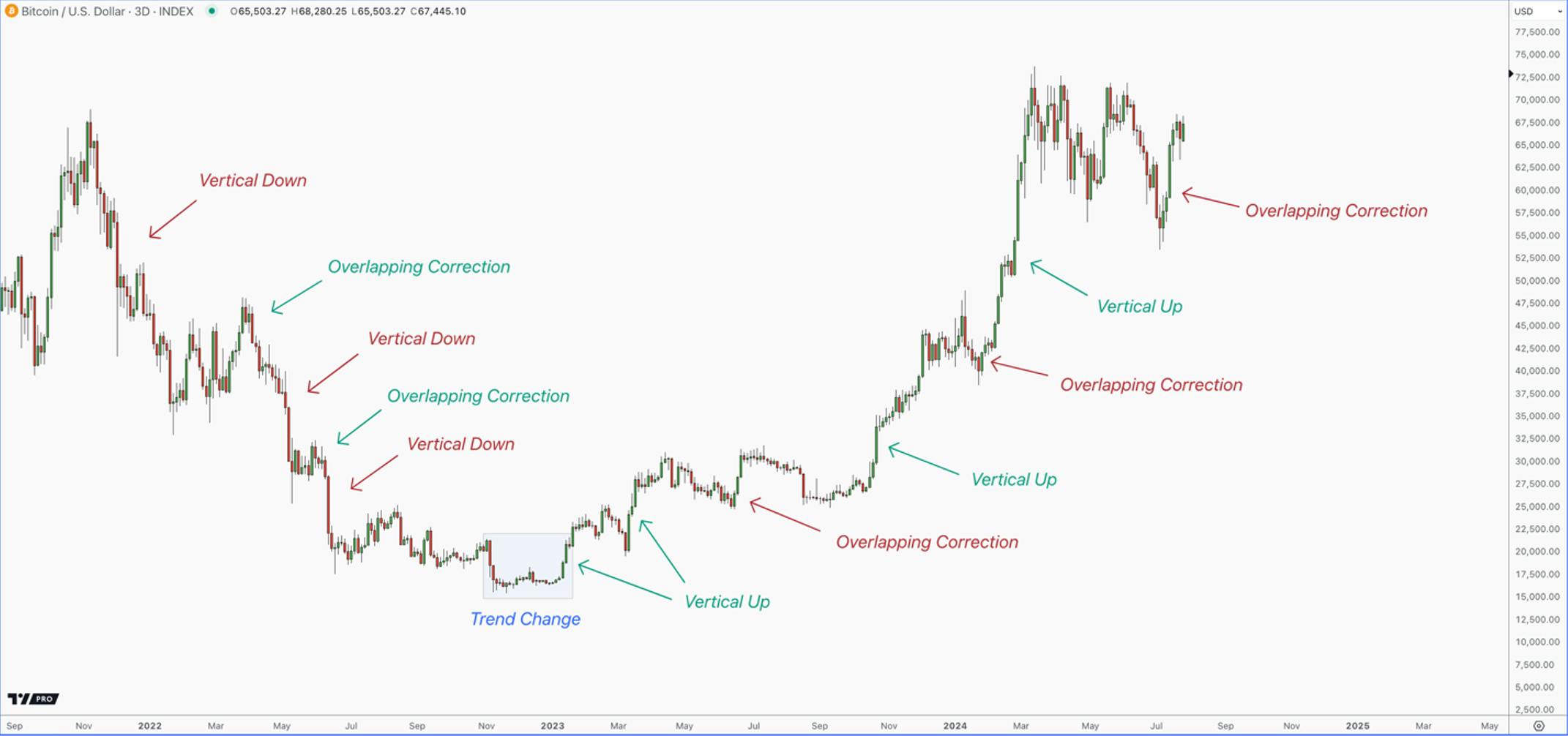
In 2022, the vertical moves were down, which were interrupted by short and shallow bounces that were overlapping and messy. These were corrections within the dominant trend, and that trend changed in late 2022. Note how the vertical moves since then have been up, while the overlapping corrections have been down. Today, we are in another overlapping and messy retrace of the vertical moves higher. This means that we are likely in a correction within a larger uptrend.